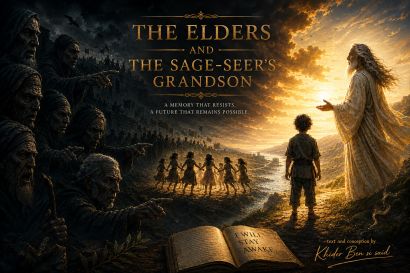
TECHNICAL SHEET AND PROJECT PRESENTATION
The Gerontes and the Sage-Seer’s Grandson
Theatrical, visual and poetic work
Text, scenic conception and artistic direction: Khider Ben si said
1. PRESENTATION OF THE PERFORMANCE
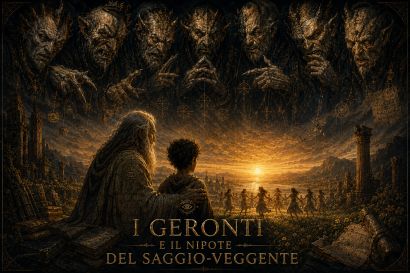
The Gerontes and the Sage-Seer’s Grandson is a theatrical, visual and poetic work exploring the confiscation of memory, the falsification of collective inheritances, and the struggle between authentic transmission and senile power.
In a world where truth trembles beneath the weight of imposed narratives, a caste of gerontes still rules over the fragments of an ancient knowledge they claim to preserve, while they have slowly deformed it across generations in order to legitimize their authority.
Behind rituals, dogmas and ceremonies of memory, the former guardians have become administrators of a reshaped, frozen and instrumentalized past.
At the heart of this twilight universe appears an unexpected figure: the Sage-Seer’s grandson.
Heir to a forgotten word and to a memory older than that controlled by the gerontes themselves, he moves among them with the unease of one who begins to understand that certain truths have been buried beneath official narratives.
Between silence, fractures, manipulation and revelation, an invisible struggle begins to take shape.
For when memory becomes power, history no longer enlightens people:
it begins to imprison them.
Poetic, philosophical and political in tone, The Gerontes and the Sage-Seer’s Grandson questions the mechanisms of symbolic domination, the corruption of transmission, the fear of renewal, and the systems that survive by transforming collective memory into an instrument of obedience.
A journey in which the old still speak… but where the future finally begins to listen differently.
2. PERSONAL STATEMENT OF THE AUTHOR
I was born in a land where speech often precedes writing, where memory circulates through voices, silences and stories passed down from generation to generation.
Very early, I understood that collective inheritance can become both a space of transmission and an instrument of domination.
This awareness runs deeply through my artistic work.
Through theatre, poetry, image and visual dramaturgy, I seek to question the invisible mechanisms that shape consciousness: the construction of narratives, the manipulation of memory, the confiscation of knowledge, and the way certain authorities use the past to immobilize the present.
The Gerontes and the Sage-Seer’s Grandson was born from a simple question:
What happens to a civilization when those who claim to protect its inheritance begin to deform it in order to preserve their own power?
In this work, the gerontes embody a caste of senile old men who have transformed collective memory into an apparatus of control. They have emptied symbols of their living meaning, frozen narratives, and turned transmission into repetition.
Facing them appears AXEL.
Not as a classical hero, but as a consciousness beginning to perceive the cracks behind official truths.
This creation explores the falsification of history, corrupted transmission, the fear of renewal, collective silence, the disappearance of symbolic languages, and the necessity of reinventing a memory capable of remaining alive.
I do not seek to condemn the elderly.
I seek to distinguish genuine wisdom from the senile structures that continue speaking in its name.
My artistic work does not seek merely to be seen.
It seeks to transmit unease.
And perhaps also… vigilance.
3. DIRECTOR’S NOTE / STATEMENT OF INTENT
Staging The Gerontes and the Sage-Seer’s Grandson does not mean telling a linear story.
It means entering a territory of confiscated memory.
A space where narratives have been slowly deformed by those who claimed to preserve them.
In this work, the characters do not merely represent individuals. They embody historical, symbolic and political forces.
The gerontes are not elders in the noble sense of the word.
They are the degenerated heirs of a sacred function.
Senile old men, they have monopolized symbolic heritage, transformed transmission into an apparatus of control, and reshaped collective memory in order to prolong their domination.
They still speak in the name of wisdom…
but transmit only its distorted ruins.
The Sage-Seer’s grandson represents an emerging consciousness. He does not seek to destroy inheritance. He seeks to recover what it was before its falsification.
The Sage-Seer himself inhabits a fragile frontier: between truth and silence, living memory and manipulated memory, transmission and confiscation, inheritance and collapse.
The staging is conceived as a dramaturgy of disturbance.
The performance must create the sensation of a world in which symbols still survive, but their meaning is slowly disintegrating.
The stage space becomes a diseased place of memory: a territory suspended between ritual, ruin, ceremony, archive and historical nightmare.
Light must never illuminate completely. It cuts, isolates, reveals fragments of truth before returning them to darkness.
The voices should sometimes seem to come from a memory, a dream, an invisible tribunal, or a collective memory buried beneath official narratives.
The children’s song occupies an essential place. It represents what power has not yet fully managed to corrupt: the innocence of human connection, sensitive memory, and the possibility of a still-living transmission.
Through this work, I do not seek to oppose generations. I question the systems that use the past to prevent the future from existing.
I seek to show how certain structures of power survive by transforming fear into doctrine, silence into discipline, and history into an instrument of obedience.
The stage space deliberately belongs to no precise era.
It may be ancient.
It may be contemporary.
It may already be tomorrow.
For this story does not speak of one people alone. It speaks of every place where memory has been used to govern consciousness.
This work does not seek to provide answers.
It seeks to awaken vigilance.
Like a voice still whispering in the dark:
“Stay awake.”
4. ARTISTIC BIOGRAPHY
Khider Ben si said is an author, playwright and visual creator. His work stands at the crossroads of theatre, poetry, symbolic narration and anthropological reflection.
Coming from a culture where orality often precedes writing, he has developed for several decades an artistic research dedicated to the mechanisms of transmission, the fractures of memory, and the systems of power that shape collective narratives.
His universe explores confiscated memory, identities in motion, symbolic inheritance, invisible violence, and contemporary forms of cultural and narrative domination.
Through dramatic writing, visual poetry, digital illustration and scenographic composition, he builds hybrid works in which speech, image, silence and fragmentation become elements of the same sensitive architecture.
His creations draw from Mediterranean traditions, popular orality, initiatory narratives, symbolic theatre, and the critical observation of structures that manipulate memory in order to produce obedience.
With The Gerontes and the Sage-Seer’s Grandson, the author continues a research centered on the falsification of collective inheritances, the corrupted transmission of knowledge, and the resistance of consciousness against imposed narratives.
5. PLASTIC AND VISUAL APPROACH
The visual universe of The Gerontes and the Sage-Seer’s Grandson is built as a dramaturgy of altered memory.
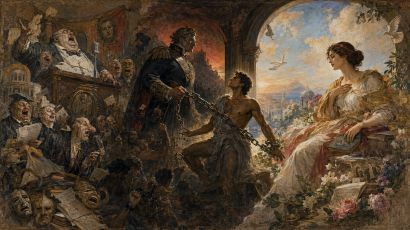
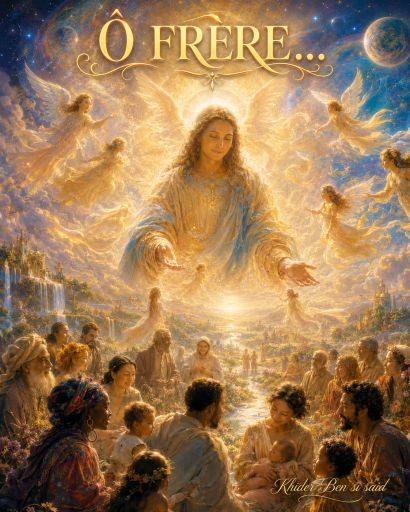
The images do not seek to illustrate the story literally. Rather, they function as fragments of incomplete archives, surviving visions, remnants of a world whose symbols have been slowly deformed.
The plastic space superimposes labyrinthine libraries, aging figures, erased manuscripts, suspended objects, calligraphic traces, mental architectures and surreal elements connected to the collapse of memory.
Each visual composition acts as a layer of consciousness.
The viewer moves through a territory where signs persist, but where their meaning seems to have been confiscated.
Light plays an essential role. It never reveals completely. It cuts, isolates, lets fragments of truth appear before returning them to darkness.
The scenographic and plastic work thus seeks to produce a sensation of memorial instability, as if history itself had been rewritten too many times.
The images become places of silent resistance.
Not answers.
But fissures opened inside dominant narratives.
6. MANIFESTO FOR A LIBERATED MEMORY
There are men who grow old without ever transmitting.
They accumulate.
They confiscate.
They lock away.
Then they rename their fear: tradition.
For centuries, senile castes have spoken in the name of peoples, ancestors, civilizations and sacred memories.
They claim to protect collective inheritance.
But they do not protect it.
They imprison it.
They slowly mutilate it.
They transform transmission into private property.
Then memory ceases to be a light.
It becomes administration.
Then discipline.
Then an instrument of obedience.
The most enduring tyrannies do not always begin with weapons.
They often begin with the confiscation of narratives, with the falsification of the past, with the installation of an aging voice that forbids every new birth.
Future generations are then taught what to think, what to forget, what to fear, and above all… what must never be questioned.
The old armchairs of power are thus filled with men who no longer guard memory:
they merely guard the keys to the archives.
They no longer transmit wisdom.
They administer the fear of change.
And the more their world cracks, the more they speak in the name of order.
The older they become, the more they accuse the future of being dangerous.
They fear children.
They fear dreamers.
They fear those who ask simple questions.
Because a sincere question can shake centuries of carefully preserved lies.
The Gerontes and the Sage-Seer’s Grandson was born against this confiscation.
This work does not speak only of old men.
It speaks of all structures that survive by deforming collective memory.
It speaks of powers that rewrite history in order to prolong their reign.
It speaks of systems that replace living transmission with mechanical repetition.
It speaks of those moments when people end up confusing silence with peace, obedience with wisdom, immobility with stability.
But this work also speaks of something else.
It speaks of the fragile reappearance of consciousness.
AXEL is not a hero.
He is a fissure.
A memory that refuses to die entirely.
A generation beginning to understand that the inheritance it received has been amputated.
Facing the gerontes, he does not seek to burn the past.
He seeks to recover what has been buried beneath official narratives.
For a people without living memory becomes a people governed by the ghosts of its own lies.
We live in societies saturated with information but starving for truth.
Everywhere, powers produce ready-made narratives.
Everywhere, institutions manufacture memories compatible with their own survival.
Everywhere, aging voices still claim to speak in the name of the future.
But the future no longer belongs to them.
It belongs to those who will have the courage to listen to silences, reopen forbidden archives, question sacred narratives and return to memory its living, moving, human part.
Art must not become the decoration of power.
It must remain a force of unease.
A breach.
An awakening.
A lamp left burning among the ruins.
This manifesto does not call for the destruction of the elderly.
It calls for distinguishing genuine wisdom from the senile structures that continue to speak in its name.
For every civilization that prevents its children from reinventing inheritance ends up transforming memory into a tomb.
And one day, in the middle of organized silence, a voice always returns to whisper:
“Stay awake.”
7. TECHNICAL SHEET OF THE PROJECT
Title of the work
The Gerontes and the Sage-Seer’s Grandson
(I Géronti e il nipote del Saggio-Veggente)
Concept, text and artistic direction
Khider Ben si said
Nature of the project
Transdisciplinary theatrical, visual and poetic work.
A hybrid project at the crossroads of:
contemporary theatre,symbolic dramaturgy,visual narration,memorial installation,scenographic research.
GenresContemporary dramaturgyPoetic theatreSymbolic theatreTheatre of memoryVisual narrationScenographic and plastic research
Languages of the projectFrançaisEnglishItaliano
Year of creation
2025 – 2026
8. TECHNIQUE / MATERIALS / MEDIUMS
The project combines several forms of writing and visual creation through a transdisciplinary approach.
Mediums usedTheatrical writingPoetic narrationDigital illustrationVisual compositionIconographic researchConceptual artScenographic dramaturgyMixed media
MaterialsOriginal dramatic textTypographic compositionDigital paintingImage processingVisual archivesSymbolic and narrative researchDramaturgical construction
Presentation supportsFine art printArtistic posters and manifestosHigh-resolution digital formatsEditorial and scenographic presentationVideo support and visual projection, depending on the exhibition or performance space
9. DESCRIPTION OF THE PRESENTED SUPPORT
The presented project takes the form of a transdisciplinary work bringing together original dramaturgy, visual creation and scenographic research.
The artistic material includes:
an excerpt from the theatrical work
The Gerontes and the Sage-Seer’s Grandson;a series of original illustrations developed from the dramaturgical universe of the work;visual compositions conceived as narrative manifestos, at the border between literature, digital painting and theatrical imagination;iconographic research devoted to memory, transmission, time, historical falsification and symbolic filiation;a scenographic device exploring the notions of archive, memorial ruin and narrative power.
The whole constitutes an autonomous artistic project, conceived as an immersive experience in which text, image, light and silence continuously interact.
The images do not seek to illustrate the narrative literally.
Rather, they open spaces of tension and interpretation, allowing a universal dimension to emerge, suspended between myth, collective memory, historical collapse and the manipulation of narratives.
10. TECHNICAL ELEMENTS AND STAGE MANAGEMENT
Stage deviceModular stage spaceMinimal and transformable stage designUse of shadows, veils and light projectionsMinimal furniture with strong symbolic chargePossibility of immersive installation depending on the exhibition or performance space
Light
The lighting device is a central dramaturgical component.
Light functions as:
apparition,erasure,fragmented memory,revealer of unstable truth.
The project favors:
low lighting,shadow zones,isolated beams,progressive variations,moving half-light.
Sound universeOffstage voicesDistant echoesAmplified breathingChildren’s songsMemorial sound fragmentsStructuring silencesMinimal immersive sound creation
Silence is considered an active element of the dramaturgy.
Lighting direction
An evolving lighting score based on:
slow transitions,ruptures of darkness,effects of visual memory,spaces of progressive disappearance.
Sound direction
Immersive sound diffusion adapted to the location:
spatialization of voices,echo work,sound deformation,dramaturgical breathing.
Video / optional projection directionTextual projectionsFragments of fictional archivesVisual texturesSymbolic compositions
11. PERFORMANCE FORMATShort theatrical performancePerformed readingImmersive theatrical installationScenographic presentationHybrid exhibition-performance format
Duration may vary depending on the presented device.