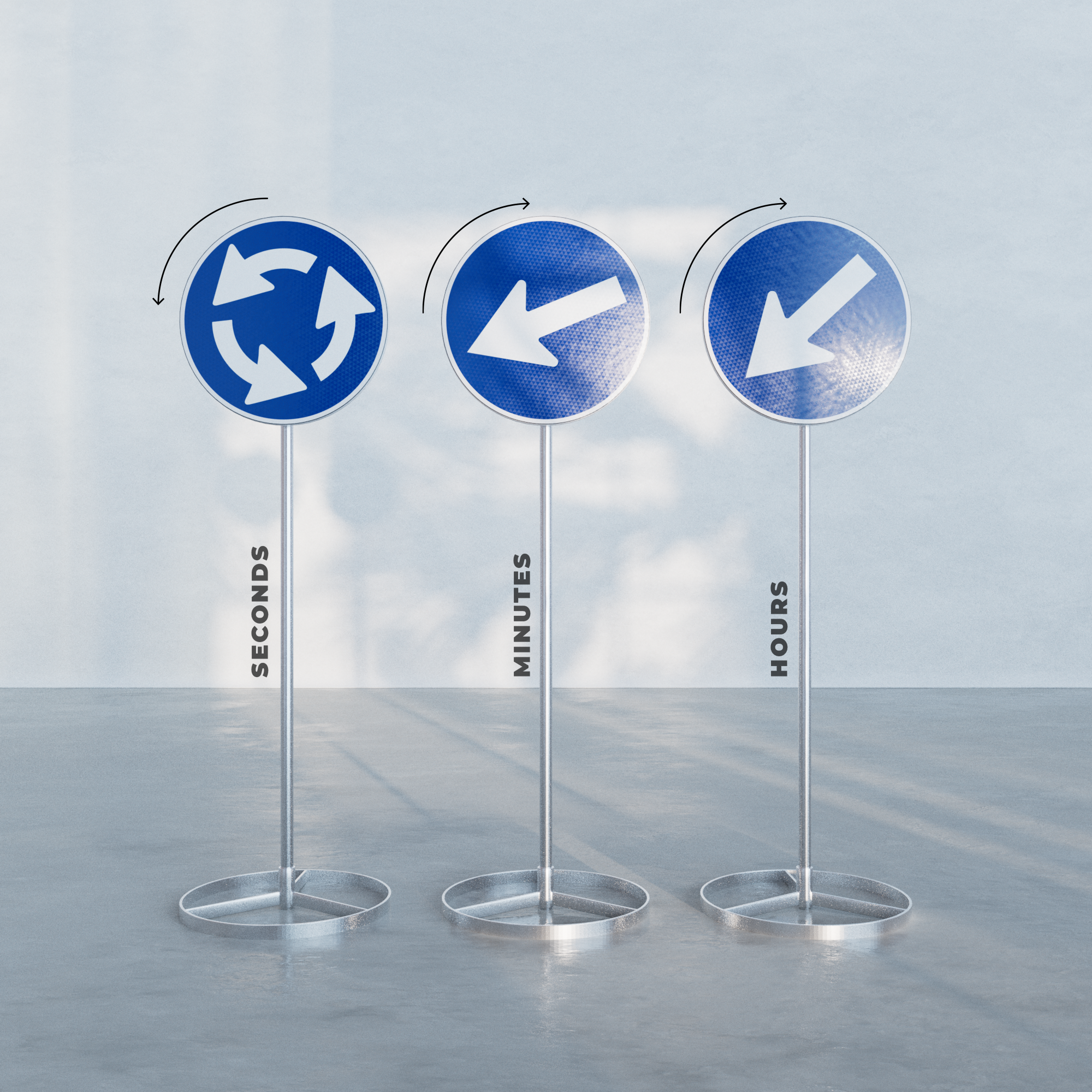
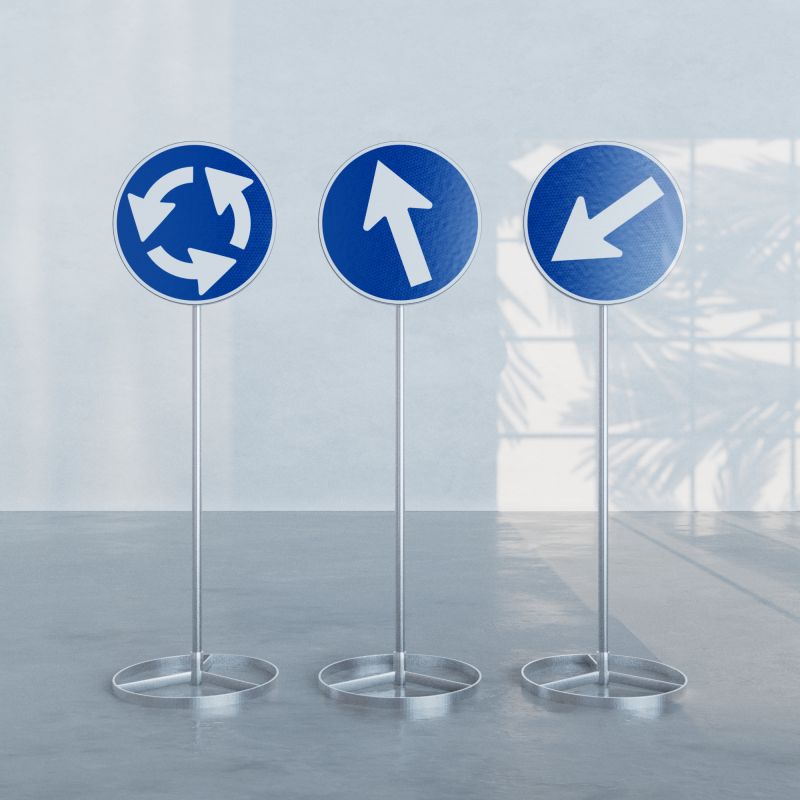
"ORA DI PUNTA" is configured as a singular visual anachrony, a triptych of road artefacts removed from their pragmatic function to rise to an unprecedented mechanism of time. Three road signs - the whirling promise of a roundabout, the categorical imperative of a mandatory direction reiterated in two instances - metamorphose into the hands of a sui generis clock. The first, in a perpetual circular motion, marks the incessant dripping of the seconds. The second, with a placid sexagenary rotation, traces the arc of the minutes. The third, finally, with sidereal slowness, completes its circadian orbit, enumerating the hours. The work is grafted into the furrow of a reflection on the peculiar anthropic intervention that has shaped the morphology of the landscape, making it, in a certain sense, "navigable" through a forest of indications and prescriptions. Road signs emerge as a palpable "trace" of this incessant work of spatial regimentation, a silent but compelling language that imposes trajectories and modulates the interaction with the urban and extra-urban environment. "RUSH HOUR" subverts this imposing logic, transforming the tools of spatial organization into gauges of an incorporeal and inescapable entity: time.
The reinterpretation of "mandatory direction" signs as the needles of a clock reveals a subtle but crucial awareness: "direction" is not a static dogma, but rather a variable in perpetual change with the passing of hours, days, eras. This intrinsic dynamism reverberates on macro-environmental perspectives, shaped by changing policies, epochal scientific discoveries and a renewed ecological awareness. The inevitability of time becomes, in this sense, a pressing warning, a "memento" on the urgent need for a radical re-mapping of values and priorities, oriented towards an eco-centric vision of our planet.
The unusual assembly of these road artefacts in a clockwork device sends an unequivocal message: the time has come - "RUSH HOUR" - to reconsider and enhance the pre-existing natural fabric, both inside and outside the urban boundaries. It is time to regenerate eco-socio-cultural spaces that transcend the merely commercial logic, cultivating fertile ground for an intrinsically biodiverse community.
Signage, traditionally understood as "boundary markers", undergoes a radical semantic destructuring. The spatial limits, once defined and insurmountable, dissolve in the fluidity of time. The only boundary that the work recognizes is the inexorable one of becoming. The topographical "landmark", a point of reference in space, gives way to a new "point of reference": time itself, an interior compass that orients towards a future of renewed harmony between man and nature. The work, ultimately, presents itself as an invitation to abandon an anthropocentric and egocentric vision in favor of an eco-centric perspective, in which human and cultural activity is (re)integrated into the vital flow of the global ecosystem.