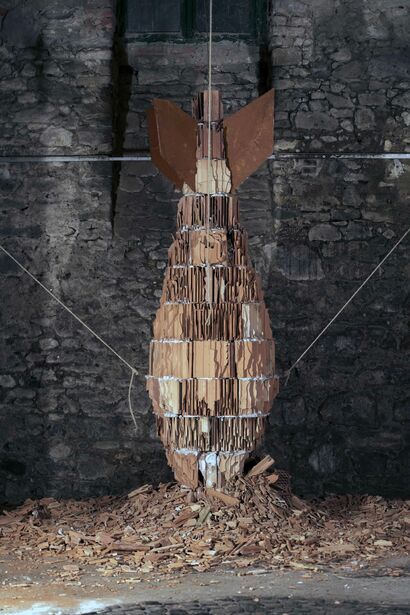
Upon exploring contemporary brick types and their structures, I began to envision how to blend various architectural styles—and the use of materials that are both authentic and reflective of the spirit of the times—with the visual language of destruction. The raw material for the piece is a 21st-century masonry block (brick) featuring a diamond pattern; when laid on edge and bonded together, these bricks form the body of the sculpture. The diamond pattern symbolizes continuity; it frequently appears in Constructivism, Islamic art, and abstract art, serving as both a fundamental structural element and a decorative motif in architecture. The body of the work—specifically the diamond patterns formed by the bonded bricks—takes on a dynamic quality as it assumes the shape of a bomb; through a process of turning (lathe-like shaping) that creates a circular profile, new apertures open up to the viewer. The historical context here reaches back to Carthage, where, according to legend, the site of the destroyed city was rendered barren with salt following the Punic Wars. To me, this parallels the military practice of rendering captured territories unusable by sowing them with landmines. The elongated body of the bomb and the distorted patterns of the brick cavities evoke Gothic cathedrals—an architectural allusion reinforced by the salt-crystal filling concentrated in the bomb’s warhead, which tapers off as it ascends the body of the sculpture.