Archive of Confusion
Participatory Spatial Installation
Archive of ConfusionParticipatory Spatial InstallationArchive of Confusion explores one of the most universal yet least discussed human experiences: confusion. Moments of uncertainty, disorientation, familiarity and estrangement accompany every life. By connecting these everyday experiences with the altered perception of people living with dementia, the installation opens a space for dialogue, empathy, and shared reflection.
The project originated in the Perception Workshops, where participants initially documented their experiences through written evaluations. Seeking a more immediate and visual form of arts-based research, Ruth Mateus-Berr invited participants to respond intuitively to two simple questions: What does confusion look like? and What does its opposite look like? Within only a few seconds, participants created spontaneous drawings or doodles that captured their inner images before they could be shaped by conscious reflection.
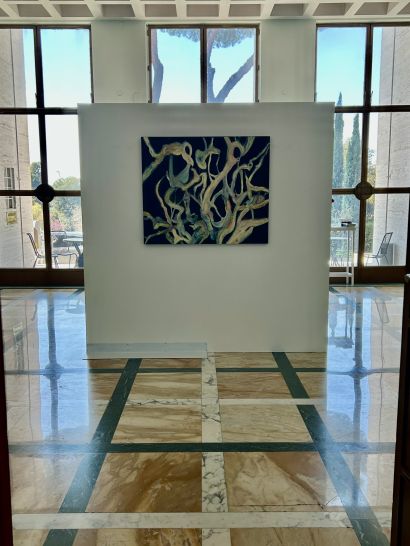
At the heart of the exhibition is a participatory wall installation composed of A3-format drawings. Visitors are invited to add their own doodles, visualising their personal associations with confusion and its opposite. Every new contribution becomes part of the installation, allowing the work to grow continuously throughout the exhibition. Rather than presenting a completed artwork, Archive of Confusion remains an evolving collective archive, shaped by the diverse perceptions, memories, emotions, and experiences of its participants.
To date, more than 500 drawings have been collected from participants in Austria, Germany, Switzerland, the Czech Republic, Portugal, Canada, and other countries. Together they form an ever-expanding international visual archivethat reveals both the uniqueness of individual perceptions and recurring collective patterns.
An additional component of the installation is a morphing film installation created from this archive of more than 500 drawings. Using digital morphing techniques, the individual images gradually transform into one another, dissolving personal boundaries and revealing subtle visual relationships between different understandings of confusion.
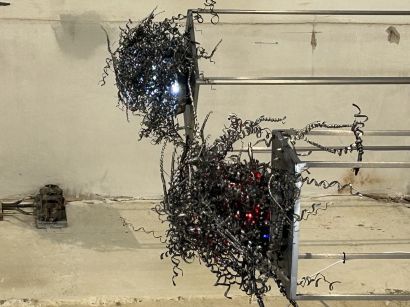
The film is projected onto a folded mesh sculpture suspended within the exhibition space. The sculptural form evokes three interconnected dimensions of memory: short-term memory, working memory, and long-term memory. As visitors move around and through the projection, they experience changing perspectives and varying degrees of visual clarity. Images projected onto the sections representing short-term and working memory appear blurred, fragmented, and difficult to grasp, while those associated with long-term memory gradually become clearer and more recognisable. The installation thus offers a poetic spatial reflection on remembering and forgetting, inspired by the observation that long-established memories often remain more accessible for many people living with dementia than recently acquired information.
Rather than illustrating dementia from an external or clinical perspective, Archive of Confusion invites visitors to encounter altered processes of perception through their own embodied experience. The familiar sensation of momentary confusion becomes a point of connection rather than separation. By actively contributing to the installation and engaging with the evolving archive, visitors participate in a collective process of reflection that encourages dialogue about dementia, challenges stigma and social taboos, and fosters empathy. The work proposes that confusion is not an experience that belongs exclusively to people living with dementia, but a universal aspect of being human. In making this shared vulnerability visible, Archive of Confusion seeks to replace fear with understanding and silence with conversation.
The project comprises two interconnected yet autonomous artistic works: a participatory wall installation and a morphing film installation. While conceived as complementary works that deepen one another, each can also be exhibited independently, allowing the project to adapt to different exhibition contexts and spatial settings.
Beyond its artistic dimension, Archive of Confusion contributes to the social sustainability of intergenerational relationships. By creating encounters between children, young adults, families, caregivers, older generations, and people with dementia, the installation transforms individual experiences into a shared cultural dialogue. It demonstrates how participatory art can strengthen empathy, inclusion, and mutual understanding across generations, encouraging communities to reflect collectively on care, memory, and human dignity. Through its continuously growing archive, the project itself becomes a sustainable, living artwork—one that evolves with every participant and every exhibition, preserving diverse voices while fostering new conversations across cultures, generations, and social backgrounds.