STEELPLANT 3 (WASTE / NOT — Steel Shavings)
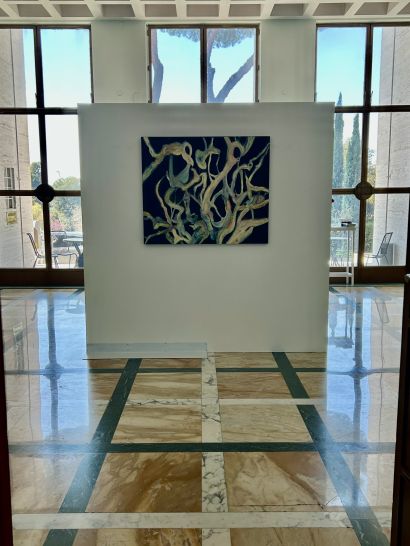
Steel shavings are generated as by-products of industrial manufacturing—residues of drilling and milling, traces of precision and technological production. Presented as a still life on a pedestal, they are removed from their functional context and transformed into objects of contemplation. Their intricate forms unexpectedly evoke botanical structures, branching growth, and delicate plant morphologies.
In Ruth Mateus-Berr's artistic practice, these industrial remnants enter into dialogue with rare and endangered plant species, dissolving the conventional boundary between the artificial and the living. STEELPLANTS brings together two seemingly opposing worlds—industrial production and ecological vulnerability—revealing their profound interdependence. The steel shavings are no longer perceived merely as waste or recyclable material but become metaphors for ecosystems shaped by extraction, transformation, and environmental change.
Steel is one of the most ubiquitous materials of the Anthropocene and can be recycled almost indefinitely. Yet even within a circular economy, every material carries the memory of extraction, energy consumption, and ecological intervention. By translating industrial residue into the visual language of botanical forms and the tradition of the still life, the work questions how societies assign value, care, and visibility to both natural and manufactured environments.
Rather than opposing nature and technology, STEELPLANTS proposes a new way of seeing their entanglement. The work invites viewers to recognise industrial matter as part of broader ecological cycles and to reflect on the fragile balance between innovation, resource use, and biodiversity.
At its core, the installation explores transformation—of materials, of perception, and of responsibility. It asks how artistic practice can reveal hidden relationships and foster a deeper awareness of the interconnected systems that sustain life. In this sense, STEELPLANTS contributes to an expanded understanding of environmental sustainability, where circular materials, biodiversity, and cultural imagination are understood not as separate domains but as mutually dependent processes. The work encourages a renewed dialogue between industry and ecology, proposing that sustainability begins with the ability to perceive connections where apparent opposites once seemed to exist.