Painting as a research-based archive in which endangered plants become carriers of ecological memory, medicinal knowledge, mythology, and cultural history. Through multilayered painterly narratives, the works investigate interdependence, biodiversity, and more-than-human forms of memory.
Limonium – Florilegical Narration
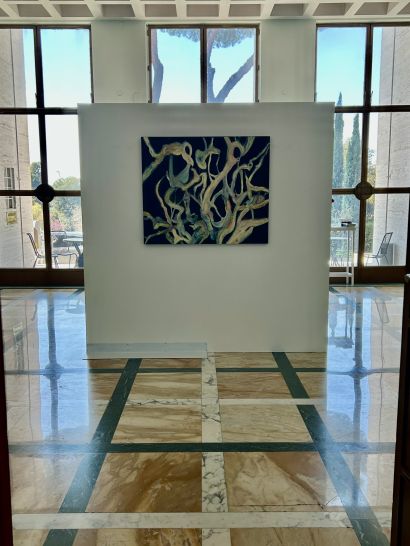
Limonium is part of Ruth Mateus-Berr’s ongoing painting series Florilegical Narration, in which endangered plant species are explored as living archives of ecological, cultural, and historical memory. Each painting is based on extensive research into botany, medicine, pharmacy, mythology, and regional histories, translating scientific and cultural knowledge into multilayered painterly narratives.
Traditionally associated with remembrance through its enduring blossoms, Limonium becomes a symbol of resilience and the persistence of memory. In this work, the plant enters into dialogue with the Ouroboros, the ancient emblem of cyclical transformation and renewal, while the figure of a pregnant woman introduces the idea of future generations. Together, these elements reflect on biodiversity, continuity, and our responsibility toward the living world.
Rather than presenting the plant as an object of botanical observation, the painting understands it as an active carrier of knowledge. Scientific research, cultural memory, symbolism, and imagination intertwine to form a visual ecology that questions anthropocentric perspectives and invites reflection on the interconnectedness of humans, plants, and their environments.
Painting becomes a space where ecological knowledge and cultural memory converge, offering an alternative way of understanding endangered species—not merely as objects of conservation, but as protagonists in shared narratives of resilience, transformation, and hope.