Painting as a research-based archive in which endangered plants become carriers of ecological memory, medicinal knowledge, mythology, and cultural history. Through multilayered painterly narratives, the works investigate interdependence, biodiversity, and more-than-human forms of memory.
In the Venetian lagoon, numerous plant species are endangered, particularly within the sensitive ecosystems of salt marshes and tidal flats. Among them is Salicornia veneta, a rare and highly salt-tolerant plant that thrives only under very specific conditions. Rising sea levels, more frequent flooding events, increasing salinization, erosion, and climate change all threaten its habitat and the ecological balance of the lagoon as a whole.
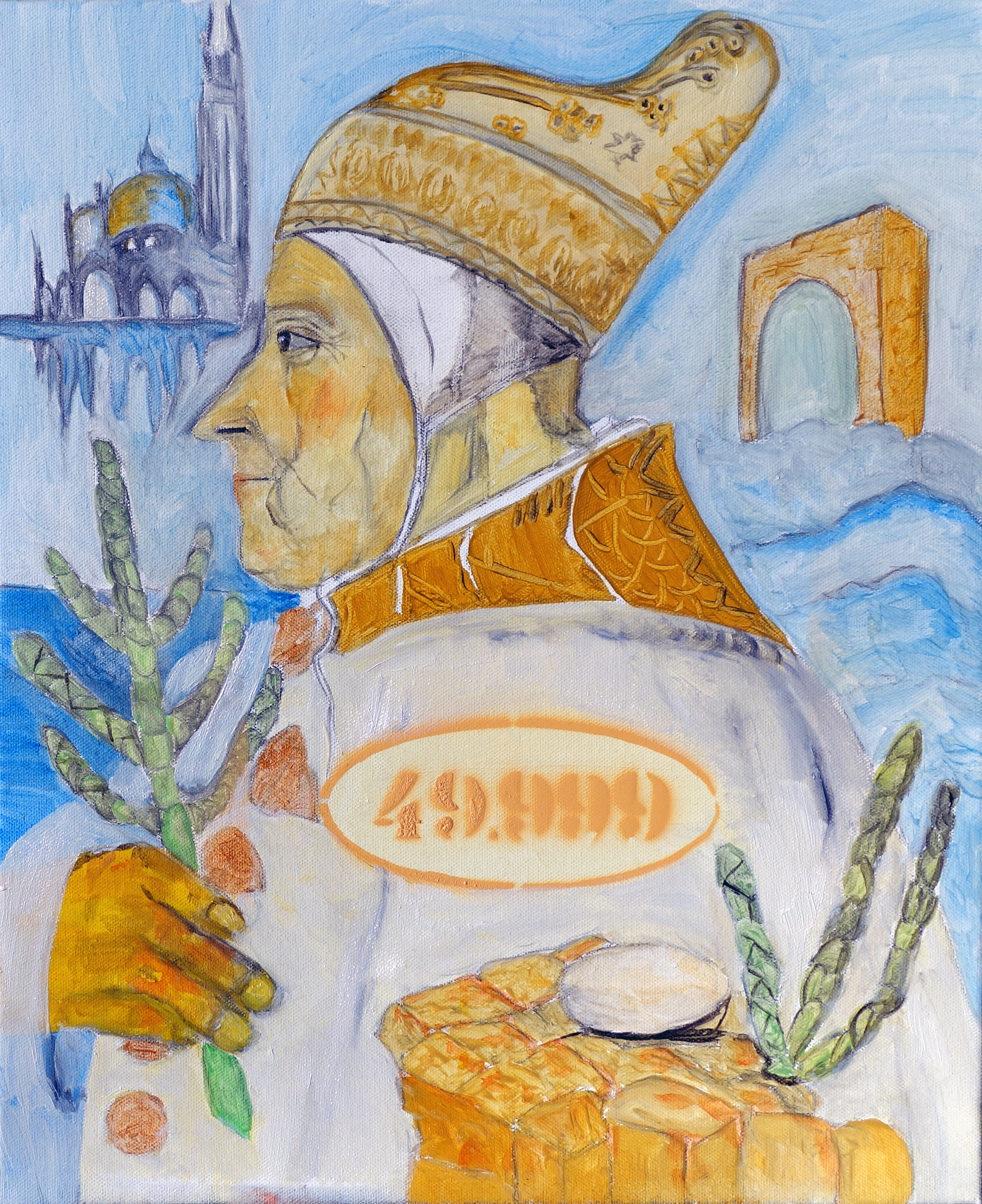
In the project SALIVENI, Salicornia veneta is placed in relation to Doge Giovanni Mocenigo (1408–1485), who ruled Venice from 1478 to 1485. His tenure was marked by the plague, a devastating fire in the Doge’s Palace, and military conflicts. He died in 1485 and was buried in the Basilica of Santi Giovanni e Paolo. The portrait of Mocenigo was created around 1478/80 by Gentile Bellini. As the official painter of the Republic, Bellini depicted the doges in a solemn, state-representative manner. The painting stages an ideal of political stability and continuity of the state.
This notion of permanence and order is contrasted with the vulnerability of Salicornia veneta, which functions as a symbol of ecological fragility. The composition is further complemented by the stencil “49,999,” referencing the imminent drop below 50,000 inhabitants. From 174,808 residents in 1951, the population has now declined to just over 50,000.
SALIVENI thus interweaves ecological threat and demographic decline: the endangered plant and the depopulating city become two expressions of an increasingly unstable balance between nature, history, and the present.