Ruth Mateus-Berr (born 28 November 1964) is an Austrian post-conceptual artist whose practice spans drawing, painting, installation, video, performance, and mixed media. She is a Full Professor at the University of Applied Arts Vienna and works at the intersection of...
Read MoreRuth Mateus-Berr (born 28 November 1964) is an Austrian post-conceptual artist whose practice spans drawing, painting, installation, video, performance, and mixed media. She is a Full Professor at the University of Applied Arts Vienna and works at the intersection of art, artistic research, and visual knowledge production.
Her work has been exhibited internationally at major venues including the Venice Biennale (European Cultural Centre, Palazzo Mora), the Arte Laguna Prize exhibition at the Arsenale Nord, Venice (Finalist/Selection 2024), Künstlerhaus Wien, the Museum of Applied Arts (MAK) Vienna, Wien Museum MUSA, the 798 Art District in Beijing, the Tokushima Modern Art Museum in Japan, as well as the Museu de Arte Contemporânea Quinta de Cruz, Viseu, Portugal.
Mateus-Berr is the recipient of the Neptun Contemporary Art Award, an Austrian State Prize for Art and Sustainability, awarded for 4 Layers of Sari against Cholera, a project that translates scientific knowledge on water filtration into artistic form and raises awareness of sustainable, low-cost solutions. Sustainability is a central and continuous concern in her artistic practice—from this award-winning work to her recent series on rare and endangered plant species (Florilegia / Rare Plants), which addresses biodiversity loss and climate change, as well as to the project Vienna Calling / Design: MAK–departure, which focused on sustainable urban futures and ecological responsibility.
In the context of EXPO Osaka 2025, Mateus-Berr conceived and curated an exhibition in collaboration with Tokyo University of the Arts (Geidai), focusing on arts-based research and intercultural exchange.
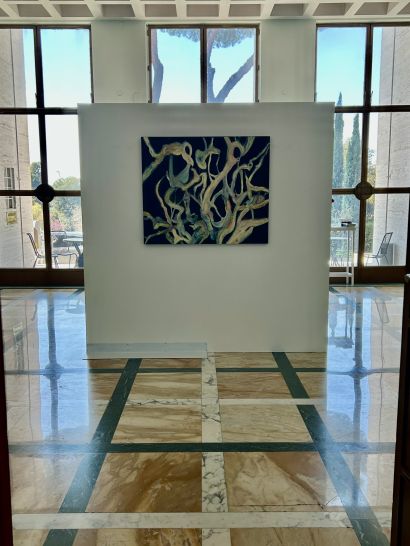
In her plant-based imagery, she connects historical pictorial traditions with surrealistic, symbolic and narrative strategies, using plants not as representations of nature but as carriers of memory, cultural knowledge, and ecological responsibility, underscoring sustainability as both an artistic and societal imperative.