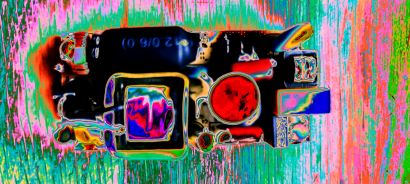
DescriptionThe original image—an overexposed, unstable, almost illegible yellow surface—is presented not as an auratic foundation, but as a neutral, already... Read More
Description
The original image—an overexposed, unstable, almost illegible yellow surface—is presented not as an auratic foundation, but as a neutral, already compromised source. From here, a variation generated by algorithmic delegation branches out, formally legitimate, conceptually equivalent. Delegation is not a rhetorical gesture, but a structural condition. Deane does not use artificial intelligence as a tool of enhancement or as an ideological antagonist. He uses it as a mechanism for normalizing error. The variations do not improve the image, they do not heroically betray it, they do not deconstruct it to the point of collapse. They maintain it in an imperfect state of functioning. This is where the artwork finds its precision: accepting that failure is no longer a critical event, but a mode of operation. Terms & Conditions (I Accept) is not a work about AI, nor about painting, nor about authorship, but about the continuity of systems even when meaning falters. For Aston F. Deane, Terms & Conditions (I Accept) is not a work of affirmation, but an act of exposure, the artist accepts that his language will not be protected, neither aesthetically nor conceptually.
Conceptual notes
For the author, the profound meaning of the work lies in a threefold renunciation that radically redefines his position. First, Deane renounces selection, accepts that not all images work and that failure remains visible, without correction or justification. In this way, the artist ceases to guarantee a qualitative outcome and instead assumes responsibility for a process. He then renounces the image as the locus of artistic identity and no longer concentrates on a powerful work, but disperses it. Finally, he renounces an external critical stance. Deane neither observes nor denounces the system from the outside, but accepts its operating conditions, including the economic and technological ones. The work thus loses a certain purity, but gains in honesty. In this sense, Terms & Conditions (I Accept) marks the transition from an analytical to an existential practice, shifting the question from "what does it mean" to "how does it continue to function"