DescriptionThe work is structured in horizontal bands of color, characterized by intense and contrasting hues—red, yellow, and green—that evoke signals,... Read More
Description
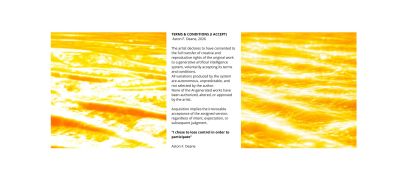
The work is structured in horizontal bands of color, characterized by intense and contrasting hues—red, yellow, and green—that evoke signals, codes, and energy fields. The apparently compact surfaces reveal an irregular materiality, made up of traces, abrasions, and marks that disrupt their continuity. Within this structure, directional shapes emerge, almost like arrows or shifts in perspective, suggesting movement and orientation. However, these directions do not lead to an open space, but remain inscribed within a closed system, devoid of real depth.
Conceptual notes
In Obligatory Directions, the artist explores the theme of orientation as an illusory construction. The lines and shapes suggest trajectories, possible paths, but these movements are already determined and confined within a structure that limits their outcome. The chromatic reference—which can recall universal signals of attention, stop, or go—amplifies this ambiguity: what seems Indicating freedom or possibility is actually part of a system that regulates and conditions every choice. For the artist, the work becomes a reflection on how we perceive direction and change.
Conceptual notes
In Obligatory Directions, the artist explores the theme of orientation as an illusory construction. The lines and shapes suggest trajectories, possible paths, but these movements are already determined and confined within a structure that limits their outcome. The chromatic reference—which can recall universal signals of attention, stop, or go—amplifies this ambiguity: what seems Indicating freedom or possibility is actually part of a system that regulates and conditions every choice. For the artist, the work becomes a reflection on how we perceive direction and change.
Perceptual experience
Perhaps the trajectories don't belong to the work, but to the way you observe it. Each gaze constructs different paths, discover which one emerges from your encounter with the work.
DISCOVER YOUR PERCEPTIVE PATH