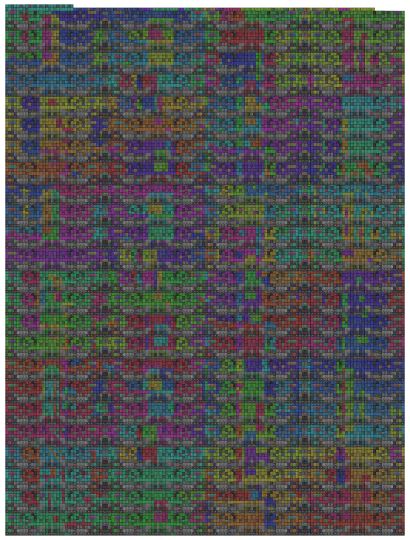
This work operates at the threshold where the photographic image loses its documentary unambiguity and becomes an autonomous visual event.
The starting point is television footage of a cheering crowd during a soccer game, with a seemingly unambiguous meaning: a moment of collective euphoria. However, isolating individual faces and enlarging them to extreme proportions undermines this certainty; grids, pixels, and artifacts emerge; the technical structure comes to the surface and supplants the illusion of photographic transparency.
As the image dissolves, so does its original meaning. The isolated faces now seem to oscillate between ecstasy, fear, horror, and vulnerability. The image unfolds a reality of its own, and the relationship between the image and the viewer begins to shift. Missing information is not supplemented but imagined. Meaning arises not solely from what is visible, but in the act of seeing itself.
From this perspective, the digital television image is not a neutral document, but rather material whose technical limitations become an aesthetic principle. Enlargement does not reveal details, but rather generates new images that were not originally visible. The individual emerges from the collective, while at the same moment his or her identity disappears back into the grid. Between visibility and dissolution, the image is neither a document nor an abstraction.
In this way, *Scream* examines not so much the event itself as the conditions of seeing. When does an image cease to depict reality, and when does it begin to create its own reality?