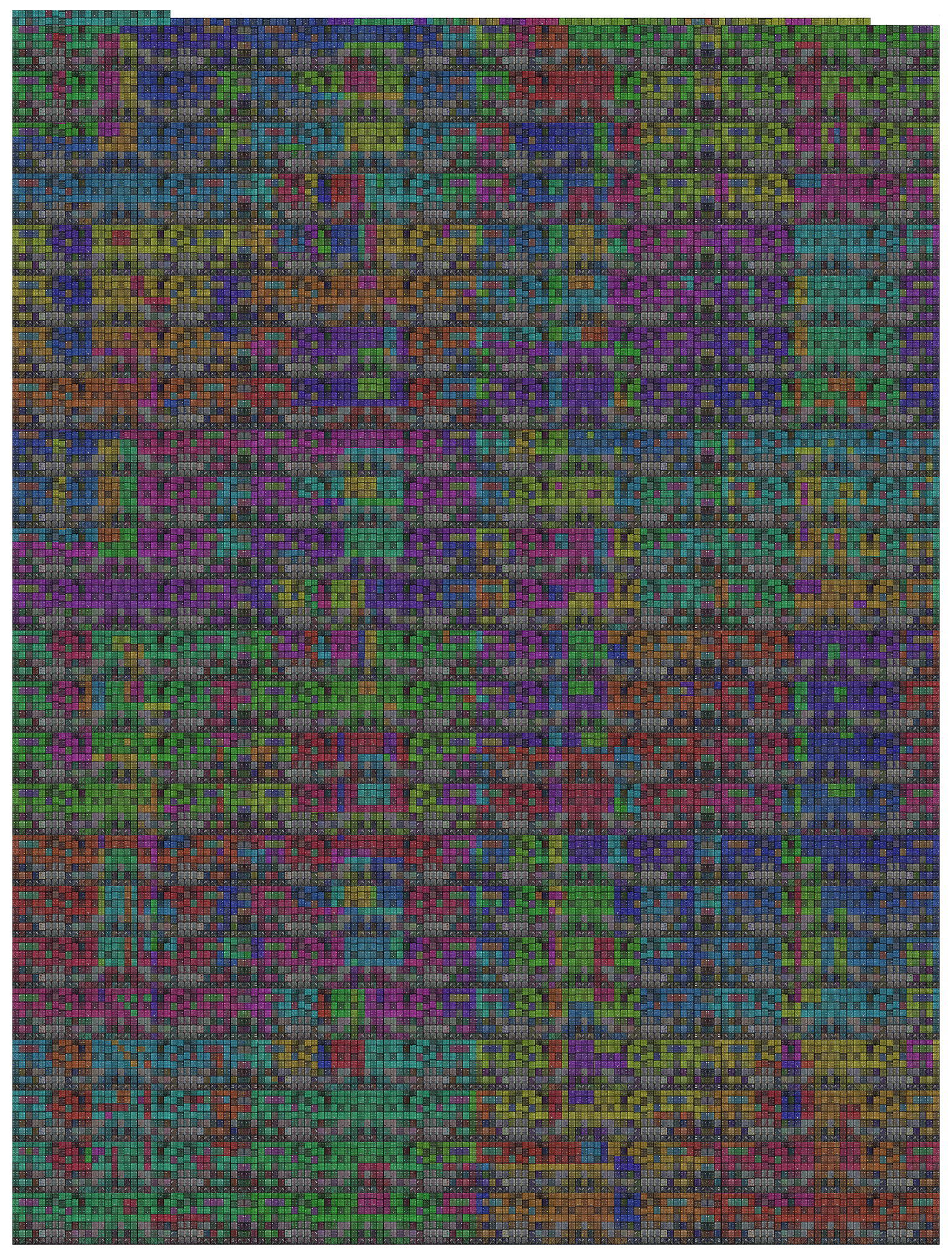
The starting point for the diptych “Open Sea” is the dimension of global container transport. The work examines the reliability of figures in the context of global trade flows—and at the same time points to the latent uncertainties associated with them.
Modern ocean-going freighters belonging to large shipping companies can transport up to 25,000 containers. Estimates of global transport volume for 2026 assume a volume of around one billion standard containers.
These figures form the structural basis of the work.
The left panel (Part One) translates the capacity of a giant ship carrying 25,000 containers into a serial grid. The functional object “container” is translated into a modular image element. From a distance, this quantity already appears as a calm, almost ornamental field of color; up close, however, the individual units are still recognizable. The quantity is still visually and intellectually manageable.
The right panel (Part Two) radicalizes this principle: one billion containers are reduced to such an extent that they appear only as minimal pixels. The image tips over into a vibrant noise of color—an extreme condensation with the loss of any identifiable form.
A kind of hyperreality emerges in which the sign replaces reality. As numbers grow larger, they lose their vividness and thus their connection to concrete experience. The difference between millions and billions remains mathematically precise, but loses its qualitative significance. Quantity becomes abstract, rhetorical, interchangeable.
This devaluation is made visible not through accusation, but through aesthetic condensation. In the reduction, information is lost and objects disappear. A contemplative space emerges in which global trade movements and the tensions associated with them resonate.