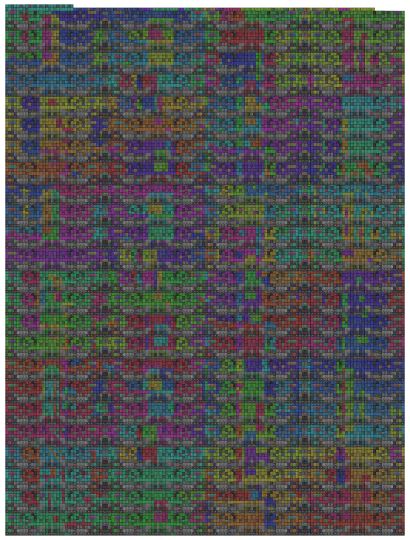
Disrupted Vision focuses not on what can be seen on television, but on what becomes visible when the transmission fails. Targeted manipulations of a digital indoor antenna lead to reception interference caused by manipulations in the room (people, objects, materials, etc.), creating images that lie somewhere between technical malfunction and autonomous aesthetics. In this way, moments are documented in which the cultural content of television dissolves and another artistic level becomes visible – the art of disruption.
The photographs show a wide range of manifestations. Strict stripes, grid fields or geometric surfaces, flowing colour fields, impressionistic compositions or surreal elements. Eyes, hands and landscape lines emerge from the noise and disappear again in the next moment. In this way, a connection is created between documentary accuracy and painterly association, between technical error and artistic tradition.
A second level of meaning arises from the fact that all recordings come from the 3Sat programme, a cultural channel that aims to give education and art a place in society. While 3Sat conveys ‘classical’ cultural content, the manipulated and unstable reception leads to a second form of culture, an aesthetic of failure. In this way, the image disturbances become not only technical artefacts, but also visual metaphors for the fragility of cultural mediation in general.
At a time when the future of public cultural programmes is repeatedly being called into question, this work takes on a particular relevance. Disrupted Vision not only captures the moment of the disappearance of images and information, but also stands for the loss of cultural certainties.
The series understands the flawed not as a deficiency, but as an independent form of perception, as an aesthetic resonance space in which the fragility, but also the mutability and resilience of cultural creation is revealed.