“Vacances Retrouvées 3” began with a small, anonymous vacation photograph found in a thrift store—a modest print whose names, dates,... Read More
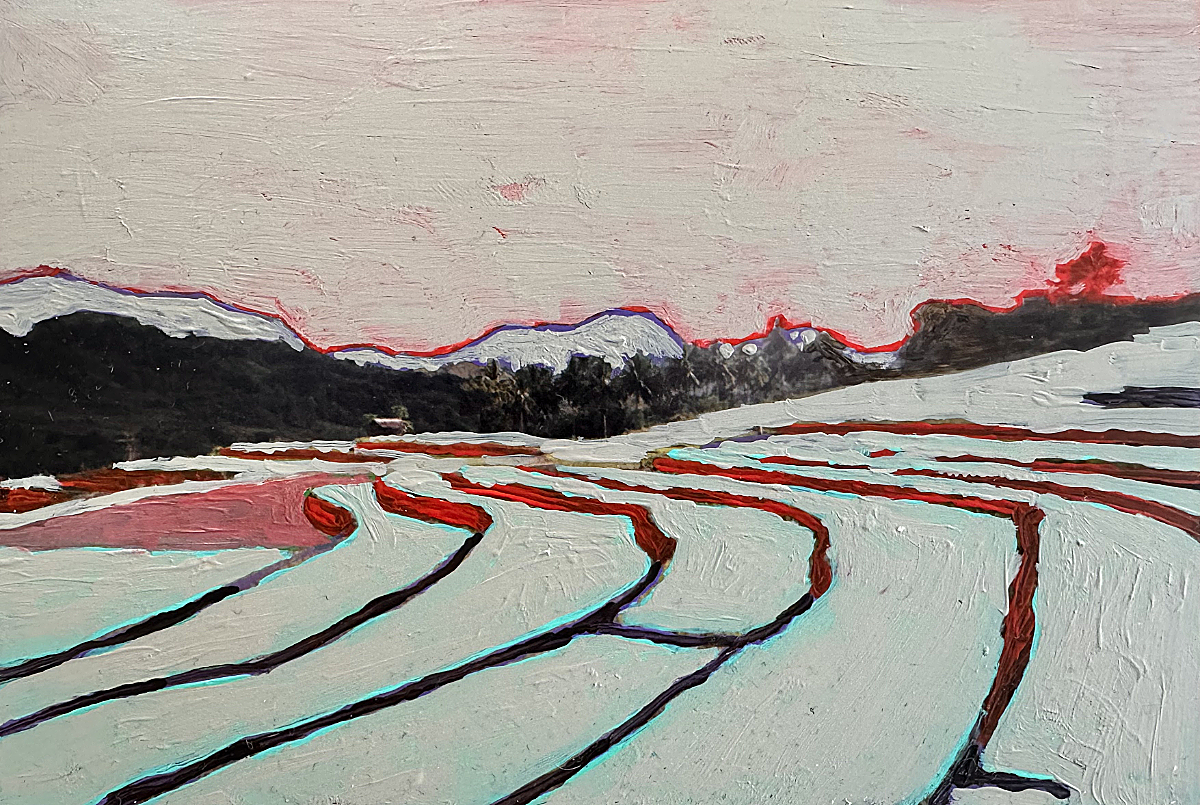
“Vacances Retrouvées 3” began with a small, anonymous vacation photograph found in a thrift store—a modest print whose names, dates, and original owners had disappeared, but whose atmosphere remained intact. The image showed a lush, green terrace landscape: layered foliage, hints of architecture, and the suggestion of a view held and enjoyed for a brief holiday moment. Rather than trying to reconstruct its “true” story, I approached it as a fragment of memory that could be re‑imagined.
In this painting I partially veil the original photograph, allowing only certain elements of the terrace to persist: the rhythm of plants, the suggestion of steps or levels, an opening that might lead to a wider landscape beyond the frame. Layers of paint obscure and reveal the source image, turning it into a visual palimpsest where my marks, the faint photographic trace, and the viewer’s own projections all coexist. The lushness of the greens is less about botanical accuracy than about evoking the intensity of being somewhere briefly, knowing the experience will soon belong to the past.
The work grows out of the central questions behind the Vacances Retrouvées series: What happens to a memory when the people who held it are gone? When photographs lose their names, do their stories disappear—or do they wait to be found again in new forms? By removing identifiable details and softening the contours of the original terrace, I preserve the emotional residue of leisure, distance, and contemplation, while protecting the anonymity of the original subjects.
“Vacances Retrouvées 3” is representative of my wider practice in its use of found materials, its interest in the fluidity of memory, and its balance between figuration and erasure. I treat these orphaned vacation images as fragments of a collective archive, using painting to transform someone else’s lost terrace view into a shared space of recognition. Rather than offering a fixed narrative, the work invites viewers to feel their own memories stirring within it—to sense, in this lush, green landscape, a holiday they may never have taken, but somehow remember.