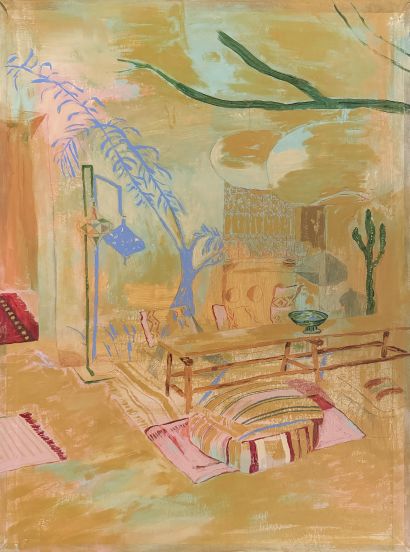
Where The Light Lingers is part of Internal Geographies, an ongoing series of imagined landscapes that explores how memory reshapes our experience of place. Rather than depicting existing locations, these paintings emerge from fragments of remembered landscapes, architectural forms and recurring motifs that gradually assemble into places that feel familiar without belonging anywhere specific.
This painting was not based on a single view but developed intuitively over time. As I worked, palm trees, pathways, distant buildings and shifting terrain began to organize themselves into a landscape that seemed to possess its own internal logic. The process felt less like inventing a place than discovering one that already existed somewhere within memory.
The title refers to the way certain places remain with us long after we have left them. We often remember not precise details but an atmosphere: the quality of light, the rhythm of space, or the feeling of moving through a landscape. In this painting, colour is not descriptive but emotional. The luminous greens, warm ochres and violet shadows do not attempt to recreate a real location; instead they evoke the sensation of a place that continues to exist in memory.
Across my practice I am interested in the territory where observation, memory and imagination begin to overlap. Where The Light Lingers embodies that search. It proposes that the landscapes we carry within us are not fixed recollections but living constructions, continually reshaped by time, emotion and experience. The result is a place that cannot be found on a map, yet often feels strangely recognizable.