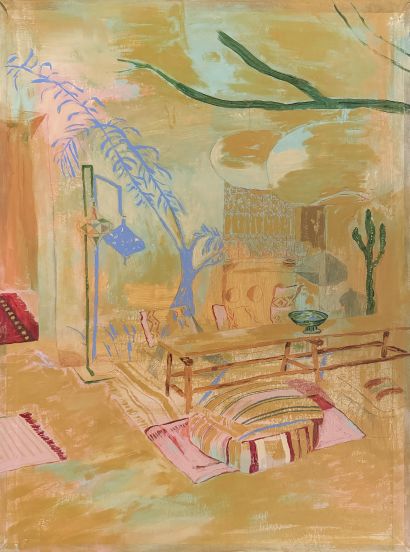
Quiet Bloom of Memory began with something simple: a plant in a vase against an ochre wall. What interested me was not the still life itself, but how such an ordinary arrangement could hold the atmosphere of a place that now exists only in memory.
Made during my residency in Morocco, the painting does not attempt to depict the country directly. Instead, it allows only fragments to remain: the warmth of the red ground, ornamental patterns reduced to a faint lattice, and plant forms that hover between domestic interior and imagined garden. Rather than documenting a specific room, the painting reconstructs the emotional residue of being there.
The contrast between the pale, almost dissolving plant and the heavy, earthbound vase reflects the instability of memory itself. The geometric pattern behind them acts as a quiet structure, suggesting the way memory tries to organize experiences that are constantly shifting and changing.
This painting forms part of my broader practice, which explores how memory reshapes our experience of place. Working between landscape, interior and still life, I combine fragments of observation, recollection and imagination into images that feel familiar without representing any single location. Colour plays an important role in this process. Rather than describing reality, it follows emotional logic, allowing the image to feel remembered rather than observed.
Although Quiet Bloom of Memory is quieter and more intimate than many of my larger paintings, it embodies the central concern of my work: how ordinary objects and spaces become vessels for memory. Through painting, I attempt to preserve not places themselves, but the feelings that continue to linger long after we have left them.