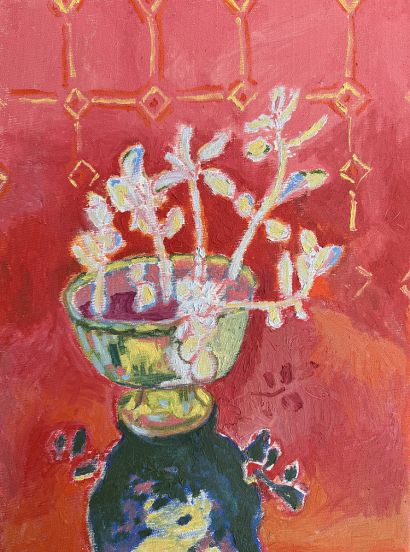
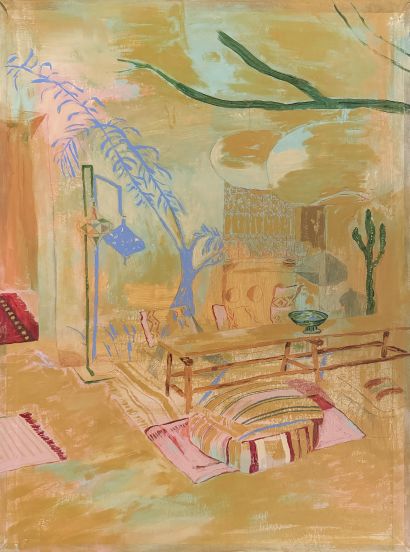
Somewhere Our Childhood Is Still Walking Home* is part of the series *Places That Remember Us*, a body of work that draws from places I have lived in throughout different stages of my life. The series begins with a simple question: what if places continue to hold something of us, even after we have left them?
The painting does not depict a specific street or village. Instead, it brings together fragments of different places that have remained with me over the years. Elements of childhood surroundings, later homes, and remembered journeys overlap within a single landscape. Through the process of painting, these places lose their geographical certainty and become something closer to the way they exist in memory: familiar, yet difficult to locate precisely.
The title emerged from the feeling that certain parts of ourselves never entirely leave the places where they were formed. Although we move on, memories continue to return unexpectedly, often attached to ordinary details: a road, a corner, a particular quality of evening light. In this sense, the painting reflects on childhood not as a period that has ended, but as something that continues to accompany us in subtle ways throughout our lives.
The image was built through a process of reconstruction rather than observation. I combined remembered architecture, roads, vegetation, and spatial impressions into a landscape shaped more by emotional resonance than by physical accuracy. Perspective shifts and compresses, colors move away from natural description, and familiar forms become slightly altered. These decisions reflect my interest in how memory transforms places over time, simplifying some details while amplifying others.
This work is representative of my wider practice, which explores the relationship between place, memory, and imagination. Across my paintings, I am interested in the ways landscapes continue to live within us after we have left them. Rather than documenting locations, I reconstruct them through recollection, allowing different moments, places, and experiences to coexist within the same image. In *Somewhere Our Childhood Is Still Walking Home*, the landscape becomes a space where past and present overlap—a place shaped as much by memory as by geography.