LANGUAGE UNDER CONSTRUCTION
For most of our species' history, we inhabited the world without writing and without complex verbal language. Yet our ancestors were already creating images, symbols, rituals, and other forms of meaning-making whose complexity continues to challenge our understanding.
Language Under Construction is grounded in an artistic and philosophical hypothesis: that preverbal forms of organizing experience constituted an original language from which verbal language later emerged. This language, composed not of words but of images, analogies, and embodied meaning, formed the ground from which we related to experience and may still remain an open evolutionary territory. Here, the word language no longer refers to grammar or vocabulary, but to the way we organize experience and construct meaning.
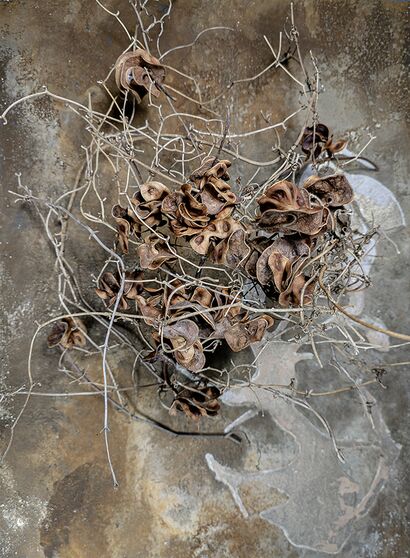
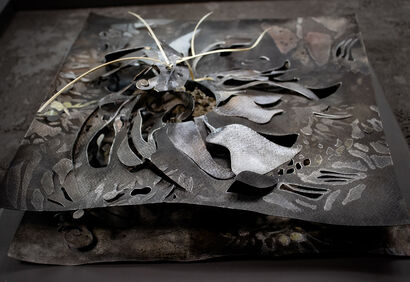
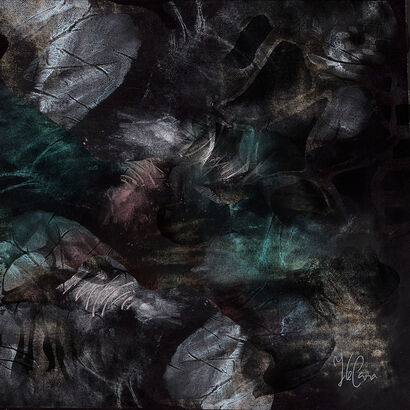
The surfaces of these works do not represent a lost script or a forgotten language. Rather, they seek to establish a dialogue between forms of understanding that preceded the word and possible future forms of experience.
At a time when artificial intelligence compels us to reconsider what we mean by human intelligence, this series poses a different question: if calculation, analysis, and efficiency can be replicated—and even surpassed—by artificial systems, where should we look for those capacities from which human consciousness itself might continue to evolve?
Epilogue
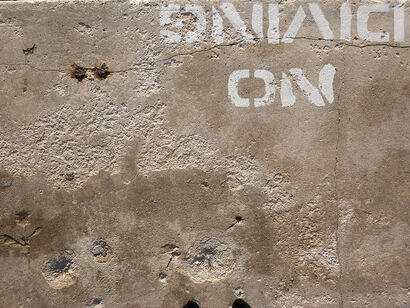
The photographs in this series do not originate from an archaeological site. The textures that evoke an ancient petroglyph are, in fact, the casting marks left on precast concrete units used to stabilize the banks of an artificial lake in the public Live Like Bella Park in Homestead, Florida. Designed for erosion control and stormwater management, these functional structures unexpectedly reveal a visual syntax that appears older than writing itself.
Language does not reside solely in what we have traditionally called language, but also in our capacity to discover meaning where we never expected to find it.
Conceptual Notes
Marija Gimbutas (1921–1994)
Archaeologist Marija Gimbutas investigated the symbolic systems of Neolithic Europe, proposing that their images and signs constituted coherent structures of meaning rather than merely decorative motifs. Language Under Construction takes this work as a point of departure for its own hypothesis: that these symbolic systems may reflect forms of organizing experience that preceded writing and, possibly, the emergence of complex verbal language. This interpretation belongs to the artistic proposal presented here and should not be understood as a conclusion drawn by Gimbutas herself.
Daniel Everett (1951– )
Linguist Daniel Everett argues that language emerged as a cultural construction developed in response to social and communicative needs, challenging the idea of an innate universal grammar. His work inspires the possibility of understanding language as an open evolutionary process rather than as a faculty fully determined from its origins.
Iain McGilchrist (1953– )
Psychiatrist and philosopher Iain McGilchrist investigates the functional asymmetry of the cerebral hemispheres, proposing that each participates in distinct modes of attending to reality. His work does not argue that one hemisphere is superior to the other; rather, it suggests that both contribute in complementary ways to the construction of experience. This perspective informs the hypothesis that different modes of attention may give rise to different ways of organizing meaning and relating to the world.