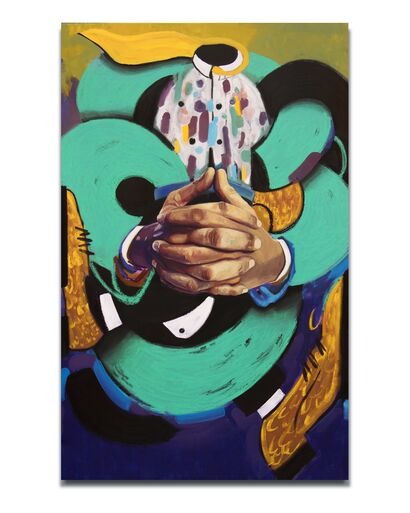
In Upper Management, the figure appears frontal, stable, and almost monumental. Yet this
apparent solidity quickly disarticulates: the head disappears, the tie floats autonomously, and
the body rests upon a corporate throne. The legs, transformed into swirling chaos, suggest
incessant activity leading nowhere, revealing anxiety, exhaustion, and desperation.
In this work, I thought extensively about Francis Bacon’s series based on Study after
Velázquez’s Portrait of Pope Innocent X, particularly the way both images approach authority as
a psychologically unstable presence traversed by internal tensions.6 In Bacon’s paintings, the
screaming mouth becomes a central void that transforms power into something disturbing
and existentially unstable.
In Upper Management, that conceptual trace remains displaced: the figure no longer screams,
but has completely lost its head. The dark void formed within the collar of the suit functions
as a symbolic equivalent of Bacon’s open mouth. Both voids operate as signs of psychological
collapse, eliminating the possibility of individual identity and leaving only the external
symbols of power: the suit, the tie, and the throne.
Performing Authority
This reference allowed me to translate Bacon’s existential darkness into the contemporary
corporate context, exploring how structures of productivity and success produce performative
and alienated bodies. Power appears here not as something heroic or stable, but as a
psychologically corrosive and absurdly demanding structure.