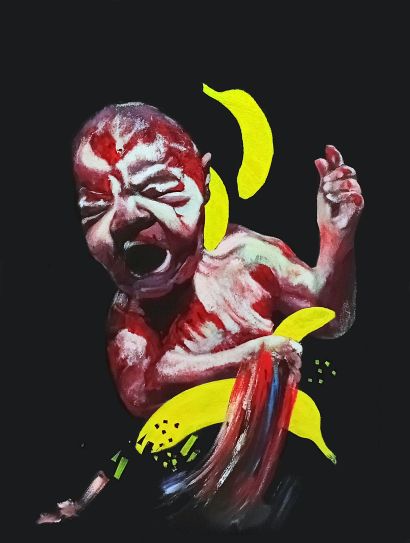
This work serves as the visceral opening to a four-part cycle titled "Salvator Mundi," investigating Martin Heidegger’s existential concept of Geworfenheit (Thrownness). It captures the precise, agonizing moment of a being’s arrival into a reality it did not choose.
In "First Touch," the traditional iconography of the "Savior of the World" is stripped of its divinity and replaced with the raw reality of biological "facticity." The central figure—a fragile, struggling infant—is not merely connected but entangled and constricted by the umbilical cord. Here, the cord is reimagined not just as a lifeline, but as the primary symbol of our unchosen attachment to the world. It represents the immediate "weight" of existence: the biological and historical baggage we are forced to carry from the first breath.
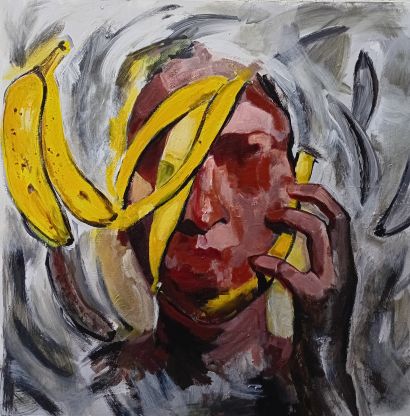
By integrating the banana—a nod to Maurizio Cattelan’s "Comedian"—as a burgeoning motif, the series introduces the "system" as an absurd, inescapable reality. In this first stage, the system is still primal and biological. As the cycle progresses, this organic entanglement will transform into a societal mask, eventually leading to a final resolution in the fourth work.
The title Salvator Mundi acts as a cynical yet profound metaphor. It questions how a being so utterly bound by the "thrownness" of its own birth can ever claim to be a savior, suggesting that true redemption (Erlösung) may only be found in the quiet, human truth of the cycle's conclusion.