The Illegal Hour
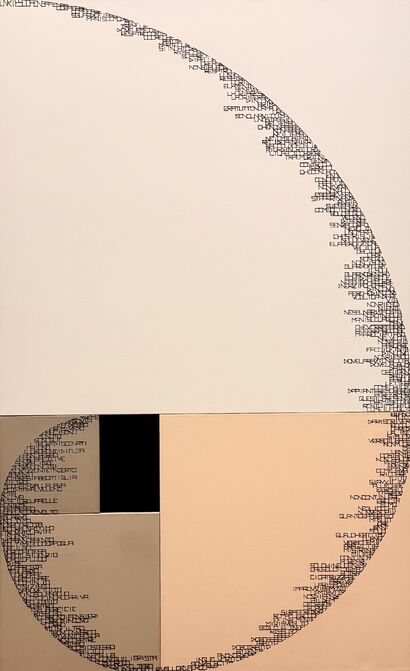
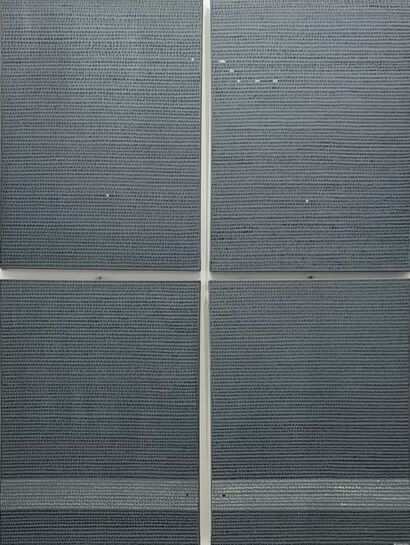
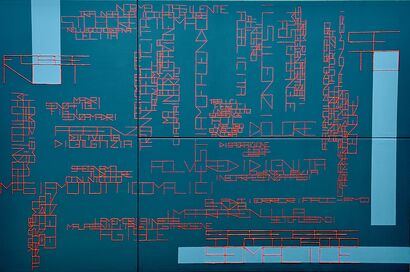
In this work, words do not merely communicate: they take their place in space, organize themselves into rhythm, and become pictorial matter. The dialogue no longer unfolds through a linear narrative but expands across the surface of the canvas as a system of simultaneous thoughts. Each word occupies a square proportionate to its length: the time required to read it is transformed into geometric measure, and thought acquires a physical body. The duration of a word becomes identical to the space it claims.
Constructed through a 2×2 square alphabet, the writing appears almost impersonal. The letters resemble codes rather than human traces; language itself is disciplined, regulated, confined within a rigorous grid. Yet the painting does not convey order, but saturation. Words overlap in proximity without ever truly covering one another, generating a congested mental landscape in which every thought struggles to find space beside the next before it has even had the chance to fully emerge.
The work stages an imaginary dialogue that reveals a form of invisible violence: the violence of speed. Not physical speed, but mental, perceptual, and emotional acceleration. The characters are not truly discussing time itself, but rather the possibility of lingering long enough to understand.
The text thus portrays a contemporary system in which thought is not meant to reach completion, but merely to be replaced by the next.
The sentence “But everything here is standing still” introduces the central paradox of the work: we keep running even when there is no direction. Speed no longer serves to reach a destination; it serves to avoid emptiness, silence, and permanence. In this sense, the dialogue reflects the contemporary condition of attention: a continuous transition from one piece of content to another, producing movement without reflection.
“I’m staying here” is the first truly radical gesture within the text. It is not an act of heroic rebellion, but a quiet refusal that gives rise to the desire to discover “what happens after the third second.”
Color amplifies this dynamic. The chromatic blocks function as cognitive impulses, sudden flashes of attention. No single element truly dominates the others; the viewer’s gaze is compelled to move constantly from one area of the surface to another, physically reproducing the very experience described in the dialogue: the incessant passage from one thought to the next. The work is not read linearly, but in fragments, through interruptions and returns.
To read the work, one must move closer, step back, search with the eyes, and rediscover the text. Reading becomes an act of slow exploration within a system deliberately constructed to accelerate perception.
The final result is a cartography of contemporary attention: a visual archive of unfinished thoughts, arranged according to rigorous rules yet incapable of truly coming to rest. And it is precisely within the fourth second—which in the painting seems impossible, almost illegal—that a symbolic space opens up, where the true act of resistance lies not in producing yet another thought, but in remaining with the same one long enough to finally inhabit it.
Text featured in the artwork
A: How long does a thought last?
B: Three seconds.
A: Only three? And then what?
B: Another one comes.
A: But that doesn't give us enough time to finish it.
B: It doesn't need to be finished.
A: Who decided that?
B: I don't know... but that's how it works.
A: I'd like to think for longer.
B: You can't.
A: Why?
B: You'd be too slow. You'd fall behind.
A: Behind what?
B: Everything!
A: But everything here is standing still!
B: And that's exactly why you have to keep running. You have three seconds... one, two, three.
A: It's already over. I didn't understand anything.
B: Understanding isn't what's important.
A: Then what is?
B: Moving on to the next thought.
A: I'm staying here.
B: But nothing will happen.
A: Maybe.
B: Then why are you staying?
A: To see what happens after the third second.