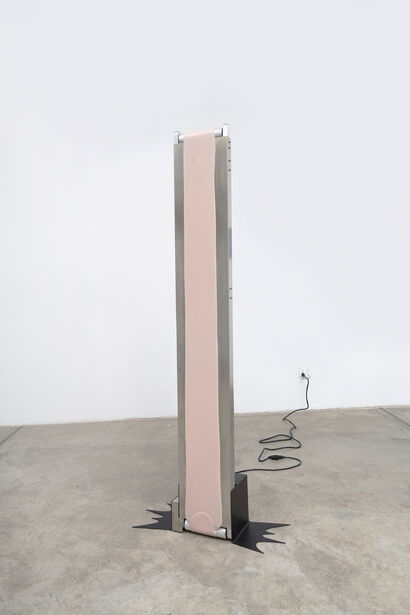
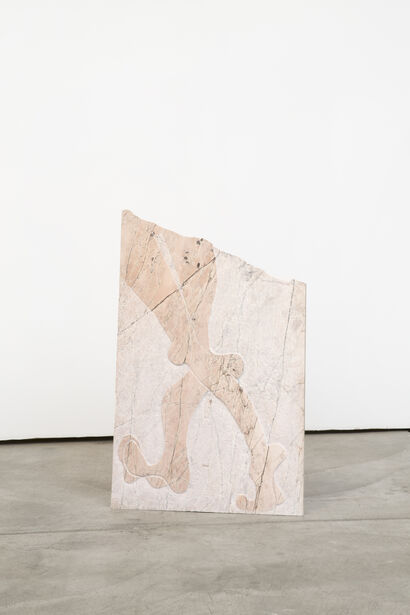
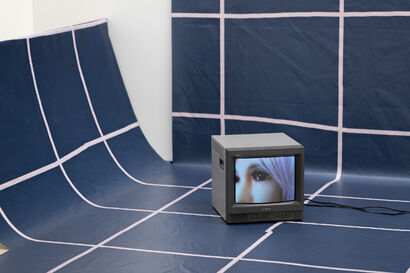
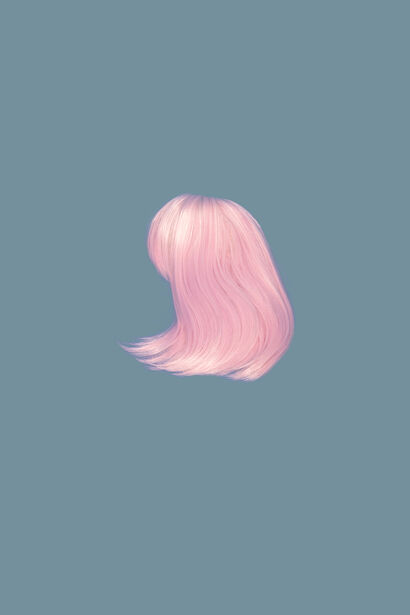
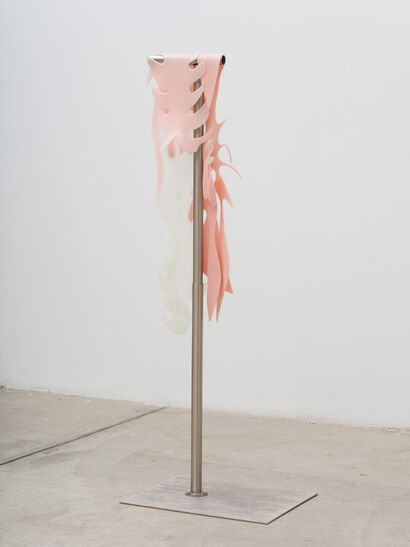
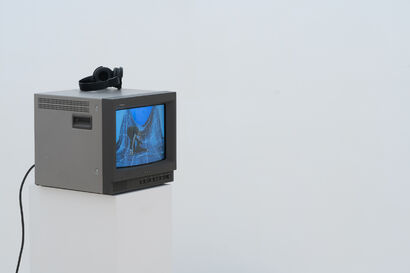
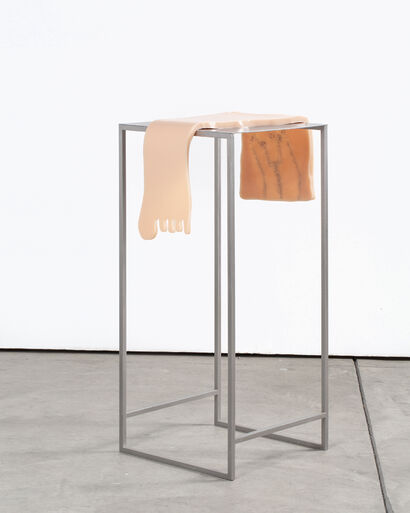
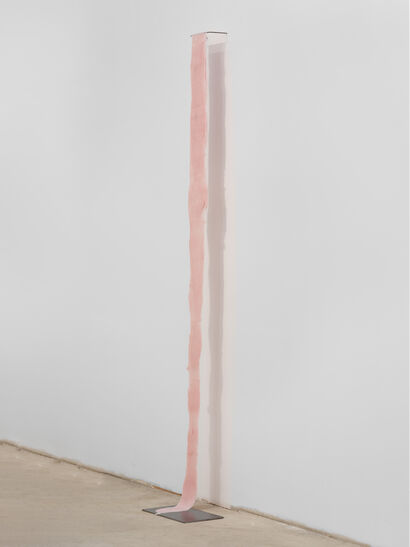
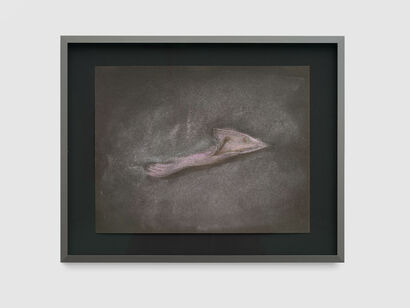
This wall tableau, rendered in pigmented silicone and steel rods, is a meditation on historical trauma and contemporary abstraction. Drawing formal elements from Jan Matejko's "Battle of Grunwald" and Francisco Goya's "Disasters of War", the work transposes scenes of historical rupture into a minimalist, almost spectral language of material tension and bodily suggestion.
At first glance, the piece reads as an ethereal tableau—soft pastel drapery seemingly melting or seeping through skeletal armatures. Yet beneath this aesthetic elegance is a sharp conceptual edge. The silicone forms resemble prosthetic limbs or synthetic flesh, suspended in states of partial disintegration. Their colors—fleshy pinks, bruised lilacs, and translucent creams—carry the echoes of skin, or scar tissue. These are not heroic forms, but ones compromised and fragile, reminiscent of both Goya’s anguished figures and the aftermath of Matejko’s manic clash.
The steel rods, thin and precise, act as both supports and constraints—tools of industrial function that now serve to prop up broken bodies or to mark the spatial logic of a battlefield remembered only in fragments. There is a palpable dissonance between the cool rationality of these geometric lines and the visceral, sagging softness of the silicone. This contrast creates a powerful dialectic between utility and dysfunction, a body extended and exhausted by its own augmentations.
Importantly, the installation resists closure. The silicone gestures—hand-like extensions, half-formed limbs—hover in a liminal space between abstraction and figuration, caught in a perpetual moment of becoming or undoing. They evoke speculative technologies gone awry, ghostly simulations of a human form no longer tethered to historical certainty.
In this way, the artist reimagines the grand violence of history not through spectacle, but through intimacy and degradation. What remains are traces—delicate, ambiguous, and profoundly moving. This work does not re-stage the past, but mourns its aftereffects in the material language of the present.