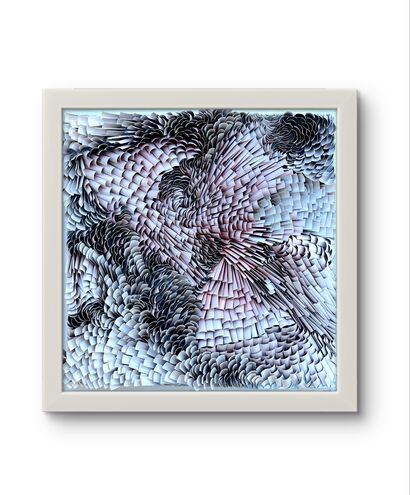
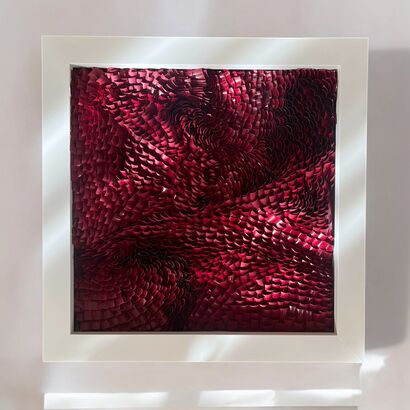
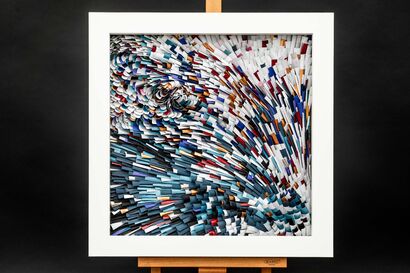
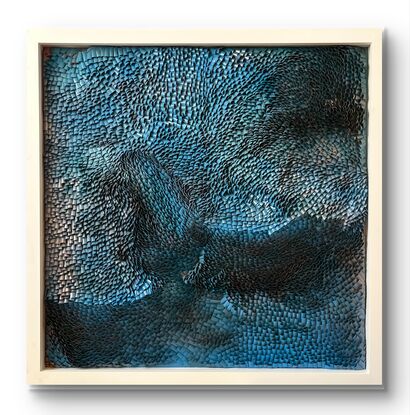
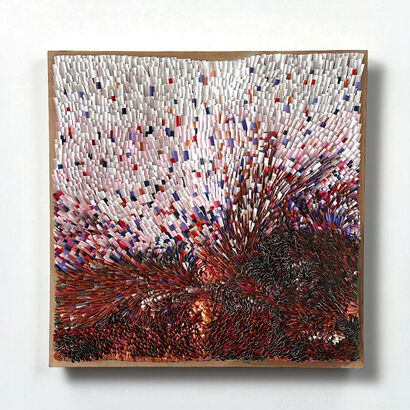
The work is made from a disused, “American-style” structure salvaged from a theater, industrial metal that is dead yet alive with absolute perfection and mineral longevity. In its stillness, the curled scraps from Desio, resembling roots and sprouts, defy the passage of time.The word “inflorescence”, therefore, becomes a key to understanding the work. Not because the work imitates a flower, but because it changes, as if driven by an internal movement. The materials, in fact, thicken, overlap, and push beyond the airspace, capturing light and creating intermittent flashes reminiscent of the Northern Lights. Perhaps this is precisely the paradox of Cerioli’s work. Metal does not become nature, but it finds a way to behave like something alive.
In terms of technique, the artist speaks of a challenge: “taming” the metal to transform it into a vibrant material. The verb, however, risks being too orderly to describe the work. Here, the alloy does not appear tamed but retains its rough edges and the memory of the precision machining from which it originated. The result is a transformation still in progress, entrusted to a surface that invites the viewer’s eye to traverse it. A field where solids and voids chase one another, allowing us to fill those very spaces, to weave into the fabric, to give it mass through our gaze.
The work’s dimensions – 110 x 104 x 10 centimeters – give it such an architectural presence that it both contains and simultaneously sets the fragments ablaze; not all of them produce the same effect, nor are they all easily discernible. It is precisely this lack of uniformity that lends credibility to the concept of germination.