The Battlefield feels like standing in a waking daydream where fourteen centuries of image history overwrite one another in real time. At the center towers a life-size girl in a cherry-blossom skirt—a post-Romantic icon of calm amid visual overload. Her frontal pose and hierarchic scale echo Byzantine panels and Gothic altarpieces, yet her presence is contemporary: she seems to ask us to slow down in a world of endless swipes.
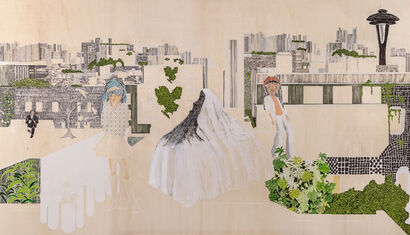
Around her unfolds a layered tableau: every motif occupies its own slice of time and culture. Lower left, a kawaii avatar with vinyl-toy eyes hops forward; to the right floats a grey obake ghost with spiral pupils—folklore and pop, cute and uncanny. They’re heirs to Murakami’s Superflat but also to the marginal doodles of medieval prayer books.
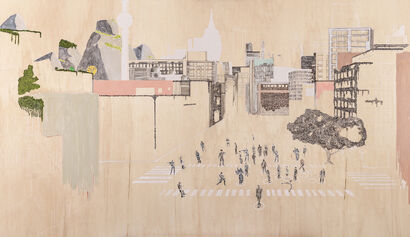
Behind them, modernist flats and Brutalist towers rise into a ruin of the now: the Romantic castle traded for concrete—decay unchanged, only the material different. Cutting through are 8-bit Mario stairways and blazing orange glitch triangles, digital errors that disrupt the pictorial space the way Op Art once shocked the eye. Voxel-red Minecraft poppies remind us even remembrance can be reduced to cubes.
A white grid spreads across the foreground. The grid is Bauhaus pure; the figures are Pop-ironic; their collision, Dada abrasive. Where Seurat broke colour into dots, here reality itself dissolves into data-points and game models.
Sakura petals and mountain silhouettes drift like background layers, posing the core question: what remains of the Romantic ideal of nature inside a smart city that translates everything into coordinates, avatars and glitches?
The Battlefield shows art history respawning: japonism, Pop, Symbolism, voxel art—none erased, all rewritten like code in an endless update. Monet’s garden, Manet’s boulevard, Turner’s steam, Friedrich’s calm horizon now load as quickly as a Minecraft seed or Fortnite skin.
The painting demands slow seeing: layer by layer, let eye and memory toggle between icon and glitch, ruin and game grid, until the paradoxical beauty of a world forever rewriting itself comes into focus.