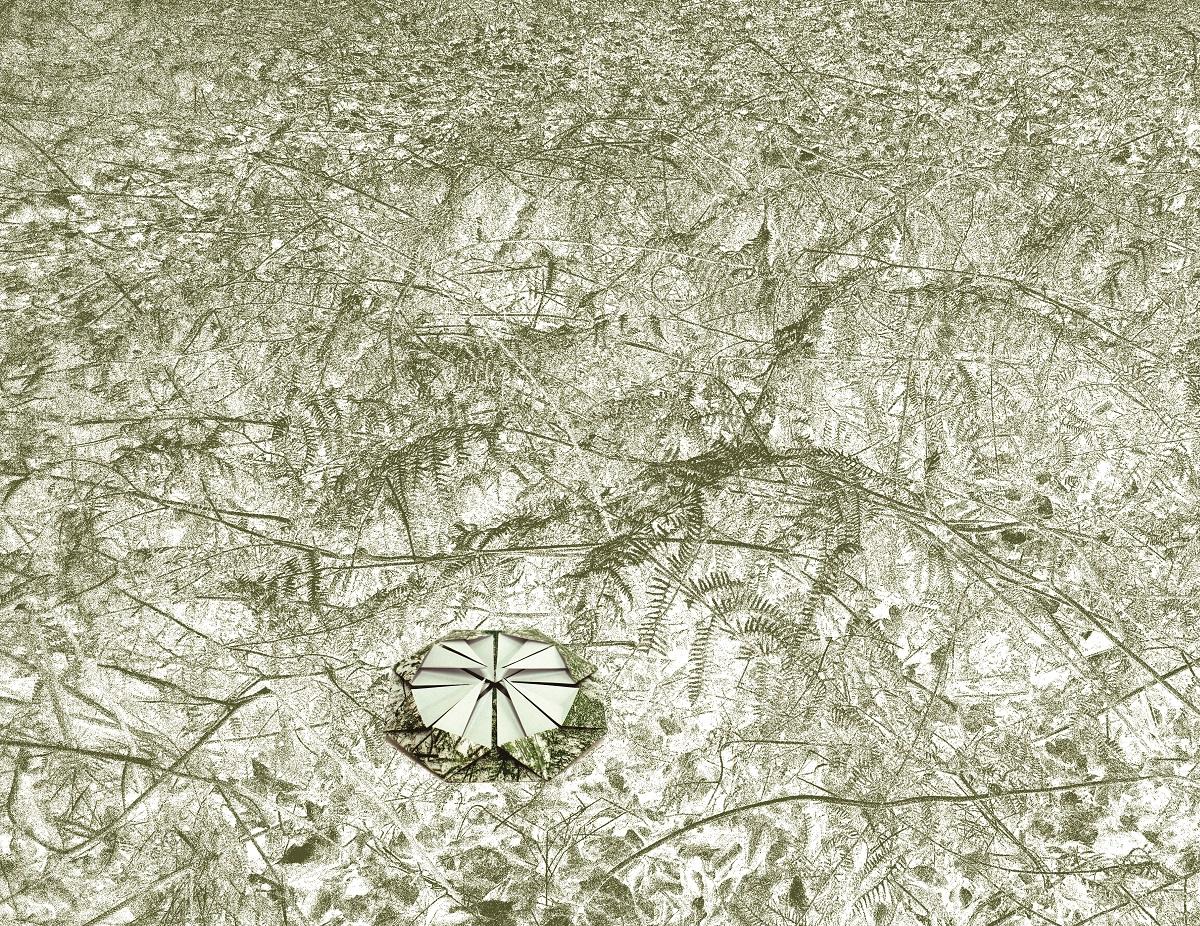
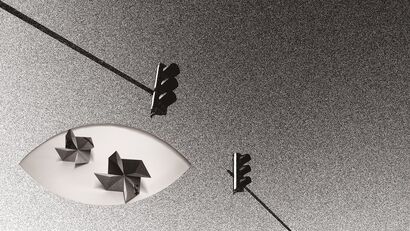
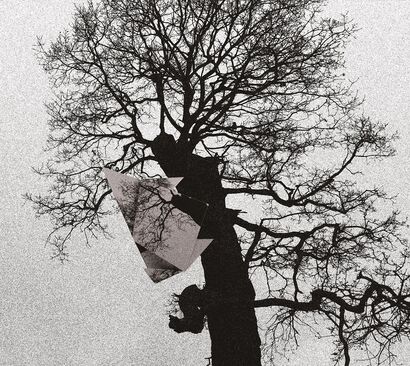
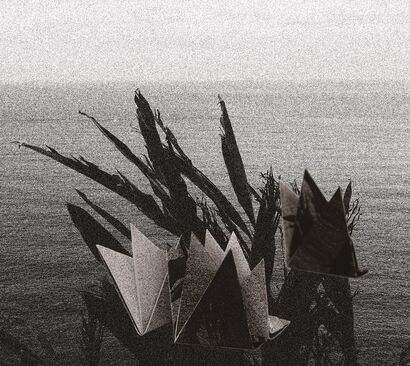
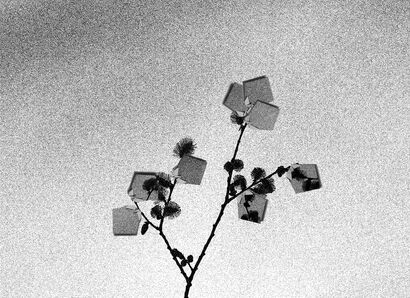
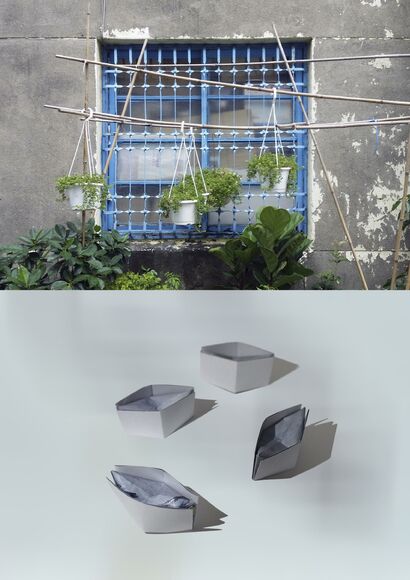
The collage approach could be a bridge to bring out the advantages of objects. After filling in the colour and using the filter on the bitmapped grayscale landscape in Photoshop, green dots replace the black dots. The white part of the image does not change, whereas the overall contrast of the green dots’ image is slighter than that of the black dots’ image; thus, the image looks lighter and even flatter after being re-constructed at green dots. I create an Origami object and implant it in the coloured stylised landscape, expecting to make a focus point on the image and implicate the layered conditions of the landscape. The Origami re-depicts the structure of the landscape through several geometric shapes. Its non-flatness depends on both overlapping folded paper and photographed angle. The folded paper forms several blocks and lines through which a volume exists and expresses its facets, inner spaces, and shadows. I captured the image of the volume from an oblique angle rather than from its fronts; in this way, the photo records more layered lightness and shadows and the front-to-back sense of the object in space. I subsequently removed the background of the Origami image and placed it onto the lightest part of the landscape image; despite the photographed background of the Origami object gone, the perspective of it still has a sense of 3-dimensional. The lightest part of the landscape image, similar to the function of background in a visual sense instead of in the meaning aspect, gives prominence to the boundary and volume of the added object; besides, the 3-dimensionality of the Origami even implies and connects the space of the landscape. Therefore, collage gathers the Origami and stylised landscape image to produce the contrast as a focus onto their combination; meanwhile, the concentrated sense of the 3-dimensional object contrasts with a sense of vast space of the flat image.
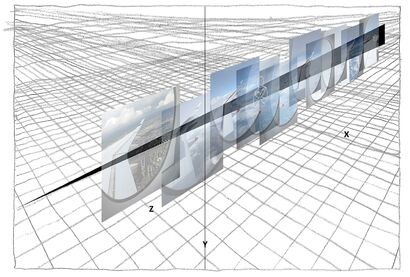
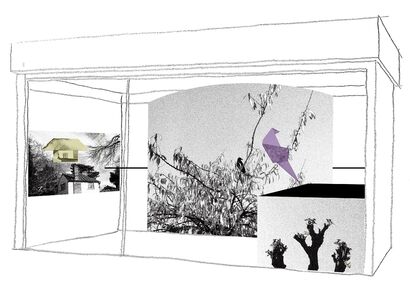
The collage could be a catalytic emblem. In my work, things from different dimensions, time, and space can transform and link together via collage. The works rely on cameras, computers, and printers to complete, involving various disciplines such as photography, sculpture, and digital collage. With these tools and techniques, I can create images/objects in different dimensions and integrate them into a sheet as a study of collage. Although adding images/objects disturbs the integrity and purity of the occupied images/objects, the creative intention and process of collage practice excitingly brings new roles to the existing images/objects and forms new concepts; furthermore, the combination even brings about the discussion about the re-production or re-definition of objects. Take this piece for example. Combining 2-dimensional stylised landscape and the 3-dimensional Origami forms a consistent relationship between the past and the future. There is no tense relationship between them despite their contrasting attributes. Through folding the print of the stylised landscape, the content and context of the stylised landscape are re-shaped in Origami form; hence, the relationship between them closely links to the intertextual deformation. The practice raises a way of re-exploring an image beyond existing shapes, frames, and dimensionality. Once the stylised landscape and the Origami are juxtaposed, the disparity and a sense of mutualism rise to the platform. As social conditions continuously change and are influenced by the past or known things, art practice as a questioning and reflecting tool needs to upgrade; meanwhile, collage as a challenging method disrupting society could be more flexibly used and stimulate more related research.