Decomposition
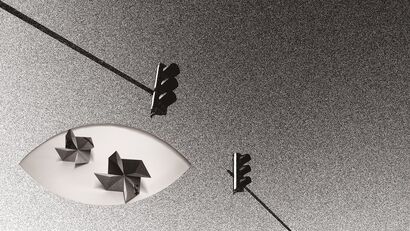
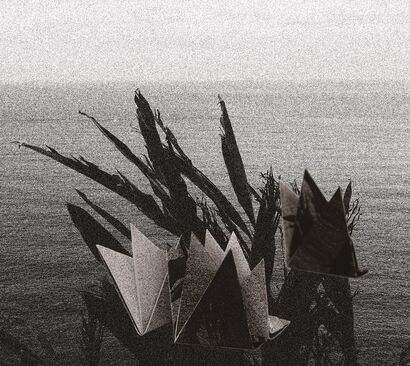
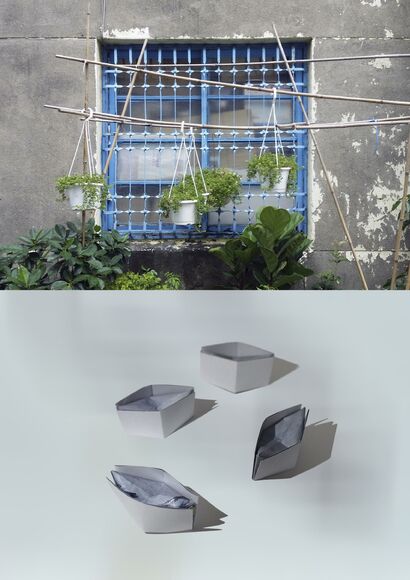
is the basis of my intertextual practice. What shape of Origami I fold depends
on the appearance and association of the object in the landscape; the Origami
as a symbol could be a similar minification, related object, or structural
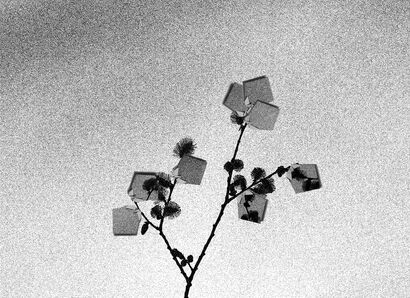
study, reacting to the original image. The structure of the tree I captured
decomposes and re-imagines after the photo is stylised. Since the photo lost
its colours and reduced some details and layers after being grayscaled and
bitmapped, the vividness of the living plant transforms to the calculated
distribution of numerous dots, dotted lines, and blocks; the realistic
expression of the object changes to be pictorial. I attempt to decompose the
thing in this image and to re-depict it by making Origami. After decomposition
thinking, the object structure in the image re-expresses via the geometric;
meanwhile, the flat image becomes an object having a sense of volume after
being folded. Once the image of geometric volume attaches to the image of a
stylised landscape, their 3-dimensional and 2-dimensional qualities complement
each other, and their relevance and connection manifest in the same frame. The
Origami object seems to be disruptive in the combination; nevertheless, making
and collaging the Origami, as a process and the result of deconstructing and
reforming the landscape, expands the context and content of the original image.
The
oscillation between the 2-dimensional and 3-dimensional concepts constantly
occupies in my work. Origami reconstructs the original image and shows the
deformed landscape, representing a transformed form crossing the dimensions.
The Origami image blending into the stylised landscape generates duality, such
as a sense of volume informed by the shadow on the object and a sense of plane
caused by the landscape without any shadow. The Origami looks like an invader
from another time-space, disturbing the flatness of the landscape but also
increasing an extra layer for the original image. The flatness of the stylised
landscape is not a second-class component or merely a background; its status is
the same as the Origami. In common sense, the crucial part of a picture often
shows a high contrast to catch the attention. Compared to the Origami image,
the landscape image has a much higher contrast of lightness; meanwhile, this
collage work emphasises the juxtaposition of the intertextual objects. Despite
the Origami having more details, such as the shadow set off by the darker
blocks of the landscape, both Origami and landscape images need the context and
process of each other to prove the intertextuality. It is worth noting that I
retain thin lines on the border of the Origami image overlapping on the darker
blocks of the landscape; therefore, the object of the deformed landscape and
its original one are recognizable and comparable. Arguably, this approach
builds the focus of the work in visual and spatial aspects while highlighting
the oscillated multiple dimensions of the components.