Escencionalismo is a bio-sensor driven audiovisual protocol that maps physiological signal — breath, pulse, galvanic response — onto real-time visual... Read More
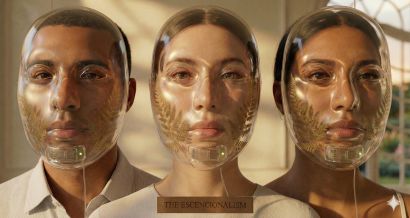
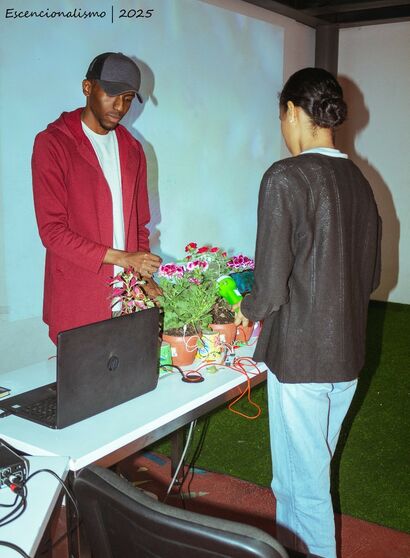
Escencionalismo is a bio-sensor driven audiovisual protocol that maps physiological signal — breath, pulse, galvanic response — onto real-time visual and sonic architecture. Escencionalismo I: Three Stages of Reality applies this framework to the still image, treating the photographic sequence itself as a biosignal: a trace of perception under pressure.
The triptych unfolds in three movements. In The Threshold, the figure stands at the edge of a dry Ecuadorian landscape beneath an impossible aurora — the ordinary world with a crack in it. Perception is intact but already suspect. In The Glitch, that crack opens: anaglyph displacement fragments the image into doubled, misregistered layers, enacting the moment cognition fails to synthesize what the senses deliver. The figure has sat down under the weight of it. In The Blossom, a VR headset replaces the sky. The darkness of the room becomes the inside of the flower. Behind the figure, a green exit sign — SALIDA — glows in the mirror, unplanned, asking whether emergence and recursion are the same gesture.
The sequence draws on two anchors: Plato's cave as epistemological structure, and the Guayacán tree of coastal Ecuador, which blooms only after extreme drought — beauty as a consequence of systemic stress. Escencionalismo proposes that the body, read correctly, already knows which stage it inhabits. The images ask whether the mind can follow.