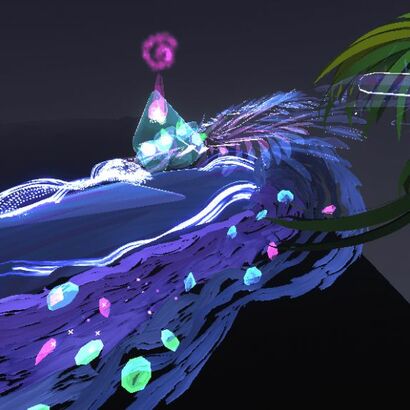
The New Moon was named after its striking similarity to Earth's moon in terms of its physical characteristics. The mass, volume, radius, and surface area are all identical to those of the Moon. The main difference between these cosmic twins is that the New Moon is inhabited by a vast number of living organisms.
II Expedition to the New Moon was organized to study these organisms in detail.
For the period of studying the new planet, a classification system was introduced:
On the Greek language - the estimated number of species united in a single micro-ecosystem (mono, dia, tria...)
The name of the living organism itself - in English.
On Earth, the binominal nomenclature introduced by Carl Linnaeus is in effect - the names of animals and plants by their genus and species.
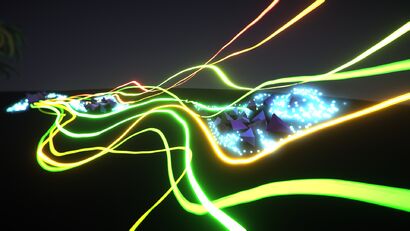
A huge number of living objects have been discovered on the planet that continuously generate powerful energy flows. How this happens and for what purposes remains a mystery.
The planet's living organisms are constantly flickering and glowing. Their translucent reflective surfaces contain strong energy charges that continuously circulate between them. It is hypothesized that energy is the primary form of communication for the planet's inhabitants