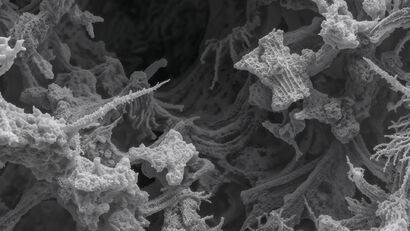
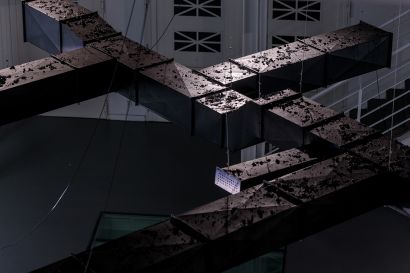
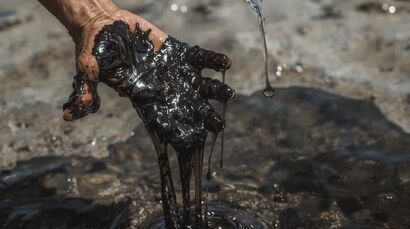
A dystopian vision of the Nordenskiöld Glacier (Svalbard), partially covered by a smoking coal heap. (ambient noise edition)
Video source: drone footage of the surface of the Nordenskiöld Glacier (Svalbard); drone footage of a burning coal dump in Nowa Ruda (Poland).
Sound source: field recordings from the area around Billefjorden (Svalbard) and a coal heap in Nowa Ruda (Poland)
Technique: Digital collage of 2 video combinations using Adobe After FX software
The albedo effect is a concept in climate science that refers to a surface's ability to reflect solar radiation. The term "albedo" itself comes from the Latin word for "whiteness" (albedo).
In simple terms, albedo is a measure of reflectivity. It is expressed as a coefficient or a percentage on a scale from 0 to 1 (or 0% to 100%).
• Albedo = 0 (0%): Means the surface absorbs all incoming radiation (a perfect black body).
• Albedo = 1 (100%): Means the surface reflects all incoming radiation (a perfect white body).
The albedo effect manifests itself in how changes in the Earth's surface albedo influence the climate, creating a feedback loop, in particular a positive feedback loop that amplifies the initial change.
The albedo effect is a crucial natural regulator of the Earth's temperature. In the context of current climate change, the positive feedback linked to the albedo of polar regions is one of the most concerning factors because it accelerates global warming in a way that is increasingly difficult to control. Understanding this effect is essential for accurately predicting future climate developments.