[SCENARIO]
Fashion is a way of being.
Especially in Italy, the art of dressing well, coordinate colors and spot new trends, has always been a defining characteristic of our national identity, capable of influencing the entire global industry.
Unfortunately, despite growing consumer awareness regarding fashion's detrimental environmental impact, affordability remains the main factor in purchasing decisions, fueling the destructive phenomenon of fast fashion.
Some of the world’s most powerful brands offer all type of clothing at low prices, encouraging rapid turnover once a trend fades, while masking the illegal exploitation of low-cost labor and massive waste of energy and raw materials behind misleading slogans.
In contrast to this, small local enterprises have emerged in recent years striving daily to revive the concept of dressing intelligently; their goals include minimizing waste, rediscovering traditional manufacturing techniques and promoting the repurposing of old garments in alignment with the principles of the circular economy.
[IDEALIZATION]
With these premises and in alignment with the principles promoted by the "Esseri Urbani" festival (which has adopted "Trame" as its 2024 theme) and the New European Bauhaus, the Via Nardelli project follows a path of rediscovering ancient knowledge to drive a revolution in the fashion world, thereby paying tribute to the textile craftsmanship of the Itria Valley and Puglia as a whole.
The installation presents itself to the public as a large net serving as a framework for a "gene library", a repository of the genes and fragments that make up DNA, encapsulating the experiences and memories of those who came before us.
[REALIZATION]
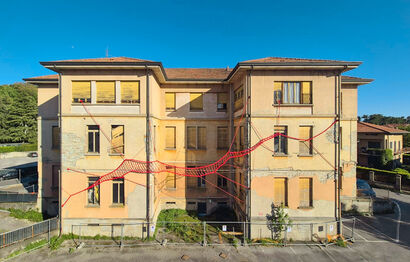
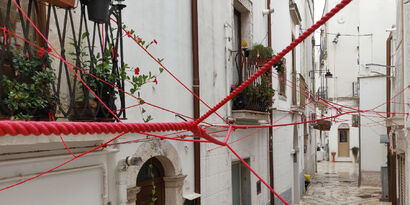
The artwork is approximately 300 meters long and consists of two main sections: (1) a horizontal stretch that spans almost the entire length of Via Nardelli, starting from the U Jùse APS headquarters at number 19 and extending to the foot of the Belvedere steps (Largo Bellavista), (2) a vertical section covering a building façade near number 101.
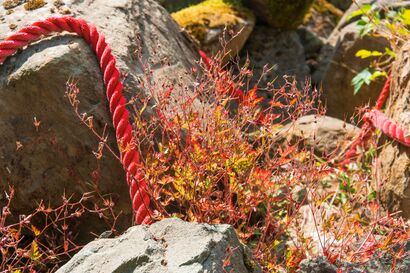
Overall, the installation utilizes existing structures such as the façades and lamps along the perimeter railing (near the terraces overlooking the valley ridge) as anchor points, extending via a system of cable lines onto which knitted inserts are attached.
The main cables is divided in two diameters (3 cm for the primary lines and 1.5 cm for the secondary branches) and are made from 100% high-quality, natural and eco-friendly jute fibers. Woven into this primary framework is an additional layer of machine-knitted, multicolored cotton yarn, secured to the structure with white cable ties.
[EFFECT]
All the area is characterized by the white color of the "Cummerse", the installation blends with the urban enviroment harmonizing perfectly with the space’s color scheme. It features a lightweight structure rising to a minimum height of six meters, without interfering with the urban environment or daily activities.
The alternation of day and night and the movement of the sun, along with the effect of artificial lighting at night, reveal genomic patterns projected onto the "cummerse" facades and the street. This interplay of light, shadow, and color (the seven hues of the spectrum) invites contemplation from below looking up, and vice versa.
Psychologically, the work aims to reawaken the memory of the human-space through an element suspended in the air that, like a spiderweb, visually captures the eyes, shifting the center of gravity from a purely external dimension to a more internal one. It's a journey into the past, when life was maybe harder but certainly more authentic.
The project was presented in Locorotondo (Bari) during the Urban Art&Architecture Festival "Esseri Urbani_Trame" in 2024.
The work remained open and free to the public from August 15 to November 15.
A series of QR codes have been placed along the street to tell the story of the project. Tactile samples have been incorporated into the main explanatory panels, located at the beginning and end of the street, as an additional inclusive feature for the visually impaired.
Team:
Gabriele Mundula: Artist
Mirco Matarante: Creative Director
Domenica Lisi: Seamstress
UJùse APS: Organizator
Photo Credits:
Image #1: Drone pilot Vito Marzulli, Genoteca, 2024
Image #2: Photographer Silvestro Simeone, Genoteca, 2024
Image #3: Photographer Silvestro Simeone, Genoteca, 2024
Video Credits:
Drone pilot & Photographer Vito Marzulli & Silvestro Simeone, Editing video Domenico Maffei, Genoteca, 2024
Direct link to the festival page:
https://www.esseriurbani.it/trame-2024-2-2/