WW_O2 is part of the White Wombs Series
A sculptural crossing of invisibility, buried memory, and revelation
Conceived as a poetic and sculptural crossing of invisibility, buried memory, and revelation, the White Wombs series emerges as a living synthesis of my entire artistic research in recent years. From the personal, social, and collective trauma explored in the Layers series to the work dedicated to Alda Merini—where madness becomes a form of covering and uncovering the soul—White Wombs marks a convergence point between language, material, ritual, and light. The very title directly refers to the poem L'Albatros by Alda Merini, from which I draw the powerful image of the “gentle white womb”: a fragile and sacred place, both generative and containing.
Body, stitching, material and fragility
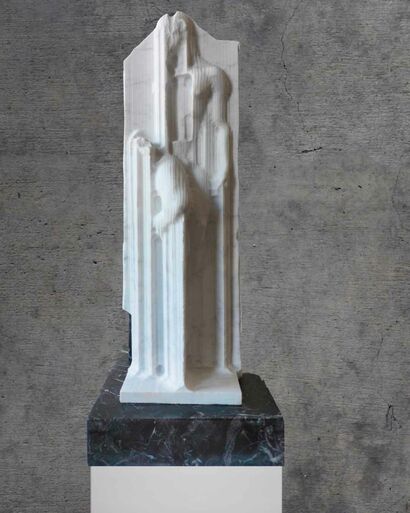
The works are made from thin slabs of marble, salvaged from offcuts and broken fragments. Each piece carries the echo of a fracture, a broken origin. The slabs are then stitched together using different materials—red thread, black thread, brass—creating a play of tensions and bonds that speak of the complexity and coexistence of difference, both in human personalities and in social fabrics. Each stitch is a surgical and symbolic act: not meant to hide the wound, but to make it an active part of the form. The sculpture becomes a vulnerable, stratified body, living through the relationship between rupture and its attempt at reassembly.
Cyanotype, writing, and light as generative tools
The technique I use is experimental in nature: each slab is coated with a light-sensitive cyanotype solution, activated exclusively by sunlight. Upon this surface, I write using egg tempera—words and drawings that resist UV rays, thus creating, once washed, visual impressions born from absence. It is through this subtraction that the word gains its power: it disappears, but it remains. The emerging marks are signs of passage, shadows that survived erosion, presences that only manifest as they seem to dissolve.The inscriptions are not merely decorative: they are fragments of thought, emotion, and time—a deep reflection on impermanence and the invisibility of human emotion. They act as channels of communication between me and the viewer, creating an inner and symbolic language that invites contemplation, challenging purely visual perception.
Light as a vehicle of knowledge
Light plays a leading role in White Wombs, both in the creative process and in how the work is experienced. It is light that activates the cyanotype; it is light that, entering through the marble’s wounds, reveals the inner world and triggers a process of discovery.Moreover, some incisions—deliberately left almost invisible on the marble’s outer surface—reveal themselves only in raking light, in accordance with an ancient Egyptian sculptural principle. Time and dust make these signs more legible, turning waiting into an ally of the artistic gesture.Light is never static: it changes with the hour of the day, with the viewer’s movement, with the angle of vision. It becomes a metaphor for introspection—an invitation to see what normally remains hidden, to go beyond the visible and enter a space of inner resonance.
Hidden sculpture, revealed shadow
Inside the enveloping structures, the sculpture itself is often hidden—shielded from direct view like a carefully kept secret. This gesture of concealment is not denial, but protection, care. The sculpture becomes a nucleus, a retained echo.It reveals itself through slits, but also through its shadow: by using targeted light sources, the inner forms project onto surrounding walls, shadows that intertwine with words and drawings, creating a language made of absence, projection, and metamorphosis. In this way, what is hidden does not disappear—it manifests in another form: more ephemeral, more poetic, more vulnerable.The shadows become immaterial imprints of the sculpture, evocations that complete the work and multiply its layers of interpretation. Once again, light does not simply show—it reveals what the marble holds back.
Interaction, perspective, and ritual
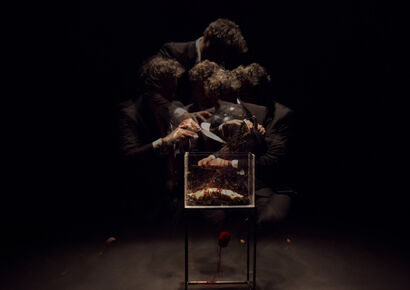
Each sculpture is constructed as a semi-enclosed container, pierced by slits. These openings become visual and mental access points, inviting the viewer to peer, to search, to glimpse a hidden world.The movement around the work is not only physical but emotional: it is a curiosity turned ritual. The experience of the work is not frontal, but lateral, fragmentary, intimate. The viewer must move around it, lean in, seek with their gaze.In this perceptive ritual, I rediscover and renew the gestures of my earlier performances (Ritual 01, Ritual 02), where the body was symbolically buried, exploring memory as a process of collective burial.
Material, waste, and poetic responsibility
The exclusive use of discarded materials—damaged marble, recovered industrial components, metallic stitching—is both a poetic and political choice. By rejecting the idea of perfection, I make imperfection the place of truth.My practice approaches an intimate reinterpretation of Arte Povera, where essentiality becomes language and the gesture becomes a bearer of memory.Particularly, references to Claudio Parmiggiani’s practice emerge in the use of voids, traces, dust, absence as a living presence. But here, stratification is not only conceptual—it is also physical: made of marks, seams, transparencies, and engravings.
Technique and process
From a technical perspective, each piece originates from a complex, layered process: selecting and cutting recycled marble, preparing the surface with cyanotype, writing with egg tempera, solar exposure, final washing to reveal the marks.To this are added the hand-stitched seams—precise, visible, affective—and the carved slits placed in specific points to guide light and vision.The work is both manual and ritual, but fused with sculptural awareness that blends tradition with experimentation. The final object is simultaneously a relic, an altar, a perceptual instrument.