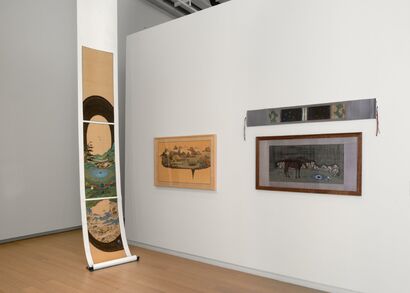
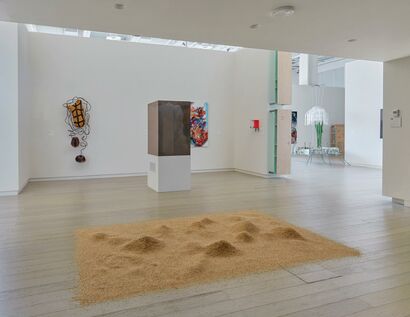
Twins, Twilight, and Apple Tree is a solo exhibition built upon the later Wittgenstein’s notion of language games. Rather than relying on fixed definitions, the work explores how meaning emerges through practice: how a signifier acquires meaning within specific contexts. The exhibition stages situations in which these contexts are unstable or shifting, inviting viewers to engage with objects and symbols whose meanings are neither fixed nor entirely open. The installations become structures in which meaning must be actively constructed.
For example, “An Apple Is Falling, Don’t Know What It Is Going to Hit” may refer to someone’s childhood memories, the recurrent of memories before death, a symbol of science, religion, technological advancement, remarks on color, language, causality, time, etc. If we combine “White Butterfly on the Wooden Cradle”, and, “Waiting, For the next Storm to Come”, it could become a story that relates to the butterfly effect, or pose the question of what we know and what we don’t know.
“Rain, Snow and Pine Tree” uses rain and snow as materials; “Once, There was a Drop of Blood” uses blood as material; “Two Names Inexplicably Flashes Through the Mind of Someone Who is About to Look Up at the Sky” contains two black squares instead of one...The relationship between paintings and titles can be seen as one of the three ways to interpret the show- It could also be perceived purely sensorily or conceptually.
The central installation poses questions about knowledge of regions that are causally disconnected from us. The audience is confronted with a choice of which color of roses will stem from the future. If they choose to believe in red roses, nothing will happen. But if they choose to believe in white roses, there will be another version of themselves in a parallel universe making an opposite decision. However, whichever choice they make will not change the fact of whether there is a parallel universe in which they are making an opposite decision.