During the entirety of our days and lives we are surrounded by messages that spread to us invitations to be positive, wealthy, and happy, in pragmatic, abstract and rhetoric ways together. “Don’t give up!”, “Stay positive!”, “Be yourself!”, are only a few of the always active notifications that dictate us how to behave. The purpose of reaching happiness – socially, economically, psychologically – is not an invention of our age. In his The Happiness Industry (2015), William Davies underline how the measurement of people happiness is an old affair that begin to evolve in a certain way since the Enlightenment period. The increasing of motivational manual-book and catchy encouragement phrases based on self esteem are nowadays permeating the mediascape and mediasphere, with social media that drive the head of the wagon.
As the Slovenian philosopher Slavoj Žižek put it, following Jacques Lacan’s statements, Jouir is the old new black. “Enjoy!” is the invisibile code that composes (and encode) every small icon on our screens. There’s a new kind of social and professional needs: flexibility, adaptation, capacity to mix up worktime and free time. But this never-ending request of wellness (and fitness) and positivity has its other side of the coin, translated in disturb like ADHD, burnout syndrome, depression, various types of anxieties. Is it possibile to search out traces of this paradigm and tendency into the virtual worlds with which we please ourselves in several ways? How the inhabitants of this lands are designed to keep up with their pre-compiled work? Are they happy to stay here/there? How their happiness and positivity are represented, if they are? In his Burnout Society (2020) Byung-Chul Han write that we are no longer in a punitive society but in a performance one. A society that constantly ask for our display of performance. As a medium based, in its commercial forms, on performance acts, videogame is well suitable for the task of investigating the visual representation of these problematics.
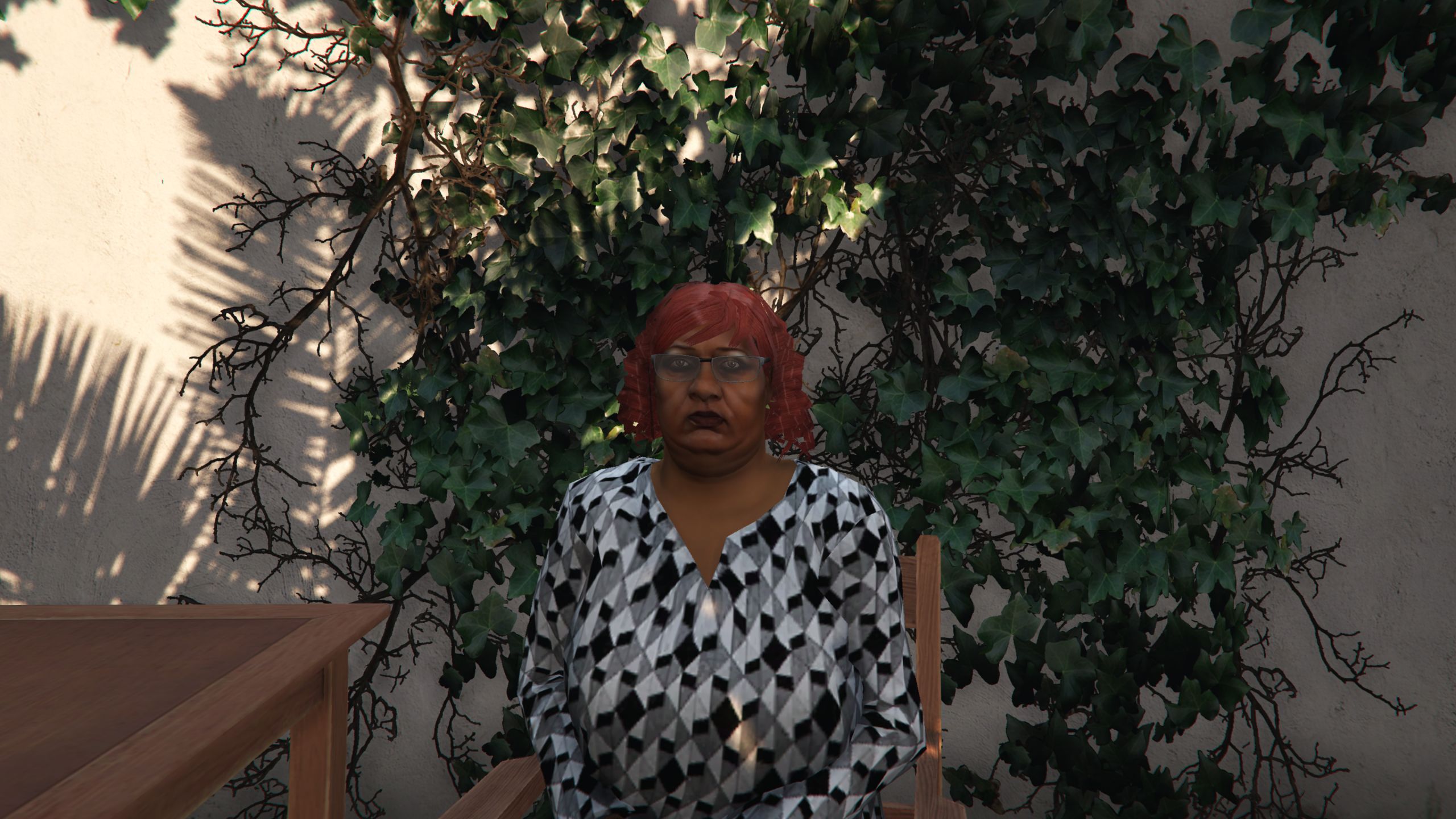
Inspired by the work of Byung-Chul Han and the photographic work The Americans by Robert Frank, I walked far and wide through the map of the videogame Grand Theft Auto V (2013) to photograph the representation of population within it. The result was a display of a generally depressed-expression upon the face of every inhabitant. None of them had the slightest hint of happiness, but a residual and visceral unsatisfaction. As a virtual reconstruction – it’s not important in this case if for a simulative or a sarcastic intent – San Andreas is a paradigmatic container of the disease that afflict the “real” population. Representation upon representation upon representation. I’ve documented my wandering with 200 screenshot-portraits of San Andreas people.
The main work consists in 20 portraits printed on photographic paper.