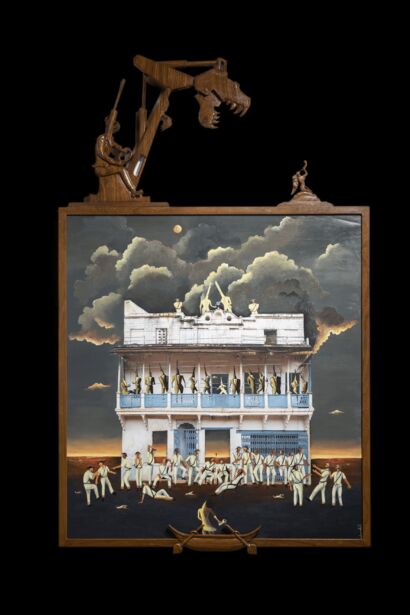
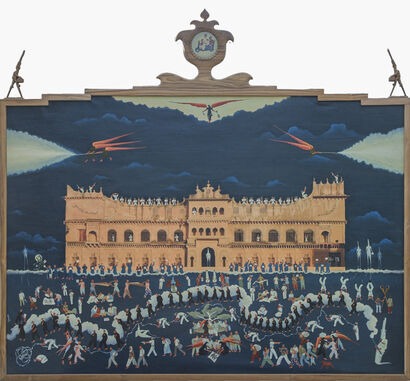
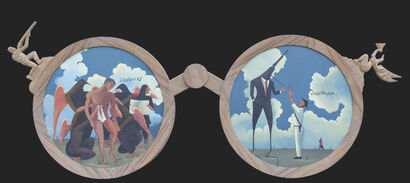
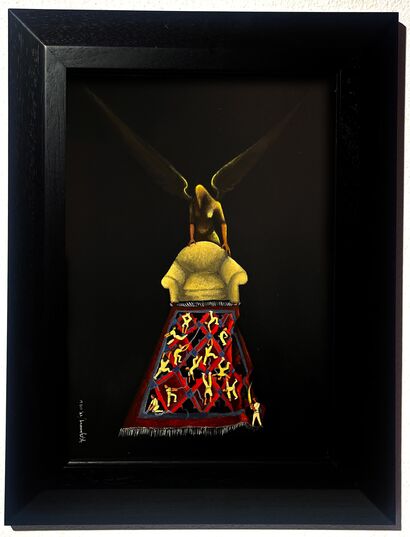
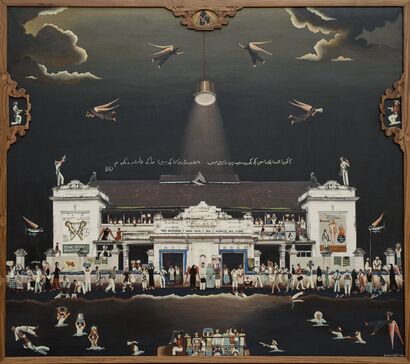
Hostile Witness is about silenced narratives. It explores the lasting phenomenon of mute spectatorship and its normalization through extreme violence. It is a series of paintings on digital prints of fragile architectural sites that are mostly unlisted monuments in the six major metros of India, which mostly will be allowed to fall to ruins and razed. The paintings shift focus through the loss of sites to the phenomenon of allowed erasures borne by the untold testimonies of the past and the present inhabitants of the sites and the city. The testimonies that they share openly, as well as anonymously, are brought on record, juxtaposed with the grand historical narrative.
This project draws from the story of Zagh-e-zaman, the crow woman of the world, and Jehel, the tyrant power grabber who captures the world through evoking the fear of the monster.
Zagh-e-zaman triggers active interaction and keeps the conversation alive in the world, or the zaman, to slay Jehel’s monster. Zagh and Jehel merge in the community when the conversation is most open. They both rise to prominence when the talk becomes one- sided. Zagh is constantly at war with Jehel and its forces mainly the Mohtasibs, or the shooting recruits, the Mukhbirs or the surveillance drones with bombs, and the Lobhis, or the greedy men who control the wealth. The Pesh Rau are Zagh’s silenced friends. They bear witness to the past and the future. They tell zagh about the plans of Jehel.
Jehel has shut down many a conversations in maghreb (west) and mashriq (east). Zagh has to restart them, and start the new ones.
These characters with their symbolic attributes, manifest themselves in the real sites and the real stories of six cities of Delhi, Mumbai, Lucknow, Varanasi, Kolkata and Bhopal. The stories have been spoken by the characters themselves. The characters have been depicted at their respective sites of the stories.
Baaraan Ijlal listened to peoples testimonies and anecdotes between 2014 to 2019 around specific sites of Bhopal, Delhi, Kolkata, Lucknow, Mumbai and Varanasi and painted those narratives onto the canvases.
Each painting is accompanied by notes from her diary.
Chowringhee, Calcutta/Kolkata
'I run a dala (pavement stall) on Chowringhe's foot, not just any other foot, where the goras (British) walked, where the revolutionaries fought, which saw bloody massacres during partition, I saw the Lenin statue being installed as a young man. I participated in every protest that promised me dignity. I'm still running. But I'm not dead. I'm still protesting. Is that not a big deal?
What is Chowringhe without me. Ami i Chowringhe (I am only Chowringhe)'