The
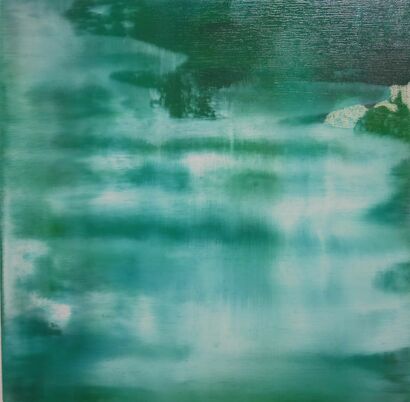
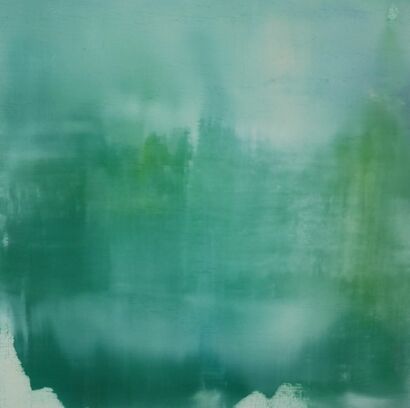
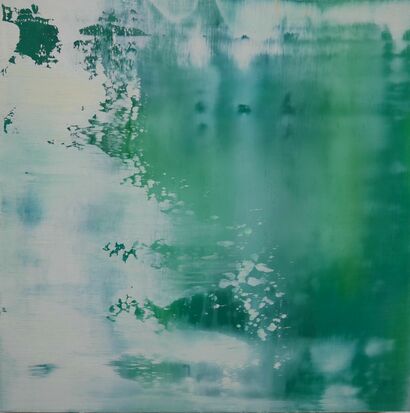
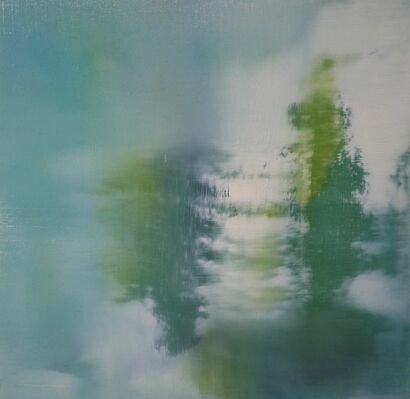
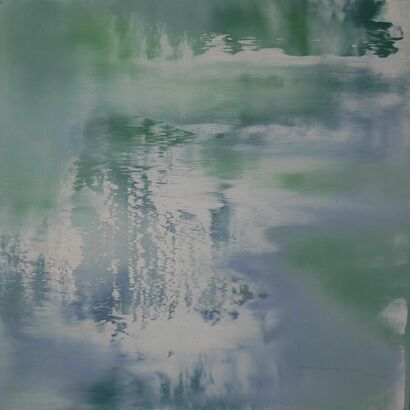
painting 'Hiraeth 16' is part of a larger series of paintings, with
the same name. The word Hiraeth, taken from Welsh, is described as;
“a homesickness or the pining for a home, a person, a figure, or a
national history that may never have actually existed. To feel
hiraeth is to experience a deep sense of incompleteness
tinged with longing.” *
'Hiraeth
16' is an abstract landscape
created from memory and reality, from imagination and longing. The
painting itself was built up with many layers. Each layer informs or
contrasts the next till the painting becomes whole. As the layers
interact and shape one another the paintings become watery and out of
focus . Just like in a dream like state or in a faded memory one can
become lost in the colours as they merge together. 'Hiraeth 16' is to
be read like a poem, not as a fact.
The
series 'Hireath' explores how we define the 'self' in relation to the
concept of home. Research into these concepts is informed by the work
of both artists and philosophers. Art movements such as the Romantics
landscape tradition, Abstract Expressionism and even the Light ad
Space art movement have all helped shape this research. The 'Hireath'
series has also take influence from the writing of philosophers on
the subject of phenomenology and ontology. In his book 'The poetics
of space' Gaston Bachelard wrote: “We comfort
ourselves by reliving memories of protection. Something closed must
retain our memories, while leaving them their original value as
images. Memories of the outside world will never have the same
tonality as those of home and, by recalling these memories, we add to
our store of dreams; we are never real historians, but always near
poets, and our emotion is perhaps nothing but an expression of a
poetry that was lost.”
Rooted
in experience and history, the 'Hireath' paintings are a response to
the diaspora of families and peoples. People move from their home for
many reasons, for want or necessity. This collective trauma can be
traced back through generations. There are now, due to geopolitical
and environmental reasons, so many who are cut off from where they
were born, from families and from cultures. These people exist in a
state of incompleteness, They reside in a fluid place where self and
home ebbs and flows between the past and present, in the empty space
of longing.
The
work 'Hireath 16' plays with the idea of a formless and flowing self.
It is a painting of the abstract space where self and home intertwine
and give meaning to one another. When the self and home
are separated one can be left with
a homesickness for a place that no longer aligns with ones memories.
The ideas of self and home can be understood through the influences
that ancestry, environment, memory and a sense of belonging have on
these two concepts, and how the self and home not only interact but
also build and define each other. 'Hireath 16' is the imagined
landscape between these two realities, between past and present,
between self and home.
*(Smith
College: Kahn Liberal Arts Institute)