My work is an
exploration into how we define the 'self' in relation to the concept
of home. What is self? What is home? And how do they interact?
A definition of self is
complicated. The self could be
defined by stating what it is not; I am not another person; I
am not the chair I am sitting on but this does not define what it is.
The self could be defined by stating what it is in this moment; I
love green; I remember that holiday; but all of this can change, our
tastes change and memories can skew or fade. The self is an
individual with their own subjective consciousness. However neither
ones consciousness, nor ones self, remains static. The childhood self
is not the same as the adult self. The awake self is not the same as
the asleep self. The self is constantly changing.
Home is a little easier
to define, though still has more than one definition. The immediate
definition is that it is the place in which one lives, or where one
is cared for. However home can also be defined as the place where one
was born, or it could be defined as a group of people or a certain
place where one feels they belong. It could be all of these
definitions, or it might be that someone feels homeless despite
having a place to live.
Looking into how we
define ourselves throughout our constant changing states, with a
reference point of place or home, brings into question how these
concepts come together and influence each other. As both home and
self can be complicated to define the notion of ancestry,
environment, belonging, and the interaction between ones self and the
space that surrounds it are concepts that are also explored.
As I delve into these
concepts, informed by the writing of Edmund Husserl, Martin Heidegger
and Maurice Merleau Ponty on phenomenology and ontology, I find there
is a fluidity between the self and home, between ones ancestry and
the environment, and it becomes difficult to separate the self as a
single entity. I am what I take in. I am a part of what surrounds me,
and it is me. We share the air we breath and the water we drink. We
swap ideas. We take our food from the same earth. Like ripples or
waves in water, one formless giant moving thing. We are ephemeral and
eternal. “Every atom you possess has almost certainly passed
through several stars and been parts of millions of organisms on its
way to becoming you.” (Bill Bryson, A short history of nearly
everything). When I look for a defined self, I find that we have form
but that it is not static. A definition may be accurate at a
particular point in time, but not the next. All of which leaves me
asking where lies the boundary between what is self and what is
other?
I have been researching
this subject with a focus on how the self can be defined in terms of
ancestral culture and birth place and what that might mean for white
Australians. The concept of home becomes even more complicated when
looked at through the lens of postcolonial theory. I know that I am
not alone when I say that, living on land that was stolen from the
nations first people (not to mention the treatment they have
suffered) does not felt right; even if it is my birth place and where
I grew up. It calls into question for me the horrendous acts of
colonialism. A system that profited only the white colonialists, a
system that the white population is still profiting from today. I am
a white woman who was born and grew up in Australia (on Ngunnawal,
Yuin and Gadigal
country). My mothers
family immigrated to Australia from England in the early 60's, when
she was 6 years old, and my father's family have been in Australia
for 5 generations. How do we define our selves with cultural identity
and our home land, what is our home land?
I now live in France
and have so for 9 years. I left Australia feeling it was not right
for me and have taken residence in the native country of my partner,
where we have built a family and laid down roots. While I have a
great love for France and cherish the roots that I have laid here, I
still do not have a strong sense of belonging. The gap that was
created in the diaspora of my ancestors has left in me what the Welsh
call Heirth, “a homesickness or nostalgia, an earnest longing or
desire, or a sense of regret. The feeling of longing for a home that
never was.” (wikipedia) These inquiries into cultural heritage and
'home' land have become particularly important to me during the past
year, firstly, because of the fires that spread across much of
Australia at the beginning of 2020 burning so much of the land where
I was born and grew up; then also (if not more so), because of the
travel restrictions due to covid 19, causing me to be cut off from my
birth place and family for several years.
All of these questions
and concepts lead me to the ocean.
I paint the
international waters that my family crossed to reach Australia, I
paint the beaches I grew up on that feel like home, I paint the seas
of my ancestors who were sailors in Wales, Ireland and England. I
paint the abstract memories and stories that connect these places and
I paint my self as the sea that flows between all this.
I paint the waves from
memory to connect to my memory of the place. Capturing a wave, a
movement that is formed from formlessness.
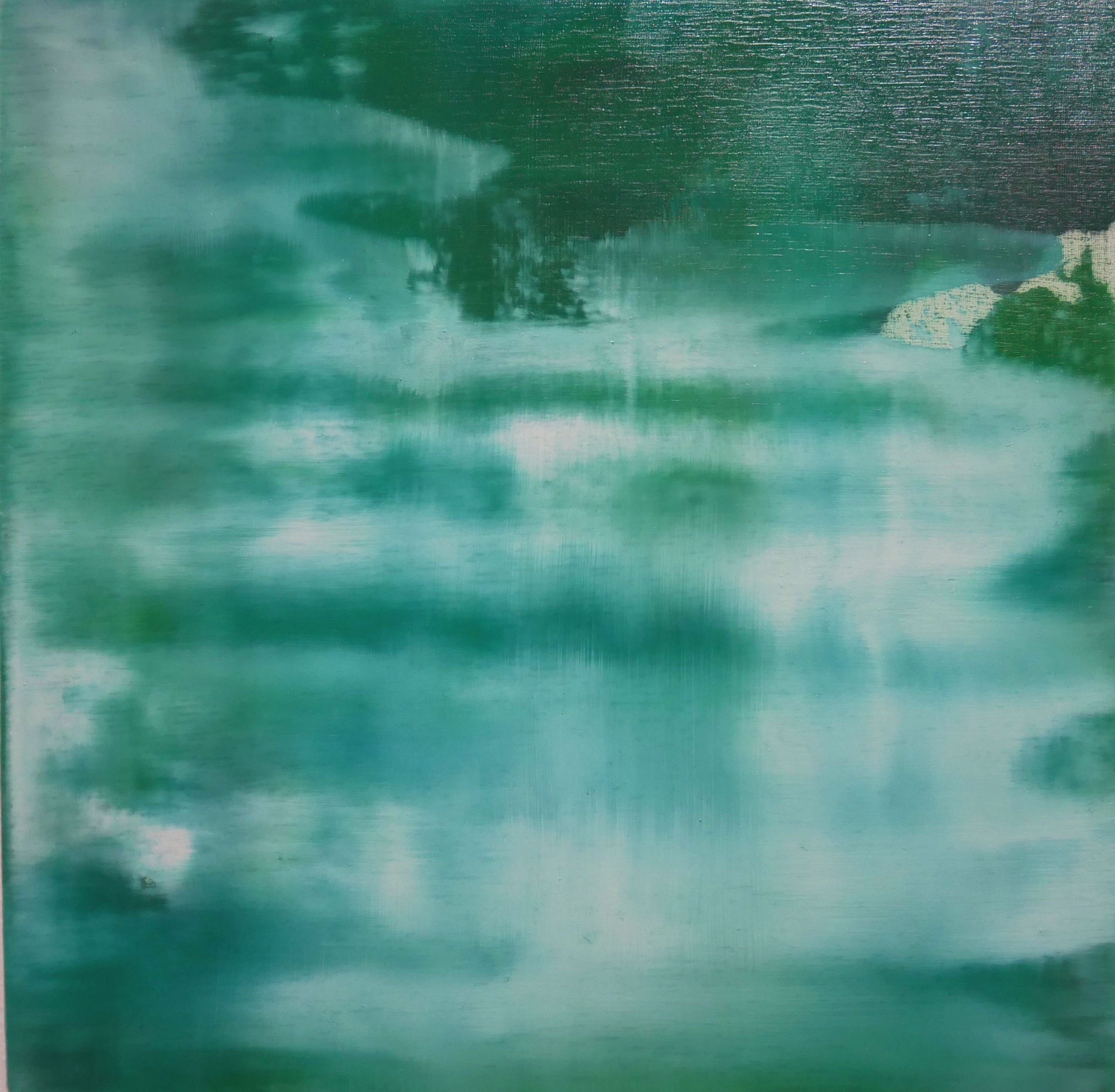
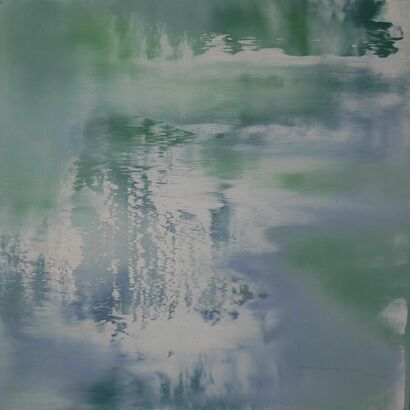
My abstract works are
more an act of placing myself in the present moment. I feel like I am
obliterated and remade again in each moment. These hand sized works
are a pure reaction to now. They are watery and out of focus, the way
our world appears through mist.
These ocean and
abstract paintings play with the idea of a formless and flowing self.
A self and home which intertwine and give meaning to one another. A
non-solid somethingness.