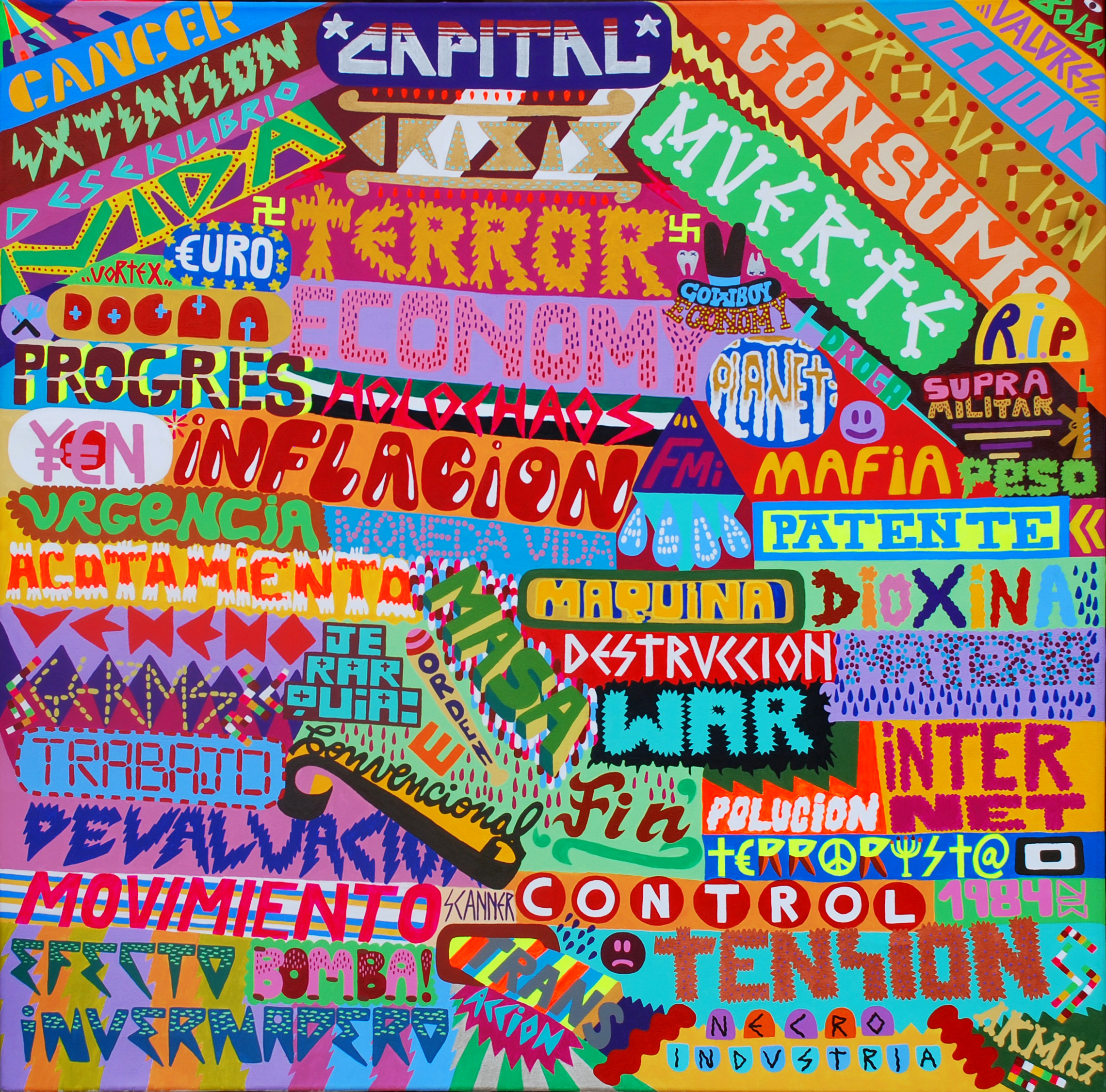
“El colapso del capitalismo” by Zosen Bandido can be understood as a visual reflection on the exhaustion of contemporary economic and social systems through the language of painting. Rooted in graffiti culture, punk aesthetics, and collective street experience, the work transforms the canvas into a symbolic battlefield where excess, consumerism, and social fragmentation collide.
The painting proposes a chaotic and vibrant universe in which the structures of capitalism appear unstable, saturated, and on the verge of disintegration. Through an explosion of color, fragmented forms, organic shapes, and interconnected symbols, Zosen constructs a visual metaphor for a society overwhelmed by hyperproduction, accelerated consumption, and the loss of human connection. The composition reflects the tension between attraction and collapse: seductive visual elements coexist with images of disorder, mutation, and imbalance.
Influenced by the visual energy of graffiti and the spontaneity of urban intervention, the work rejects rigid hierarchies and embraces improvisation, movement, and visual noise as a form of resistance. The painting does not present collapse as a singular catastrophic event, but rather as an ongoing process embedded in everyday life — visible in environmental deterioration, information overload, emotional alienation, and the commodification of culture itself.
At the same time, the piece contains an undercurrent of transformation and regeneration. Within the apparent chaos, new visual ecosystems emerge, suggesting the possibility of alternative forms of coexistence beyond dominant economic structures. Zosen’s imagery often combines dystopian tension with playful and psychedelic elements, creating a complex emotional landscape where critique and hope coexist.
“The Collapse of Capitalism” also reflects the artist’s long-standing connection to public space and collective expression. Coming from graffiti culture — historically linked to marginal voices, self-organization, and resistance to institutional control — the work can be interpreted as both a social critique and an affirmation of independent creativity. In this sense, the painting becomes not only a representation of systemic collapse, but also a celebration of the capacity of urban culture to imagine new forms of freedom, community, and visual language.