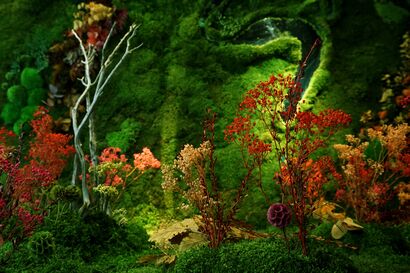
Claudia Bonollo is a multifaceted artist. She has always integrated her artistic crossing with research on the creative act in all its possible forms, with a particular emphasis on colour and eco-friendly,biophilic and empathetic design, alternating between research and experimentation in every field of creation.
Founder and Director of Atelier Cromatico, International platform for art, culture, and colour research, experimental laboratory for conscious chromatic exploration.
ATELIER CROMATICO - International platform for art, culture, and colour research. Experimental lab for conscious chromatic exploration
Founded in Madrid in 2002 and led by the Italian architect and artist Claudia Bonollo, Atelier Cromatico is an international organization and a cultural platform for research. It is a hub for cultural promotion, originally established as a laboratory for a new artistic landscape, and has since become a meeting point for artists, architects, art lovers, historians, philosophers, psychologists, and more. The activities are structured around workshops, themed dinners, creative nights, masterclasses, seminars, exhibitions, video screenings, all guided by two fundamental criteria: the belief that research should be approached in a multidisciplinary manner, and the importance placed on experimentation, transforming each participant in our initiatives—whether a teacher, student, or visitor—into a researcher. It has also become a private gallery that opened its doors during the Madrid Design Festival, Open House and Cruza Carabanchel (2024). Sophia Cromatica represents our latest venture in colour research https://creativeinsomnia.wordpress.com/sophia-cromatica/
EDUCATION:
She graduated from the UIA (International University of Art) and the Faculty of Architecture in Venice (IUAV). She pursued further studies in London (Bartlett School of Architecture) and Madrid (ETSAM), where she currently resides.
Her years in Venice were fundamental in developing her sensitivity to colour and its nuances. During long walks observing the transformations of the sky and the play of light on the lagoon, she began creating her first artist's books, square paintings, and paper mosaics that could be endlessly composed, eventually leading to her first chromatic collections.
During this time, she began studying the I Ching, a book that would accompany her throughout her life, and painted her version of the Book of Changes. This meticulous work took three years to complete.
KESA - THE RITUAL
She was invited to create a Kesa (the sacred 11-striped robe), reinterpreting an ancient 9th-century Buddhist ritual reserved for nuns. In addition to the robe, which represents the most important relic in Buddhism, she also painted zagu, small meditation rugs used in ceremonies in the Dojo. These painted canvases were made from humble and recycled materials. Once treated, they were assembled and sewn together with silk thread by 161 monks from around the world. Her personal vision of the Kesa, initially controversial (as no artist who wasn't a religious figure had ever painted a sacred robe), was firmly supported by Master Taiten of the Zen Buddhist Monastery in Fidenza (Italy).
THE IMAGINARY IS NOT A PHANTASY
She became interested in the imaginary of architecture and its most visionary aspects, both in painting and cinema. This led to the creation of her first meta-projects (architectures born from a colour or that change its colour depending on the time of day) and "thought- architectures" metaphysical sculptures that could be held in one hand. These experiments evolved into "total installations," the initial exploration of sensitive spaces, combining art, architecture, and various elements (real and virtual) such as light, lightboxes, projections, etc., in a sensual staging that stimulates the senses and explores deep emotions. As Corbin says in one of his famous conferences in Eranos - If we want to recover the imaginal, we must first recover its organ, the heart, and elaborate its philosophy -.
This imaginative rhetorical capacity is the himma that Henri Corbin speaks of in his study of Ibn ‘Arabi. “That power of the heart is what specifically designates the word himma, a word whose content perhaps better clarifies the Greek term enthimesys which means the action of meditating, imagining, projecting, ardently desiring: in other words, of having (something) present in the thymos, which is vital force, soul, heart, intention, thought, desire (ci, p. 224)
EDUCATIONAL EXPLORATIONS AND RESEARCH
She organized a colour theory course at the School of Architecture at the S.E.K. University in Segovia and a series of monochromatic seminars (White, Black, Red, Blue, Green, Gold, Yellow, etc.) with a special focus on the symbolism and applications of colour in various social contexts throughout history. "COLOUR IN ART," an exploration of colour in art, was presented for the first time at the Institute of Culture in Madrid.
All these experiments converged in the creation of the imaginary world of Tangramville, the city for playing. The models, sculptures, and sets created were exhibited in various venues. With the collaboration of STUDIO DAP in Milan, critic Marco Brizzi in Florence, and COAC (Colegio de Arquitectos de Cataluña), the first interactive CD-ROM for teaching architecture to children was created, sponsored by the European Community (EUROPA 2000: "Architecture and New Technologies").
Over the years, she has conducted many Master Classes on colour. The latests took place at La Casa Encendida during the seminar CREAtividad y SOStenibilidad (Creativity and Sustainability) in Madrid Madrid Design Festival and Cruza Carabanchel 2024.
BEAUTY IS ITSELF A CURE– LE CORPS IMAGINÉ (2001-2024).
The experimentation that Claudia Bonollo has been carrying out since 2001 is a multidisciplinary research that has as its object the human body. Selected by CAMERA (Conseil Audiovisuel Mondial pour les Ètudes et les Réalisations sur l'Art), CNRS France, and CICT/Unesco, she began a series of multidisciplinary investigations into the cell in Paris in 2001, collaborating with professionals from various disciplines (doctors, neurobiologists, psychoanalysts, psychologists, theologians, and shamans).
These studies converged into two research projects: "BEAUTY IS ITSELF A CURE" and later "LE CORPS IMAGINÉ" (the imagined body), which continues to this day. The project, now in its 23nd year, has evolved, spread throughout the human body, and extended to the study of emotions, biological happiness, and the body's reactions in a state of well-being.
She created her first cellular space (an installation with music and projections) in the courtyard of the Italian Institute of Culture in Madrid, sponsored by the Italian Embassy. In August 2021, she presented her latest research, and her recent creations on colour and light (THE IMAGINED BODY 2001-2021) were exhibited and published in the Proceedings of the international conference AIC2021 organized by the International Colour Association (AIC) in collaboration with the International Light Association (ILA).
As a contemporary Orpheus, she transforms cellular images which are processed through sound, colour and movement, transforming them into maps of consciousness, inner landscapes (metabiology, maps of being where the body is represented as a sacred icon), sensitive spaces (virtual environments, projections for experimenting with various levels of well-being), chromatic narratives, short films, experimental colour visualization techniques.
Over time, this multidisciplinary project has been transformed into a therapy as art. An emotional research based on colour. An initially unconscious re-enactment of the cathartic power of art in its broadest sense which also includes music and dramaturgy. The ancient Greek tragedies, as Aristotle explains in his Poetics, help, through the strong events represented, the viewer to detach himself from the passions and daily problems. The same power is attributed to music. In this wake, psychoanalysis, from Freud and Jung onwards, attributes to artistic catharsis the power to free the individual from the emotions that oppress him and to recover vital energies. In ancient Asian, Mesopotamian and Egyptian civilizations, colours were attributed healing power. And even the Greeks, inserting themselves in this millenary tradition, used colors to cure diseases. It is no coincidence that Bonollo’s experimentation is called, at first, “BEAUTY, IS ITSELF A CURE». The diseased cell, now transformed into a healthy coloured cell, infuses new vital energy to the observer. A research that soon extends to the whole human body, to the study of emotions and happiness. The transfigured cells are transformed into a multidisciplinary project with multiple applications, which borders other disciplines that would seem totally foreign to it: medicine, biology, neurobiology, psychology, psychoanalysis and theology. “IL CORPO IMMAGINATO» (THE IMAGINED BODY) is now a multimedia project that offers a different point of view on the human body, illness and healing. From this research, installations are born in which art and architecture are combined, real and virtual elements, spaces in which the senses are stimulated by a perception of well-being. Transfigured cells become a map of consciousness, biological landscapes are cartographies of being in which the body is represented as a sacred object, sensitive spaces are virtual surroundings, projections where various levels of well-being are experienced, chromatic narratives are short films or experimental techniques of visualization with colours.
ORGANIC MULTISENSORY INSTALLATIONS/SENSITIVE SPACES AND SUSTAINIBILITY
In 2023, she began an intense collaboration with Miguel Valdián, Director of Biomima (http://biomima.org) for the Bionic Festival 2023 (https://claudiabonolloatelier.files.wordpress.com/2023/03/bionic-festival-dance-with-trees-2048x1242-1.jpg). She created sensitive and sensory scenographies with organic elements for the dancers in this collective who improvise dances with plants and mobile settings, where nature accompanies meticulous colour research.
The first performance was created during the Madrid Design Festival, followed by experiments with the group of dancers collaborating with Bob Wilson on Turandot at the Royal Theatre. The latest experiments were presented in the last edition of the Bionic Festival 2023 (November).
The Route of the Forsaken, my last research (the Imagined Body), will be a PERMANENT EXHIBITION at The Ilustre Colegio de Los Médicos De Madrid (The Illustrious College Of Physicians Of Madrid). It will be available for viewing with guided tours during the open days (26-29 September 2024) as part of Open House Madrid, which has selected this artistic project.
SHORT FILMS
Since 2014, she has been part of the VIDEOS DE AUTOR platform, and one of her video art works, LA CELLULA CITTÀ, was selected for the exhibition "SOCIAL CITIES – Self Identities, Common Places" and the programming of the international performance and independent cinema festival during the 71st Venice Film Festival.
At the very beginning, the scientific iconography was a source of inspiration. Some short films in which some scientific starting images are elaborated, have been awarded in the Ciencia y Sugerencia competition. The interest in the mystical visions of Sufism and in the studies on active imagination illustrated masterfully by Henri Corbin, push me to attend the intense annual meetings of philosophy, theology and history of religions, organized by the CEEC (Centro Estudios Espirituales Comparados) in Arena de San Pedro (Ávila-Spain). “My transdisciplinary research awakens the interest of professionals from distinct fields of knowledge: art and architecture critics, philosophers, anthropologists, doctors and therapists, biologists, neurobiologists, mathematicians, physicists, psychoanalysts, psychologists and theologians. The artistic and theoretical work is selected by Bernard Légé, Head of Research Projects and Delegate of "Image et Science", an emanation of the CNRS in Paris and by the Director of CAMERA (Conseil Mondial pour les Études et le Réalisations sur l'Art) in France.
In 2008, it was my first cellular space (sensitive installation with projections and music) in the Patio of the Italian Cultural Institute in Madrid with the Patronage of the Embassy of Italy followed by several meta-projects and installations in Paris, Cantercel (France), Madrid (Múseo La Neomudejar) and Fundación NMAC – Montenmedio Arte Contemporáneo.
“I have created a series of installations, cellular spaces where a more active participation of the spectator is intended, which is an integral part of the work.” (Claudia Bonollo).
QUANTIC ROOMS
But colour interests Claudia Bonollo not only as a cultural tool but also, and above all, as an element that generates inner transformations. Chromatic worlds encompass material, spatial, emotional, spiritual potentialities and become authentic places of the soul, metonymic paradigms between internal and external vision. "Total installations" are sensitive spaces where colour becomes an experience.
In this direction, different versions of contemplative rooms were developed, the most elaborate being "LA HABITACIÓN CUÁNTICA," exhibited in the "CRUCES Y CONVERGENCIAS" show at the La Neomudejar Museum in Madrid. She also organized a roundtable discussion with psychologists, artists, and architects analyzing various aspects of these rooms. The experimentation continues with ephemeral installations in Cantercel (Montpellier, France) and the Fundación NMAC for contemporary art (Vejer de la Frontera, Spain), always accompanied by conferences and workshops.
"The chromatic rooms and holograms are the result of a creative process inspired by an incessant exploration of emotions: colour-emotion transforms into space, into a path constructed from within. It is both narration and contemplation, a tool to project and build our meta-interior architectures. These visions arise and are transformed by colour, and colour, in turn, stimulates and transforms us. The chromatic space are a mythic narrative, a sensitive and vibrant environment, virtual and ever-changing, as fleeting as thoughts... Chromatic narratives become personal and intimate landscapes, mirrors of the soul, essential cartographies of our consciousness."
A new quantum room with new content will be featured, along with a new container, in the upcoming edition of the Proyector Festival (www.proyector.info Madrid 11-22 September 2024).