"If during a concert, we had the opportunity to observe the air, vibrating simultaneously influenced by voices and instruments, we would be amazed to see colors organizing and moving within it." – Athanasius Kircher
Between the visible and the invisible, between the audible and the inaudible, between the readable and the unreadable, between light and darkness, between body and soul, between day and night, between man and God, there is resonance, and this resonance is our threshold to the infinite." - John O'Donohue (1956-2008)
EPHEMERAL INSTALLATION / SENSITIVE SPACES
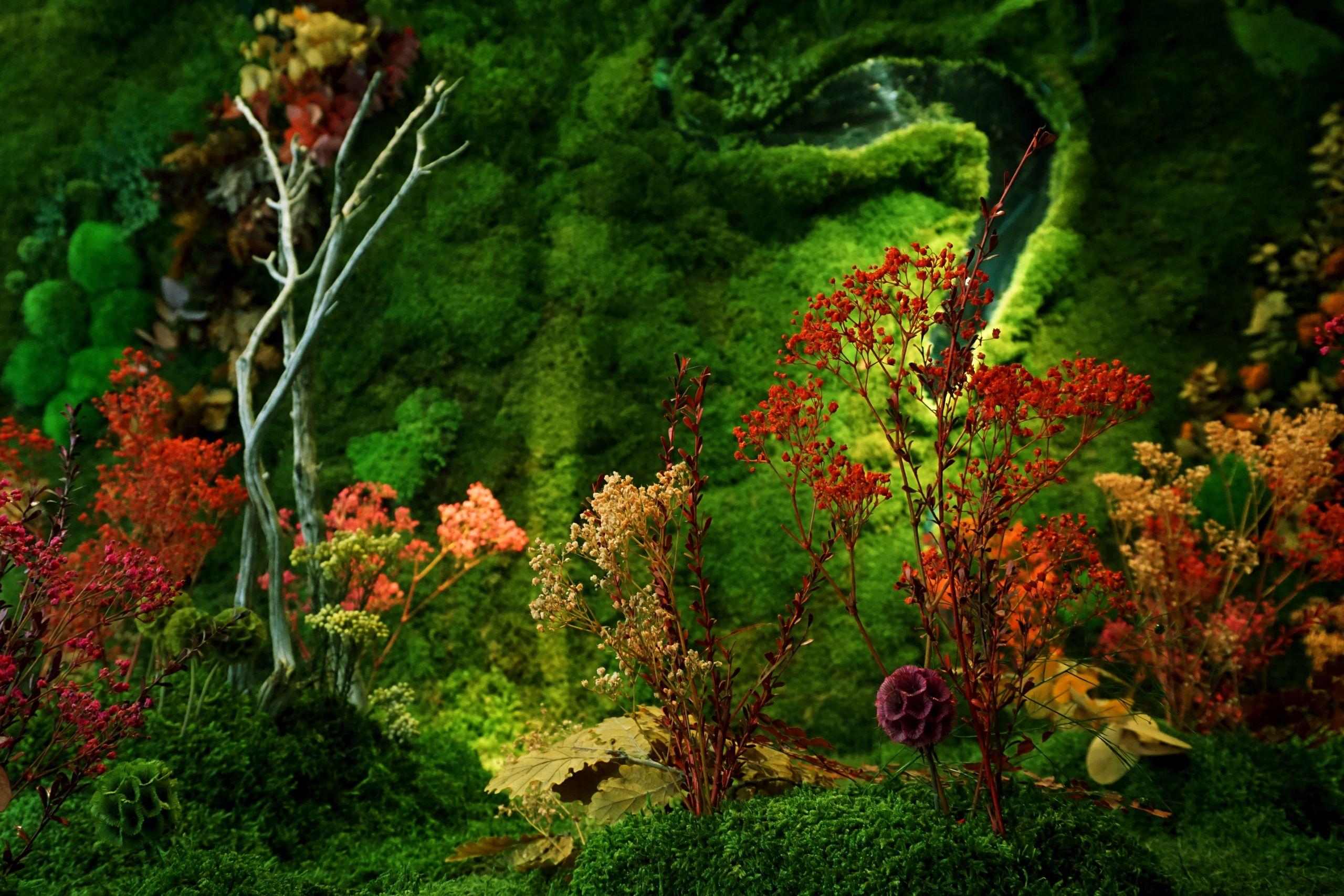
One of my sensitive installations, CHROMATIC SYMPHONY, is a dreamlike garden that explores the multiple relationships between COLOUR and SOUND.
There is a symmetrical relationship between sound and colour. The music that moves towards colour can be found in the artistic work of Skrjabin, Schoenberg, and Stravinsky, just as the relationship between painting and music permeates the entire body of work of Kandinsky and Klee.
These two phenomena share a common origin and present surprising affinities. Both phenomena are governed by the same laws and metrics. Both originate from vibrations that propagate through space in a wave-like motion, and their measurement, although expressed differently, has the same basis. The ratio of frequencies in the spectrum is exactly the same as musical frequencies.
When we talk about this relationship, we inadvertently refer to a phenomenon called SYNTHESIA: from the Greek "συν-αισθάνομαι," meaning "perceiving together."
I have always been concerned with colour: all my gardens and organic installations spring from a deep interest in colour and its invisible harmonies. My compositions take into account not only the colours of moss, leaves, and flowers but also how they interact with the environment and space. They are empathic spaces in which colour becomes emotion at first and then, experience.
Our aim is thus the creation of "dreamlike landscapes” that change and redefine spaces. They are continuous metamorphoses that disorientate and amaze, immersing the onlooker in magical atmospheres that explore hidden dimensions behind the green surfaces and the colour of leaves and flowers.
By means of a set of wavy mirrors representing out of scale sinuous rivers, placed and partly hidden among the garden’s sensual reliefs, what is “elsewhere” is included inside the installation. Unobtrusive lightning with little spots set in place in strategic areas, helps to define a landscape in becoming. All the mirrored images change continuously revealing amazing and ephemeral visual alchemies. Hide sensors with the smell of grass and rain powerfully activate our memories
One can perceive thus a hidden reality, shaped by a kaleidoscopic mosaic of transitory appearances and then, once that the image and landscape have been altered, the audience will see a reproduction with a new and different visual dimension. The public contemplates views of a mirrored world, like Alice in Wonderland, the protagohnist of Lewis Carroll's famous story, living in another reality through the looking glass. As the plan behind our gardens actually is to show not only what is visible but to refer to and show what is not yet.
When I think of Claudia, the first thing that comes to mind is her overflowing femininity, that passionate, moody femininity, with the colors and the animality in the gaze of Slavic women.
And I believe it's precisely that femininity, the earth-mother creator, the mandalic center of the world, that produces her art. An alchemical art, made of essences, enamels, lucidity, scents, and secret recipes that produce unique, ephemeral colors, where invisible traces suddenly appear through the use of UV lights, like mysterious languages or messages, precious colors and essences to the eye.
I believe Claudia's experience as an architect is expressed in the proportions of her works, in their modularity and repetitions, in the balanced juxtaposition of forms and materials, with the constant intention of infusing hypnotic and spiritual strength into her works. But also in the careful relationship her works have with the spaces that surround them, with the container, with the narrative obtained in the installations and exhibitions, and finally with the use of light and shadows that create the performative effect of the physical experience, as if a final layer were added to the work, making it complete.
From essences and enamels to the three-dimensional forms of flowers, branches, lichens, and tree essences, the step is short because the search for threedimensionality and unexpected color, for the cryptic yet unified structure of the message, persists and consolidates.
Perhaps a recurring word is "mystery," what we do not see but intuit, what remains hidden and almost appears by enchantment, the world of shadows that supports the chromatic explosion, that makes us feel as if we are in a secret garden in the evening, where plants breathe, and a whole world stirs, hidden, in nocturnal fragrances.
Perhaps that's why each of her works is thaumaturgical and like a mandala draws us in and purifies our fears, our trivialities. It emits vital and positive energy in its silence, like a source of pure water in which we want to quench our thirst every day.
For this reason, I would like to see each of her works fight a daily battle for us humans, in those non-places, in those architectural abominations produced by our way of life, where people suffer the daily eclipse of beauty—offices, hospitals, streets, stations, airports, schools, gardens, parks, and churches. I find her art to be more public than private, which is why one of her mandalas is in the center of my studio in Amsterdam and helps us be happy.
Francesco Messori, CEO D/Dock, Amsterdam