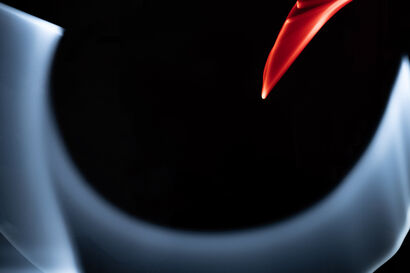
In 2010, he started taking photographs using a technique called "Light Painting". Photos created in this way are like paintings, except that instead of a canvas, a camera matrix is used. Painters use paint, photographers use colored light, and paint brushes are replaced by various light sources. This allows for a completely new approach to photography and its possibilities. However, the creation process itself is the same, so this technique combines the world of painting with the light of photography.
Biographic note
Robert Kuźmicz has been involved in photography for 25 years, but in 2010 he learned the Light Painting technique. He noticed that this technique offers many more possibilities than contemporary photography, developing it towards classical painting. In the years of 2015-2017, he presented his works at competitions and exhibitions. The culmination of this stage was the presentation of the works in the "Art Corner" organized at the Photo/Video fair in Łódź. There, he could present the possibilities of this technique to a wide audience during a specially organized interview. His portfolio works were also presented and discussed by an art critic. The next stage was theoretical education. Robert is a graduate of many courses in photography, art history, interpretation of works of art and printing of Fine-Art prints.
In August 2023, he decided to return to competitions and exhibitions, with a specially prepared collection of photos. The style of his works was quickly appreciated by many art galleries and organizers of Fine-Art group exhibitions. The works were shown at the FotoArtFestival in Bielsko-Biała, along with the presentation of the works in the form of a film at the "Diaz 2024" Festival, then qualified for group exhibitions of galleries in London, Venice, Paris, Stockholm, Poznań and Gibraltar.
In February 2024, the Royal Blue Art Gallery in Stockholm awarded him the Grand Prix and honored him with the main prize in the form of a solo exhibition. In the same period, the prestigious Annual Photography Awards 2024 competition recognized his works "Dead Forest" in the Fine Art category.
Manifesto of “Conscious Abstraction”
The symbol grounding problem, formulated in the late 20th century, revolutionised the academic landscape, particularly in the theory of artificial intelligence, linguistics, and philosophy of mind. However, this discovery had little to no impact on art.
Since the advent of abstraction, a dominant theory held that artists create images subconsciously using internal symbols—a "language of thought," a concept developed by American philosopher and cognitive scientist Jerry Fodor. In the late 20th century, cognitive scientist Steven Harnad published *The Symbol Grounding Problem*, in which he challenged this theory. Harnad proposed that a system based solely on syntactic representations—analysing sentence structure, word relations, and grammatical functions—cannot constitute a true language unless its symbols are grounded in the external world, i.e., connected to real objects and events.
The concept of abstraction in art should undergo the same kind of revolution that occurred in science: it must be grounded in universally comprehensible symbols to become a fully-fledged language.
The guiding idea behind my work is that the discoveries of cognitive science have enabled artists to become writers who compose with abstract symbols—symbols that serve as vehicles for philosophical inquiry. In this framework, form and colour are tasked with defending the abstract concept being brought into question. Only when these roles are clearly defined can we fully engage in a meaningful discussion of composition, form, and the conceptual content of the artwork
“One cannot learn Chinese using only a Chinese dictionary.” In art, likewise, every abstract concept requires a description through symbols—not merely a monolingual dictionary composed of formal rules and visual theories. When artists rely solely on compositional principles, they produce something akin to visual exercises—pleasing in appearance, yet lacking in discernible meaning. In my view, this purely aesthetic approach to abstract art stems from a cognitive illusion to which many artists have succumbed.
Consider the following example: when standing on flat terrain and looking around, the Earth appears flat—we cannot perceive its curvature. It is only through science that humanity has come to understand the Earth as a sphere. Similarly, if we wish to uncover the truth within abstract art, we must view it from a broader, more informed perspective. I believe that if art teaches us how to look, science enables us to see.
An essential aspect of the language of abstraction is its freedom from ornamental and incidental forms which, being devoid of meaning, offer only the illusion of intentional creation. Every artistic expression must convey content and be grounded in established symbols. Just as language is governed by the rules of grammar and stylistics, adherence to the principles of visual theory serves to reveal the conceptual clarity and substantive coherence of a work. It is important to remember, however, that while both grammatical rules and art theory create order and harmony, they do not themselves carry meaning—just as random words do not constitute a coherent sentence. Only through the integration of established symbolic systems with the theoretical foundations of art do we arrive at a fully developed language of abstraction.
The concept of a language that unites established symbols with the theory of art also addresses the problem of imitation. This issue did not arise primarily from a desire to replicate the style or artistic values of earlier creators, but rather from the limited number of variables available to support the creation of new visions. Theories of composition and colour imposed a range of constraints on the artist, restricting the variability of the emerging work. As a result, artists began to experiment primarily within the domain of painting technique. The concept of a language of abstraction fundamentally transforms this approach.
Let us consider the description of an abstract concept such as “love.” The literary topos of love in poetry will differ from the account offered by a biologist or a psychologist, although each of these fields is likely to share certain underlying patterns. Similarly, the understanding of any abstract concept is shaped by an individual’s education and worldview. A single, seemingly simple word—such as “love”—is grounded in multiple symbolic systems across various contexts, yet these symbols often remain universally comprehensible. “Beauty” serves as a common denominator among these diverse symbols; just as harmony and order in grammar and stylistics represent the beauty of language, so too does theory in art reflect beauty within the visual domain. For abstraction to function as a language, it must embody beauty; by analogy, the symbols embedded within this language must also possess aesthetic coherence. Such an artistic language—operating through abstract forms—relies on this integration of symbolic clarity and aesthetic order.
The purpose of creating wisdom narratives—whether religious or mythological—was to seek answers to the question of why the world around us is the way it is. Art served as a mediator, translating complex concepts for a largely illiterate society. Science poses similar questions about the existence of the world; however, it is fundamentally based on the empirical method rather than on beliefs and dogmas. I believe that only the combination of the scientific method and the language of abstraction enables a more comprehensive account of concepts that transcend our current understanding of the world.
For can one truly depict "eternity" through figurative art? I am convinced that it is not possible, as it would entail rendering a physical representation of something inherently intangible. In contrast, the essence of eternity can be readily grasped through abstract concepts: *eternity* as "an infinite period." This is a notion that defies expression through the language of science or figurative art, and thus becomes a challenge for the expansive descriptive apparatus of abstract art, supported by philosophy and symbolism. Abstraction offers a means of approaching concepts that elude strict definitions by interpreting them through the language of art, thereby aiding in their comprehension. The use of established symbolic problems within abstraction holds the potential to reveal a new realm of artistic inquiry. In doing so, art acquires a renewed purpose: to forge a philosophical approach to conceptual thought, to facilitate its understanding, and to uncover its interrelations with other abstract ideas
Abstract art, to me, represents the spiritual dimension of science, complementing it effectively by encouraging unconventional thinking and fostering discourse in which the artist assumes the role of a researcher, guide, or even prophet. The artist’s task is not to merely depict how a chosen subject affects themselves personally, but rather to indicate the potential threats and implications that the concept under consideration carries within the realms of philosophy and science. I would replace the egocentric “I” of the artist with the perspective of “we,” so that the artist’s voice becomes representative of multiple communities. The artist’s egocentrism—for example, the justification “for me, the color yellow symbolizes...” as a rationale for its use in a composition—is an adversary to the language of abstraction, as it prioritizes aesthetics—form—over content, which, in my view, inevitably leads to errors in meaning.
For example, in a work on the subject of “Teleportation,” the challenge is not to comprehend what it would feel like to see one’s own duplicate (which can be experienced by looking in a mirror), but rather the moral implications of the concept: is teleportation equivalent to murder, given that it entails the destruction of the original and the creation of an imperfect copy? At the moment when a person is converted into information during transfer, is it permissible to modify them, for instance, to eliminate illness? This, in turn, opens a discussion on the notions of freedom and societal control.
In summary, an abstract work presents a creative challenge because it requires the rejection of one’s own belief system and the articulation of a coherent philosophical framework and substantive rationale that justify the composition—this very form. In my artistic practice, light functions as this “double agent.” To define light, we must consider its material properties (science) alongside its wave-like, immaterial aspects (abstract art). I invite discussion on why light is the medium of art’s future