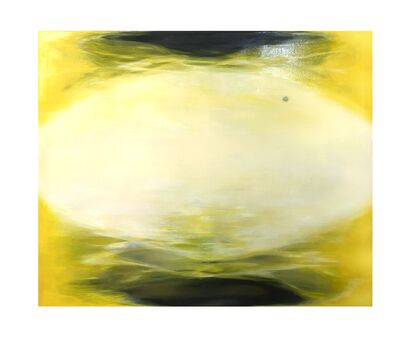
Jingyan Ding
(b. 1999, Jilin, China) currently lives and works in Milan. Jingyan Ding’s work
revolves around the impermanence of the self, exploring its transformations
and infinite possibilities within the realm of rupa (phenomena, the world of
forms). Influenced by Taoist and Buddhist thought, he engages with the
notions of the intangible, the formless,impermanence, and infinity, while
posing a fundamental question: Are we living in a virtual world? In his work,
the tensions between reality and virtuality, first-person and third-person
perspectives,as well as seeing and being seen, intertwine to construct a
profound exploration of identity,existence, and perception.
For him, the self arises from non-self. In an increasingly virtualized era,
individuality flows like data, constantly shifting in a state of non-linearity and
uncertainty. Through painting, he constructs a fluid visual language that
immerses the viewer in the experience of a drifting, ever-changing self.
Yellow becomes a metaphor for this cycle, symbolizing the continuous
transformation within the world of rupa, as well as the emergence and
dissolution of consciousness in an eternal state of uncertainty.
The Tao Te Ching states that the essence of the universe is change and
impermanence. Laozi believed that“ nothingness ” is both wisdom and
the origin of the world. Through his work, Jingyan Ding seeks to provoke
reflection on the relationship between emptiness and substance, reality
and simulation, creating a perceptual threshold that feels both familiar and
unfamiliar—ultimately leading viewers to question whether the world they
inhabit is truly real.