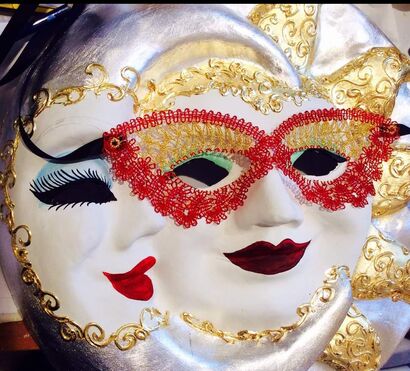
Master Craftsman DPM Laboratory Venice island of Burano D'Ercole Paolo Massimo The ancient Buranello bobbin technique BuraNo It is estimated that the first Burano laces date back to 1500. At the time, the making of lace was carried out only...
Read MoreMaster Craftsman DPM Laboratory Venice island of Burano D'Ercole Paolo Massimo
The ancient Buranello bobbin technique BuraNo It is estimated that the first Burano laces date back to 1500. At the time, the making of lace was carried out only and exclusively in stately homes, using needle and thread without the support of a canvas. The "point in the air" was created and geometric designs, flowers, animals, scrolls and racemes were made with it.
In the seventeenth century embroidering began using the "rosette stitch", worked with small flying flowers and the "counter-cut point", used for the large scrolls and the relief in the contour strings. These embroideries soon spread to Europe and the Burano lace makers were even called to France, to start an important creation of lace.
Embroidery is undoubtedly a technique of great effect to decorate the fabric (or other materials that support it), making it rich and precious, even more so if there is a graphic project that anticipates the subject, the colors, the subsequent positioning once completed. . Or:
Punching is thus defined as the work of a person who digitized a design transforming it into embroidery
Whether done by hand or machine, embroidery cannot ignore a design created by man
We live in a technological era that allows us to imagine anything, starting from a virtual reality that transforms and becomes a three-dimensional object (from the monitor display to the object that is touched and perceived in its shape).
Speaking of embroidery, one aspect of my business, the process of transforming from a vector or bitmap design to an embroidery file that can be executed by a machine, requires a considerable effort.
An embroidered decoration is the interpretation of a drawing made on paper (or digitized) and subsequently elaborated by needle and thread that pierce the fabric and passing from one side to the other, in a myriad of points (of different sizes) and which according to the orientation given to them creates chiaroscuro and three-dimensional effects in the light.
The technique is the same, both for hand-made embroidery and for machine-made embroidery.
In the first case, it is the man who manages the needle and the thread tension, following a pattern or design transferred to the weft of a framed fabric.
In the second case it is the software of an embroidery machine, equipped with a needle, thread and the ability to read a special file, which together with the Artisan Puncher and Embroidery machine perform the same operations in a Fusion of History, Art, Culture, Design, which determine the object
The Man / Craftsman / ARTIST :
Paolo Massimo D'Ercole