
14 Apr Interviewing Yanhua Feng | A curatorial note by Giulia Colletti
Hi Yanhua! Nice to meet you. Starting with the basic, tell us a little about the life journey you’ve gone through that have inevitably led you to be the artist you are today.
I didn’t arrive at painting in a straight line.
My early training was in design, in a system that emphasized clarity, structure, and control. You learn how to make an image work, how to make it legible, how to bring it to a point of resolution. That way of thinking stays. I still feel when something holds, when a composition stabilizes. But over time, that clarity started to feel too complete.
Design tends to move toward resolution. It closes. And I found myself becoming more interested in what resists that closure, in what remains slightly unstable, slightly unresolved. So painting wasn’t a rejection of that background. It was a way of working against it from within.
I’m still attentive to structure, but I’m more interested in the moment it begins to loosen. When an image still holds, but only just. When it starts to slip without fully collapsing. And I think that comes from understanding how images are constructed to be legible in the first place.
Because once you see that, you also see how quickly they close.
A finished image carries a kind of authority. It suggests that something has already been settled. I’m not particularly interested in that kind of resolution. So the work often begins at that point, where something appears complete, and then is opened again.
Not to dismantle it entirely, but to keep it from settling too quickly.
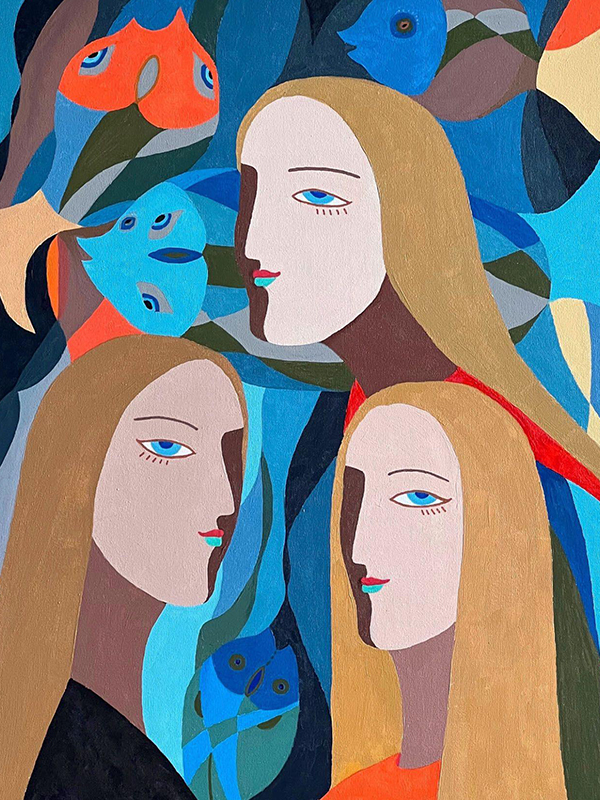
Parallel World Series 2, 2023
Acrylic on Canvas
Your abstract style is distinctive in your paintings. What drew you to this artistic movement? Is it complete freedom, or is there something else that guides you?
I don’t really think of abstraction as a kind of freedom, at least not in the way it’s often described. If anything, it feels more like a condition.
I think we’re living in a moment where images arrive already resolved. They’re highly produced, highly legible, and very quickly consumed, and I started to feel that kind of clarity was becoming a problem. It leaves very little space for uncertainty, or for anything that doesn’t immediately make sense.
So abstraction, for me, isn’t about escaping meaning, it’s about delaying it. I’m interested in what happens when recognition doesn’t arrive all at once, when an image doesn’t fully settle. When you’re not entirely sure what you’re looking at, but you stay with it anyway.
That moment of hesitation feels important as it interrupts that immediate consumption we’re so used to: it’s not a stylistic choice, it’s structural. We already experience the world in fragments, but those fragments are constantly reorganized into something that appears coherent, often too coherent. In that sense, abstraction isn’t really about openness in a romantic way, it’s more about resisting closure, and allowing the image to stay in motion a little longer.
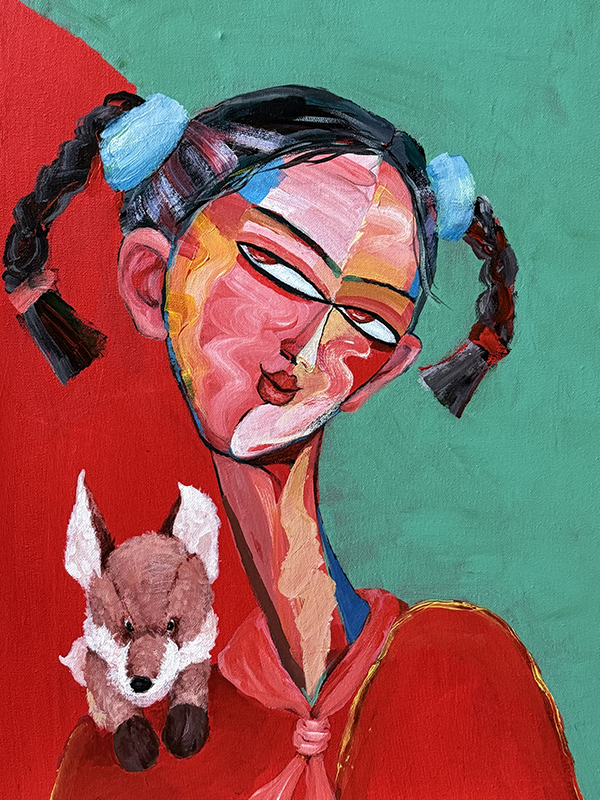
Daughter II, 2023
Acrylic on canvas
Your artistic output encompasses an abstract style – your favorite – but also a more
illustrative one, as in the “Daughter” series. In these works, you explore an
emotional connection and overcoming boundaries. Can you tell us more about this?
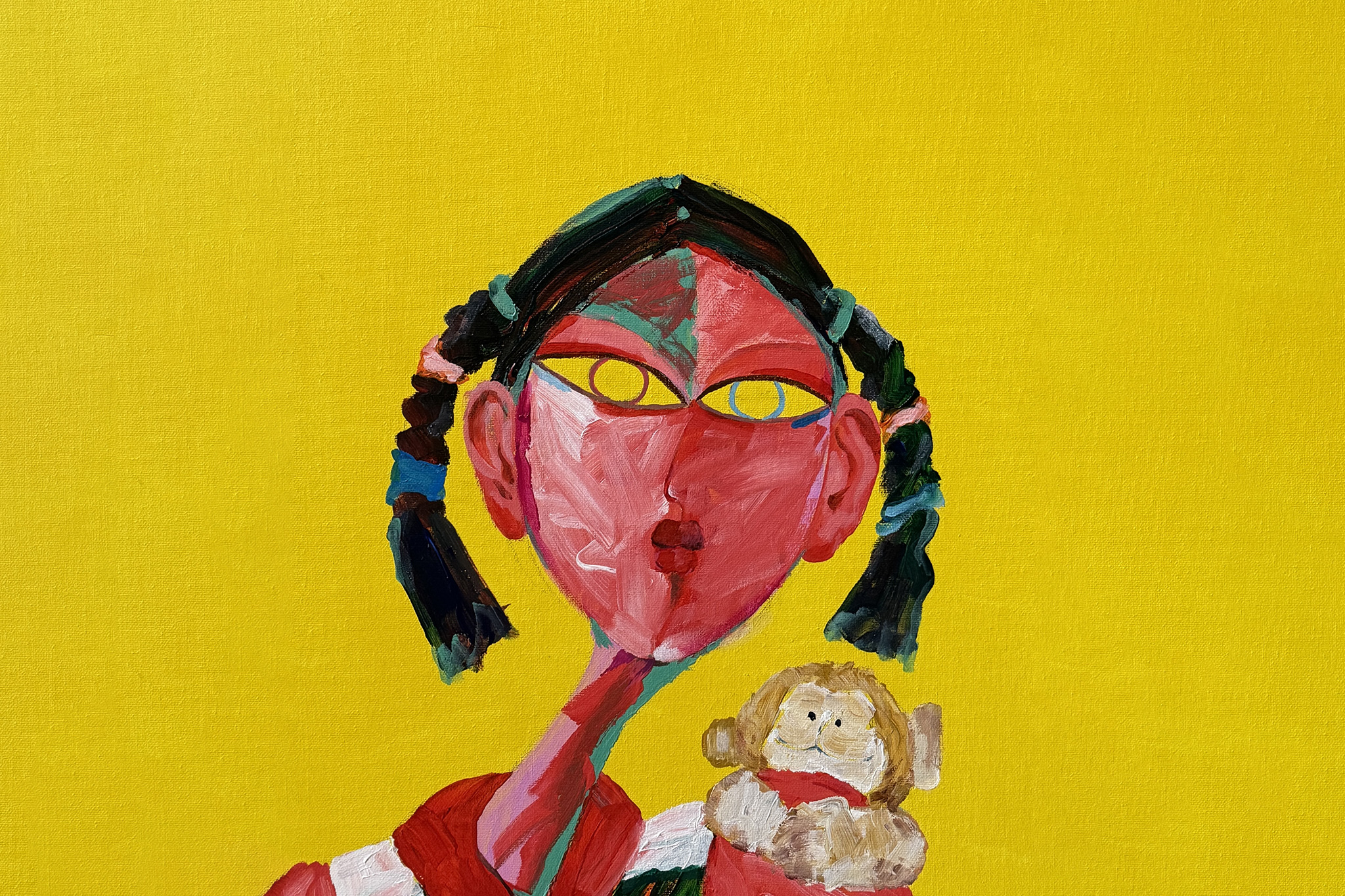
The “Daughter” series comes from a very personal place, but I’ve never approached it as a straightforward narrative. There is, of course, a relationship at its core. She is one of the closest presences in my life, and I’ve spent a lot of time observing her as she grows. That process, from dependence toward independence, is gradual but visible. You begin to notice small shifts, in how she behaves, how she expresses herself, how she starts to position herself in relation to the world. But I wasn’t interested in documenting that directly. What led me to figuration in this series was a need for specificity. Abstraction can hold a lot, but there are moments where the body becomes necessary, where presence needs to be more concrete. At the same time, I didn’t want the image to become fixed or fully resolved.
She often appears alongside soft toys, plush figures that are familiar and immediately recognizable. They carry a sense of comfort and play, but they are not neutral. I think of them as carriers of shifting traits. A monkey might suggest a kind of openness or playfulness, something light and still forming. A fox begins to introduce something more complex, more self-aware, slightly guarded.
These associations aren’t fixed, but they trace a movement. As she grows, what is projected onto these figures begins to turn back toward her, shaping how she comes to understand herself.
What interests me is the tension between something intimate and something constructed. So the series isn’t about describing her as a fixed subject: it stays close to a process of becoming, without trying to resolve it too quickly, because that process never fully settles.
Let’s talk about the Arte Laguna Prize: you were one of the artists selected in Painting, and your work “Affection No.1,” will be exhibited at the Arsenale Nord in Venice from November 6 to 29, 2026. Congratulations! How did it feel to actually be announced as a finalist?
It’s an honor to be selected as a finalist for the 20th edition of the Arte Laguna Prize, and to be included among such a strong group of artists. To have the work shown at the Arsenale Nord in Venice adds another layer to that experience. It’s a context with its own history and weight, and I’m glad the work can enter into that space. The work selected, Affection No.1, is part of an ongoing series that looks at intimacy, not as something stable, but as something that carries tension. We often think of affection as something soft or reassuring, but I’m more interested in what sits beneath that surface. How closeness can also involve projection, control, even a certain kind of possession. These are not separate from care, but entangled with it.
That’s where fragmentation becomes important. The image doesn’t present the body as a unified whole. It comes apart, re-forms, slips between recognition and abstraction. I’m not trying to describe a relationship in a literal way, but to stay within that unstable space where something is felt before it is fully understood. So the work isn’t about defining intimacy, but about holding it open, allowing it to remain unresolved.
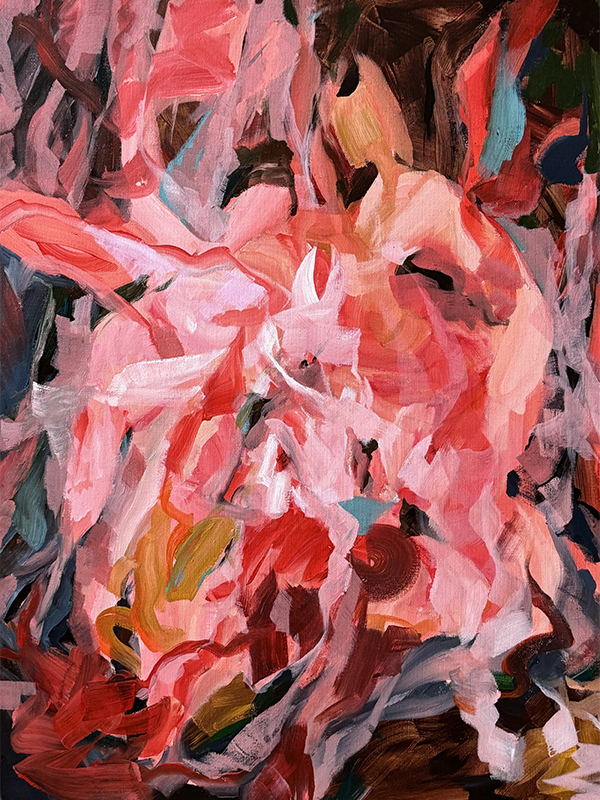
Affection no. 1, 2024
Acrylic on canva
Recent and future projects
Lately, I’ve been working through historical painting, particularly from the Rococo period, not as something to preserve, but as something to enter and unsettle. What draws me to Rococo is its surface, its attention to pleasure, intimacy, and the body, but also the instability that sits just beneath it. It’s a language that appears light, decorative, even effortless, but it’s never entirely neutral. There’s always something excessive, something on the edge of slipping. I think about our current image culture in similar terms. We’re surrounded by images that arrive fully resolved, highly polished, designed for immediate effect. They move quickly, circulate endlessly, and tend to smooth over any friction. In that sense, they begin to resemble a kind of contemporary Rococo, where surface becomes a way of managing or softening what might otherwise feel unstable.
I’m not interested in reproducing that surface. I’m more interested in entering its logic and letting it come apart. Rococo places the body at the center, structured through intimacy and desire. Today, the body is also central, but it is continuously edited, filtered, and re-formed through different systems of circulation. In my work, the body resist that kind of resolution. It remains partial, unstable, sometimes on the verge of disappearing. Going forward, I want to continue working within that tension.
Not toward a fixed language, but within a set of conditions that keep shifting. Each body of work brings its own problems. They don’t resolve. They extend. And that’s where the work continues.
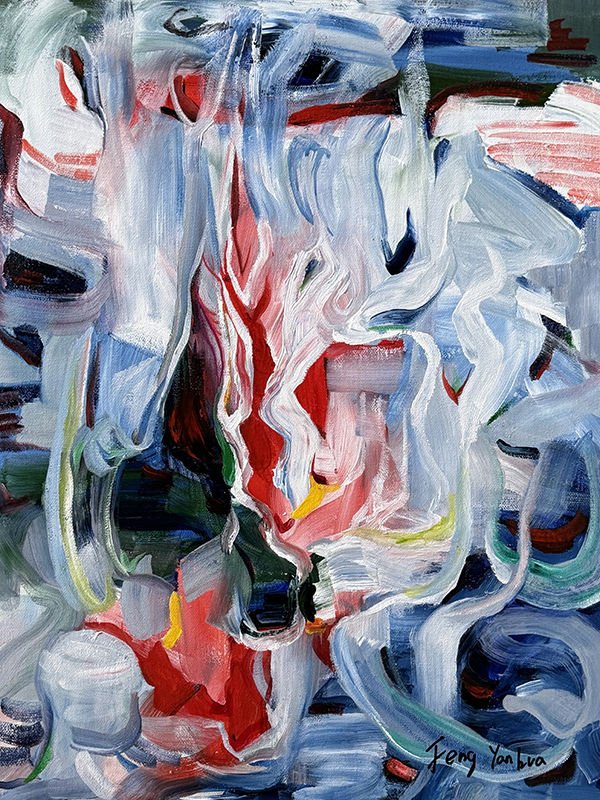
Winter Veins, 2024
Acrylic on canva
Why do you make art?
It doesn’t function as a choice in the usual sense. It’s something I return to because other forms of resolution don’t hold. The work doesn’t begin from answers. It begins from what remains unresolved.
The artist’s work is rooted in how images function today, and in how that function becomes invisible. We’re surrounded by images that arrive complete, seamless, easy to consume. They move quickly, and they close quickly, and the artist is interested in interrupting that closure.
Fragmentation in Feng’s work isn’t a stylistic decision, but it’s structural. We encounter the world in fragments, but those fragments are continuously reassembled into something that appears coherent, often too coherent. That coherence produces a sense of certainty.
By exposing the seams, the artist is trying to reintroduce instability, to allow meaning to remain in flux rather than settle immediately.
These images appear stable, even authoritative, but they are built on specific systems of representation. Yanhua Feng is interested in the points where those systems begin to show, where the image exceeds its own structure.