
25 Mar Interviewing Ashlin McAndrew | Body and Craft
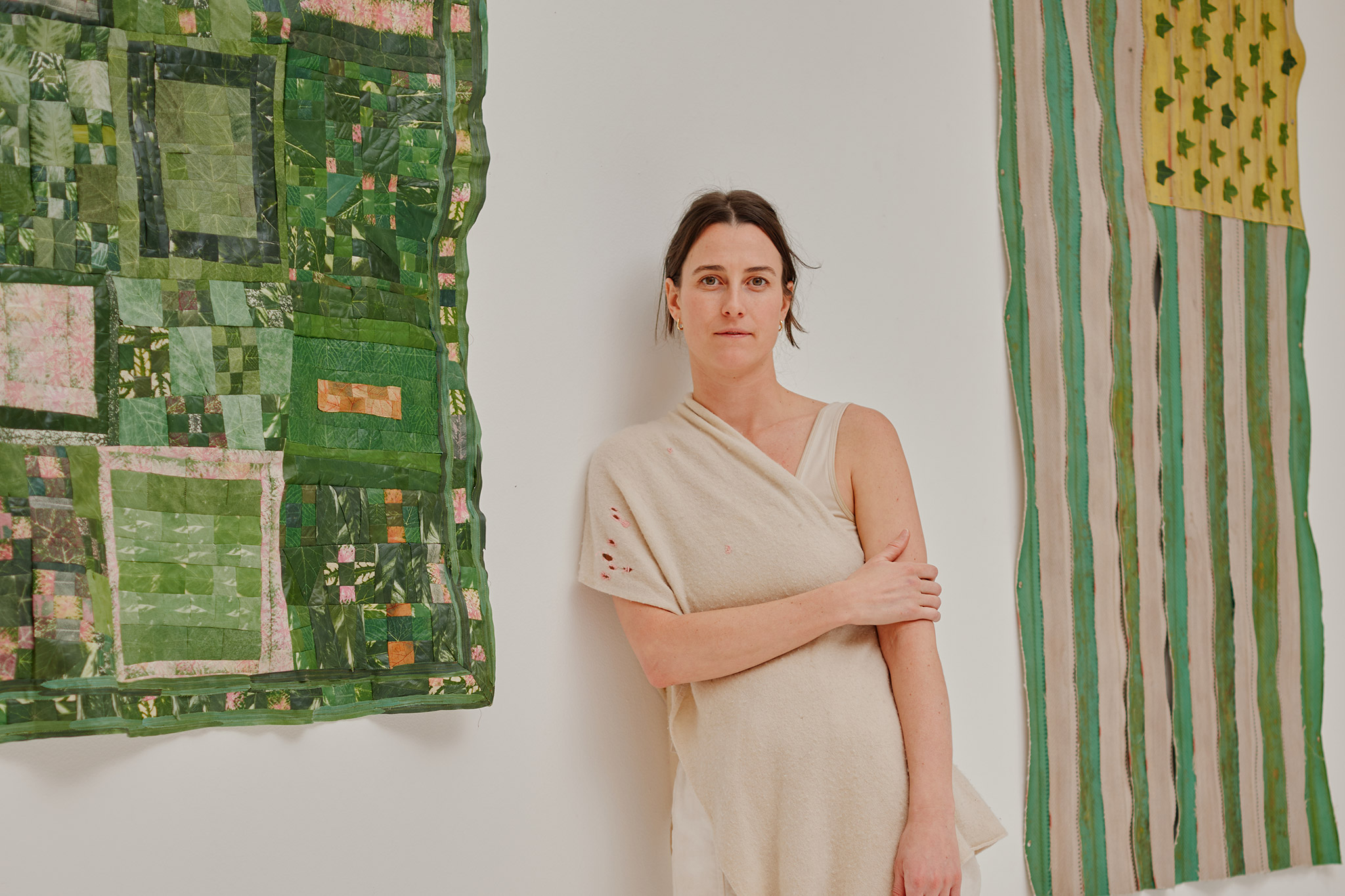
Ashlin McAndrew is an interdisciplinary artist whose practice addresses the profound disconnections of contemporary life—from our bodies, each other, and the earth. By transforming discarded materials like disintegrated clothing and synthetic plants through slow, deliberate hand-stitching and assemblage, she challenges the “disposable culture” of the modern world.
With a background in Material Futures and Somatic Awareness, McAndrew’s work—such as her Post-Colonial Quilt—functions as both an indictment of industrial systems and a pathway toward collective healing. Ultimately, her art reclaims overlooked histories to foster transformative listening and reconnect us with our shared environments and humanity.
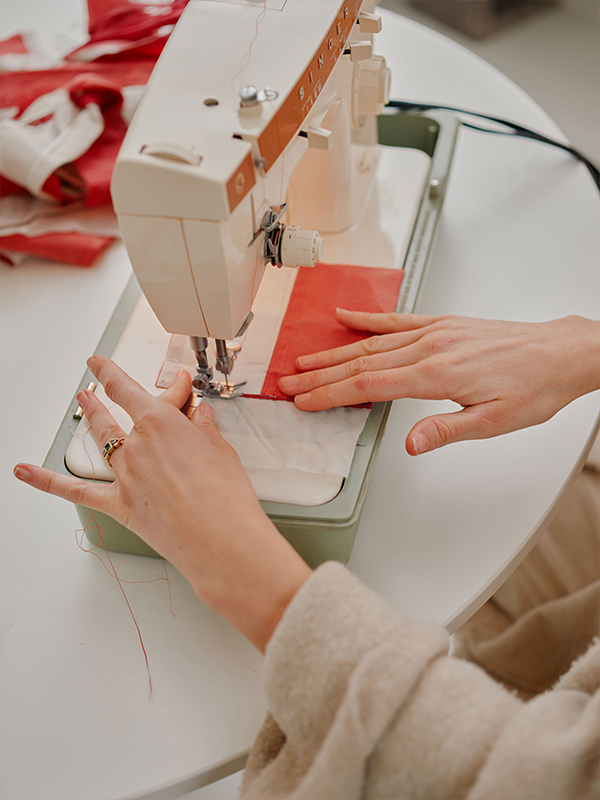
Ashlin McAndrew quilting
Hi Ashlin! It was nice to meet you. Starting with the basics, tell us a little about the life journey you’ve gone through that have inevitably led you to be the artist you are today.
Growing up, I was a very physical and active child — very tactile and kinetic. From a young age, I loved collecting found objects, whether that be used band-aids from the doctor’s office, turning an old deck of cards into jewelry, or foraging certain plants outside. Growing up in suburban New Jersey in the early 2000s, I felt that loving and cherishing mundane, disposable things began to give them meaning. […]
I turned to my art practice as a deeper way to process that life transition. The through line during this time, and in my art practice today, is the body. At the time, I was making work exploring the objectification of bodies in marketing and our own dissociation from our bodies, rather than being able to see them as the incredibly intelligent and powerful vessels that we can express, listen, feel and create through.
My interest in the body and in the material world led me to pursue a career in the fashion industry in my early 20’s. While I was interested in fashion as a medium that addressed issues of identity, embodiment, and our relationship to the natural world, participating in an industry that I saw as part of the problem wasn’t for me. And offices and desks definitely weren’t for me.
Material can become a window into our collective history and collective unconscious. I’m still interested in taking things apart to see them more deeply — and putting them back together in a new way — in order to reveal new and untold stories.
The Body is a central element of your artistic career: it’s implicitly present in every artwork, establishing a relationship between body and materials. How does this concept integrate with your work?
To me, relating to and having a dialogue with materials — and even other humans — is a dialogue my body is engaged in, rather than my intellect. I perceive our bodies to be extremely intelligent, holding ancient wisdom, with a much deeper capacity to perceive, feel, and hold nuanced and varied perspectives.
So many ancient cultures have been rooted in a practice of making and craft. We can’t make things purely with our minds. To me, making and engaging with physical art keeps me rooted in my body and in reality, and connected to the fact that our bodies and the earth are finite. I believe making physical objects is a radical act of embodiment in a hyper-manufactured, disposable world.
At its core, my work is about investigating image versus reality – probing at veneers or performativity to reveal what truly lies underneath. For example, things that are mass-manufactured might look beautiful at first glance, but are designed to break or fall apart.
So, coming back to the body – the body is the way we know and see beyond the veneer. It offers us a kind of contact with the world that does not lie to us. Intellectually, we might be fed all sorts of messaging, propaganda, marketing, but deep down, our body knows what is real. Our body knows what has substance and quality.
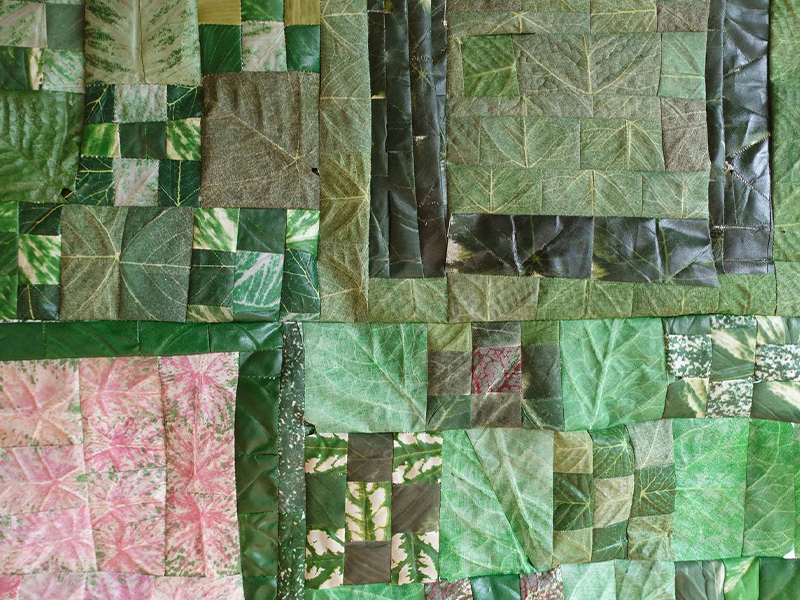
Post-Colonial Quilt, 2024
Discarded plastic plants, cotton thread
Your main technique is embroidery, born from the curiosity that drove you to be the artist you are today, since childhood. How does this technique capture the use of the body?
How did your inclination towards art begin?
To speak to how my inclination towards art began, an early core memory for me is when a nanny of mine gifted my sister and me handmade stuffed animals that she had crafted herself. Even though I was only 3, I had such a deep sense of how special that object was. It felt infused with love and care. From that moment on, I wanted to learn how to sew. And yet, in the world I grew up in, sewing seemed to be a lost art. It wasn’t until I was 27 that a classmate of mine finally taught me how to use a machine.
For me, when I make with my hands, my mind quiets and a deeper wisdom inside emerges. The stillness, the silence, just being with the material teaches me so much. It starts to feel like I’m staring into a crack in the sidewalk for days on end — taking in the hidden lives and worlds of certain objects, and therefore the hidden lives and worlds of our own existence.
Often I’m brought to a place of quite deep emotion, where I feel like I begin to see myself and the world in a much deeper and broader way. This way of making also connects me to a lineage and history of women making — or “women’s work”. The deep insight and embodied understanding that comes from mundane repetition is a very unique state of consciousness, and it makes me wonder about the mysticism and wisdom of women — and the connection between that and the continued relationship, throughout history, of using their hands to make, and experiencing the world through their hands. That state — quiet, present, absorbed — is what I’ve come to understand as the deepest form of attention.
My nanny wasn’t just gifting me a stuffed animal. She was gifting me her time, energy, presence, and intention — within every stitch. I feel that this is what is lacking in the world now. It’s what I hope to offer through my art: perspective, connection and meaning.
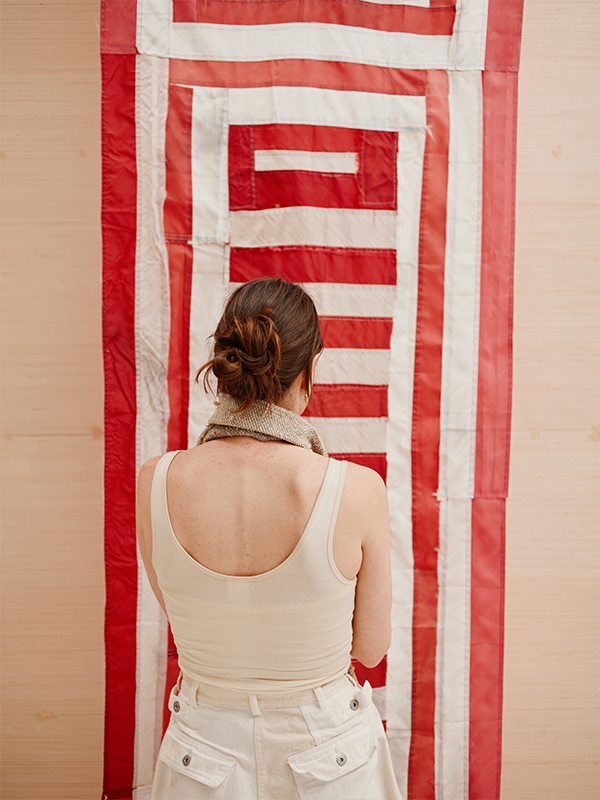
In Divisible, 2025
Discarded American flags
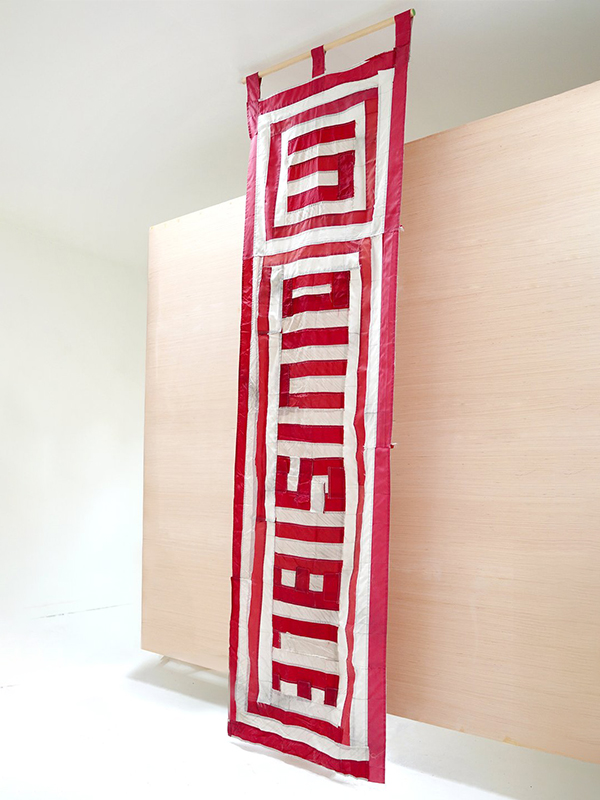
Congratulations again on being selected as a Sculpture Finalist for the 20th edition of the Arte Laguna Prize! Your work “In-divisible” has been selected and will be exhibited at the Arsenale Nord of Venice in 2026. How does it feel to be among the 120 participants? Can you tell us anything about the work we’ll see on display?
Thank you. It is truly such an honor — and such a historic venue, one I have had the privilege of experiencing as a viewer. It is truly a dream to show my work here, and such an honor to be amongst peers who are so dedicated to their art practice. I’m extending them all a heartfelt congratulations, and I look forward to meeting them in November.
A little bit about the work on display:
In the year leading up to making this piece, I had been working with discarded materials from where I live locally — discarded electrical wires, plastic plants, decommissioned fire hoses. Then one day, a friend sent me a free Craigslist listing. Someone who was cleaning out their garage was offering for someone to dispose of their flags, or perhaps use them for an art project. I took them happily, but as always, I didn’t know what they would become.
As I took the leap to start cutting the stripes apart, the word “indivisible” popped into my head. At first, I wasn’t sure it was a real word — it was in my memory from saying the Pledge of Allegiance in school when I was 7. I looked it up and discovered it was, in fact, a real word. More than that, it seemed to capture what the flags were currently wanting to communicate about the moment this country is in.
And yet, to me, this piece isn’t just about the current state of affairs in the U.S. It’s about the fact that this country was built insisting it is “for all,” while its very existence implies erasure — a disconnection from land, culture, tradition, and wisdom. This work holds an inherent grief and hope — a deconstruction of what once was, and a hope for what might lie on the other side of this dissolution.
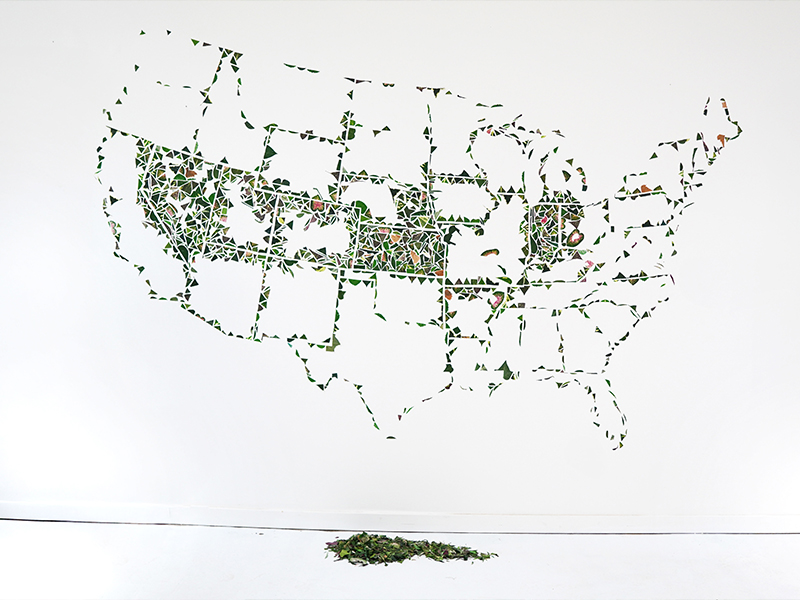
Fragments, 2025
Plastic plant fragments, quilt off-cuts
Thank you for telling us your story! One last consideration about your future projects?
It’s been an exciting time leading up to the Arte Laguna Prize exhibition. At the moment, I am continuing to work with discarded and found materials, exploring personal and collective territory — themes of boundary, border, ritual, and repair. I’m also working with sound as a way to explore themes of listening. I have a few pieces that will be on display at the CICA Museum this August in Gimpo, South Korea.
I’m also in the process of launching a project I feel really passionate about — a nonprofit called EartHouse. The intention is to bring more ease to artists and designers wanting to work collaboratively on social practice and social impact projects, and also to offer a space for artists to connect and share with each other.
I’m interested in art as a form of repair — socially, environmentally, internally. My work offers small symbols and representations of that, provoking a larger question of how we can acknowledge our collective history in order to move forward in a more human and more connected way. Ultimately, I’m interested in projects that are starting to extend beyond my studio and into place and community.