The Birth of the World — A Digital Oil Painting on
Myth, Power, and Cosmic Balance.
Please read a more detailed description at the following address:
https://drive.google.com/drive/folders/1KbyKae4oigXHCgBuixAo6QlO05Ecqu2o?usp=sharing
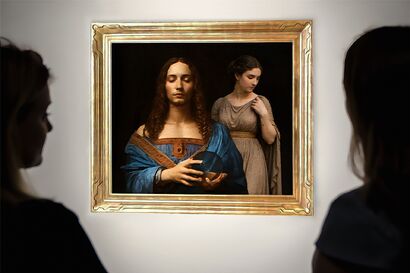
The Birth of the World stands as a striking example of how digital
oil painting can transcend the limitations of medium and technique, evoking the
gravitas of classical art through contemporary execution. Entirely hand-painted
without the use of artificial intelligence, this work reimagines mythological
cosmology through a modern digital lens while preserving the solemn dignity of
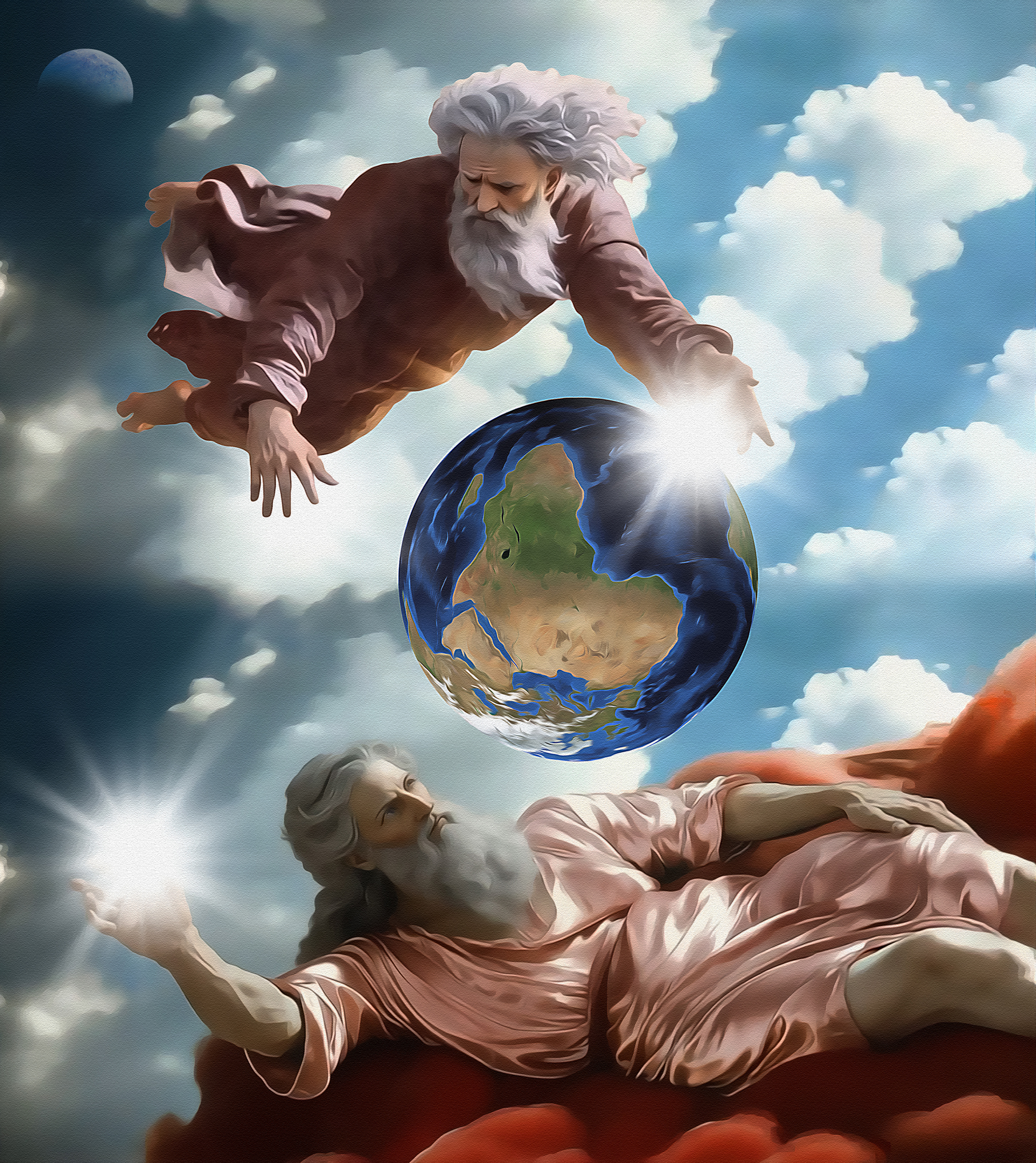
the classical tradition. The composition—two godlike figures hovering amid
celestial light, their hands radiating energy as a reversed Earth spins between
them—invites reflection on creation, control, and the fragile equilibrium of
existence.
Stylistically, the work echoes the grandeur of High Classicism and Northern
European mythic romanticism. The two deities, rendered with dramatic
chiaroscuro and luminous brushwork, evoke both Greek and Norse archetypes—Zeus
and Odin, the omnipotent forces of creation and reason. Yet their expressions
are not triumphant; they are contemplative, even burdened. This emotional
restraint shifts the work from mere depiction to philosophical meditation. The
reversed globe—Earth turned upside down—becomes the symbolic axis of the
painting’s narrative. It implies that creation itself might be imperfect or
incomplete, a divine experiment under revision. The inversion also reflects the
moral and environmental disarray of our modern age, suggesting that the gods,
or perhaps humanity acting as gods, have lost their original balance.
The beams of light extending from the deities’ hands symbolize both creative
power and the destructive potential of enlightenment. The painting’s mythic
energy lies not only in its subject but in its tension between symmetry and
disorder. The clouds and heavens, rendered in soft, almost tangible textures,
contrast sharply with the solid presence of the planet, grounding the
metaphysical in the material.
Conceptually, The Birth of the World operates as both myth and
mirror—a vision of divine craftsmanship and human hubris. It can be read as a
cosmological allegory for the Anthropocene, a world sculpted and reshaped by
its own makers. The two gods might no longer represent creation and destruction
but rather knowledge and consequence—forces eternally intertwined.
Critically, the artist’s digital mastery enhances, rather than diminishes,
the painting’s authenticity. The meticulous control of light, texture, and
atmosphere demonstrates that digital painting, when executed by hand, can
achieve the same spiritual and aesthetic depth as traditional oil. Indeed, this
synthesis of classical form and digital precision is what gives the work its
profound allure.
The Birth of the World is not merely a depiction of myth—it is a
myth reborn. It transforms ancient narratives of origin into a modern
reflection on creation’s responsibilities and failures. Through its refined
composition, moral gravity, and painterly grace, the work stands as a testament
to the enduring power of myth to articulate the questions of our time: Who
creates, who controls, and who must bear the light when the world turns upside
down?