
IRON & FLESH


CATEGORY

DIMENSIONS
37.00x46.00

YEAR
2025

PRICE
Not for sale
ABOUT THE WORK
IRON AND FLESHInstants from a History that Never Learned20-words intro:Imaginary archive of biomechanical bodies in the World Wars, technology does... Read More
IRON AND FLESH
Instants from a History that Never Learned
20-words intro:
Imaginary archive of biomechanical bodies in the World Wars, technology does not save mankind but perfects its capacity for destruction.
PROJECT DESCRIPTION
The Twentieth Century invented industrial mass destruction, then turned the camera upon itself to document the horror. Robert Capa, with his trembling Leica, delivered to us the naked body of war: the mud, the smoke, the leap into the void of the soldier dying live, the precise instant in which life hangs suspended between one moment and the next. His work did not celebrate military technology, but revealed its human cost, frame after frame, refusing all aesthetic distance or consolation. If the war photographer’s task is to make visible what history would prefer to forget, Capa fixed for eternity the precarious boundary between humanity and inhumanity that traverses every armed conflict.
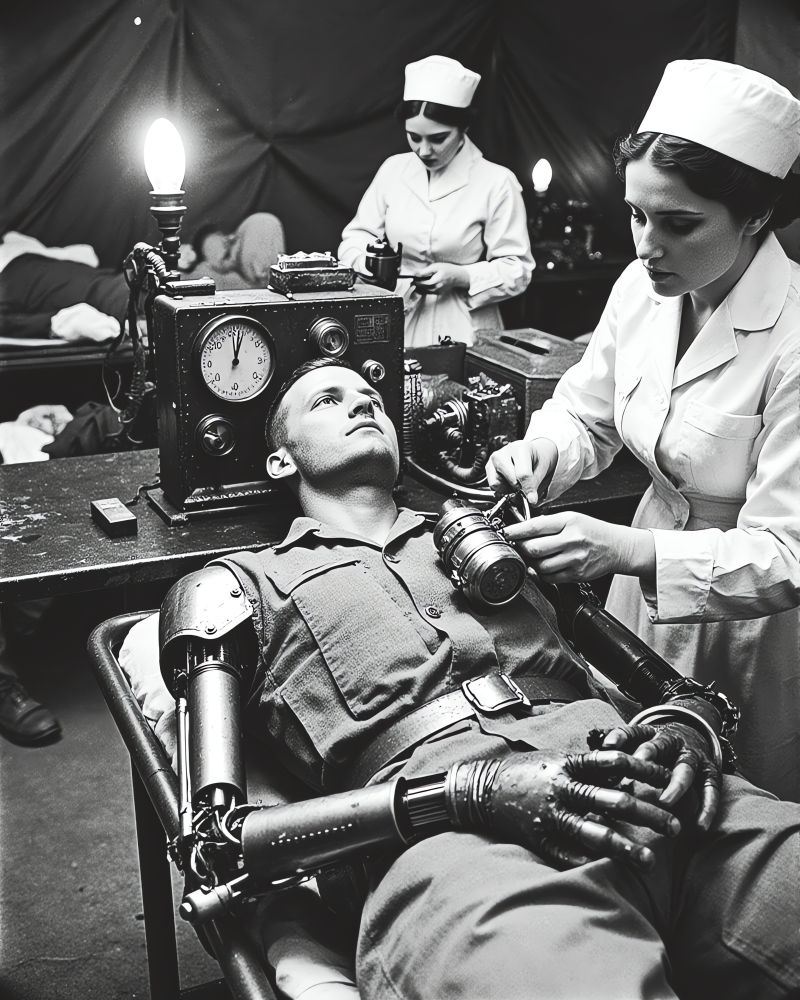
Iron and Flesh situates itself within this visual tradition through a paradoxical deviation: it constructs a photographic archive of events that never occurred, documenting a parallel timeline in which the First and Second World Wars unfolded with a critical variant. In this alternate universe, biomechanical technology—the surgical and mechanical fusion of human organs with devices of steel, brass and steam—is not futuristic but contemporary to the conflict, absorbed into the daily life of war with the same normality with which we today absorb the smartphone or the internal combustion engine. Soldiers possess artificial limbs powered by pneumatic pressure, officers have undergone cranial modifications to enhance tactical perception, bodies are enhanced before being wounded, transformed into biological platforms for the war machine.
The project presents twenty black-and-white photographs that faithfully simulate the aesthetics of World Wars reportage (1914–1945), with particular reference to the raw, intimate and physically engaging style of Robert Capa, but also to propaganda images, heroic poses, battle scenes and command portraits that defined the iconography of the World Wars. These are not science-fiction illustrations, but documents claiming the status of "archival rediscovery". The fiction is total: film grain, optical imperfections, every day or dramatic composition, natural or bulb-flash lighting. The aim is to generate an effect of historical uncanny, a disturbance born from the immediate recognition of the photographic language—both in its Capa’s view form of raw testimony and in its official form of military documentation—combined with the refusal of the expected historical content. What we see seems authentic because it is formally so, but what it shows is impossible, and it is precisely within this impossibility that its deepest truth resides.
THE PARALLEL UNIVERSE: TECHNOLOGY AS INVISIBLE CONDITION
In this alternative timeline, the technological development of the early Twentieth Century followed a different yet plausible trajectory. Discoveries in mechanical engineering, pneumatics and emergency surgery produced not only more efficient weapons, but more efficient bodies. The Great War, with its voracious mutilations, accelerated preventive rather than restorative biomechanical integration. One does not wait for an artilleryman to lose an arm before replacing it; the arm is enhanced prior to engagement to permit the loading of heavier shells, more stable aim, resistance to shock. Military field hospitals do not merely treat wounds, but optimise bodies for resilience, transforming medicine into engineering applied to flesh.
This technology is steampunk in material but cybernetic in concept: brass, copper, carbon steel, natural rubber, leather belts, steam valves, visible and palpable hydraulic circuits. No electronics, no silicon, no miniaturisation. The modified body is heavy, noisy, requiring constant maintenance. It is a biological machine integrated with the industrial machine of conflict. Crucially, this modification is not viewed as aberration but as necessary, almost natural adaptation. The society of that time absorbed military transhumanism as we have absorbed the mobile phone or the motor car: initially with hesitation, then total normalisation, finally making it invisible.
The twenty images explore this state of affairs through the multiplicity of wartime experience. They do not limit themselves to dead time or logistical routine, but embrace the entire spectrum of conflict: from smoky trenches where modified soldiers load heavy weapons with mechanical limbs, to high-altitude command posts where officers with ocular prosthetics study tactical maps; from chaotic battle scenes, with explosions and biplanes flying over hybrid bodies of flesh and metal, to official ceremonies in throne rooms where decorated generals display their prosthetics as medals for valour. We see nurses in surgical tents operating upon patients with mechanical instruments integrated into their own bodies, but we also see direct action: soldiers advancing under enemy fire, pilots fighting in the sky with artificial hands firmly gripping the controls, officers in dress uniform displaying their biomechanical integration as a sign of status and power.
This scenic variety serves to demonstrate that modifying technology belongs not only to the rear, to the hospital or workshop: it is present in the beating heart of action, in the violence of engagement, in the heroic moment and in the bureaucratic one. The uniformity of modification—the fact that it is present as much in the common soldier as in the high-ranking officer in full regalia—suggests a society entirely remodelled around the logic of military enhancement. There is no longer difference between the natural and the artificial body; there is only the operative body, more or less efficient and mechanised.
PHILOSOPHY: THE MACHINE OF REPETITION
The theoretical core of Iron and Flesh interrogates the relationship between homo faber and homo necans, between man as maker and man as killer. The central thesis is that war does not represent a failure of technology, but often its primary testing ground and its implicit destiny. When man develops a tool, the first historical question has never been "how can I heal?" or "how can I connect people?", but rather "how can I strike better?", "how can I resist longer?", "how can I kill from a greater distance?" This is not technological determinism—machines do not decide autonomously—but anthropological determinism: it is man’s direct inventiveness toward mutual destruction, with a constancy that traverses centuries and civilisations.
But is this tendency fate or choice? Are we programmed for collective self-destruction, or have we simply normalised a series of contingent choices until making them ineluctable? Iron and Flesh poses this question in visual terms: if we could build bodies perfect for war as early as 1916, and if we did so, does it mean we are destined to utilise every scientific advancement to perfect the art of destruction? The biomechanical implant in the project is not restorative prosthesis (as in our post-1918 world), but preventive offensive enhancement. The soldier is not "fixed" to return to civilian life; he is "perfected" to prolong the conflict, to become a more stable firing platform, a sentinel requiring no rest, a combatant knowing no physical fear.
This raises fundamental ethical questions: where does individual responsibility begin when the body itself becomes weapon? If a mechanical hand kills, is it the man or the machine that performs the act? And if the hand was installed from above, if biomechanical adaptation was forced or induced by military logic, who bears moral responsibility? The soldier who accepted modification to survive, or the society that made modification the sole condition of survival? And further: if technology makes war more efficient, reducing the physical pain of the combatant (who no longer feels the arm he loses, because he has already lost the original arm), does it make war more acceptable, easier to declare, easier to prolong?
The normalisation of the monstrous is the heart of the visual discourse. In the images, no one looks with horror upon a comrade’s steel arm. No shock, no revulsion. Only acceptance, weariness, or—in the case of officers—pride. This banality of technological evil—to paraphrase Arendt—is more disturbing than any grotesque monster. It shows us that the capacity to adapt to violence is infinite, that any horror, repeated daily, becomes bureaucracy, becomes normal, becomes invisible. The modified body is no longer exception; it is new norm, industrial standard of flesh. And if today we accept without flinching that drones kill at a distance, that real soldiers are guided by algorithms, that the battlefield becomes virtual for the shooter and remains devastatingly real for the target, then perhaps we are not so distant from those soldiers of brass and flesh who gaze at the horizon with metal eyes.
Furthermore, the project explores the concept of military post-humanity ante-litteram. Today we speak of enhanced soldiers, exoskeletons, brain-computer interfaces for drones. Iron and Flesh projects this tendency backward in time, showing that the impulse to fuse man and machine for belligerent purposes is not futuristic but as ancient as the first industrial war. The difference is only of degree, not of nature. Our drones are the Zeppelins of this universe; our remote operators are the generals with the optic eye of that timeline. History does not repeat, but rhymes violently. And if the rhyme is perfect, perhaps it is because the poem is always the same: the poem of domination, of survival at any cost, of transforming the other into target.
METHODOLOGY: SYNTHETIC ARCHAEOLOGY
The artistic practice here defined as "Synthetic Archaeology" uses artificial intelligence not as a tool of arbitrary generation, but as a means of speculative excavation. The AI functions as a construction site where to reconstruct missing finds, imagining what might have been documented had historical choices been different. The process is constrained by three rigid principles that guarantee internal veracity, whilst admitting variety of scenes:
Material and Historical Coherence
Every biomechanical element must be constructible with technologies actually existing between 1914 and 1945. Only brass, copper, carbon steel, natural rubber, leather, glass, clockwork mechanisms, low-pressure pneumatic systems, steam valves are used. Forbidden are titanium, modern plastics, electronics, printed circuits. The design must appear functional and heavy: imperfect, subject to wear, requiring maintenance with spanners and oiling. Imperfection is a fundamental requirement.
Compositional and Linguistic Fidelity
The photographic aesthetic must replicate with absolute precision the reportage of Capa and his contemporaries, but also official military photography, propaganda, command portraiture. This means: reduced depth of field, high (simulated) ISO grain, natural or bulb-flash lighting, unstable framing suggesting the physical presence of the photographer in danger, close angles permitting no emotional distance, but also formal, studied, monumental framing for command scenes. Black and white is not stylistic choice but ontological: it is the only way these images could exist, anchoring them to the era.
Narrative and Ethical Variety
Unlike approaches privileging only dead time, this project embraces variety: epic battle scenes, explosions, heroic gestures, official poses, but also moments of medical routine, maintenance, waiting. Technology is present in every register: in the soldier’s cry as he charges, in the general’s immobility as he receives honours, in the nurse’s precision as she operates. This variety demonstrates that war is simultaneously spectacle and bureaucracy, heroism and mechanics, glory and maintenance. Showing an officer with a mechanical eye inspecting troops is as disturbing as showing a nurse adjusting an automatic respirator upon a wounded soldier’s chest, or a pilot gripping the control stick with a metal hand as the biplane banks in the chaos of aerial combat, because all these scenes reveal the total internalisation of technology within the social and military fabric.
The creation process involves the construction of extremely detailed prompts including specific references to period camera models, lighting conditions, precise anatomical descriptions of modifications. Each generated image is then selected for its power as "false truth": it must arouse the suspicion of being a period negative rediscovered in an attic, not a digital creation.
EXPANDED DIMENSIONS: THE AUDIOVISUAL INSTANT
To the twenty photographs is added a two-minute audiovisual composition in which selected images are brought into subtle animation—the flicker of film grain, the trembling of a hand-held camera, the slow pan across a trench wall. This is not cinematic narrative, but the illusion of a document that has survived time.
The soundscape anchors the piece in historical reality while amplifying its temporal dissonance. Two authentic radio broadcasts are layered into the composition: Robert Dougall reporting from an Atlantic convoy on 11 November 1941, and the first NBC bulletin announcing the attack on Pearl Harbor on 7 December 1941. Beneath these testimonies runs a musical score generated through artificial intelligence, composed in the stylistic register of Wagner, functioning as both homage and warning.
Together, these three strata—moving images, historical broadcasts, synthetic score—construct a temporal palimpsest. The viewer-listener encounters a document that claims authenticity through its component parts while the whole remains impossible, suspended in the same cognitive dissonance as the photographs themselves. We hear what was actually said in 1941, but we see what was never photographed. The gap between the two is where the project’s central questions resonate most acutely.
PURPOSE: INTERROGATION THROUGH RECOGNITION AND RESPONSIBILITY
The ultimate purpose of Iron and Flesh is to create a space of cognitive dissonance where the viewer becomes involuntary historian of a past that never occurred, but that might have occurred. When we recognise the historical authenticity of the framing—both in its Capa’s view form of raw, participating testimony and in its official form as military document—we must simultaneously confront the content that denies our known history. This gap generates a friction that cannot be resolved simply by observing; it requires a choice, a judgement, a taking of position.
The project pushes the viewer to pose a series of questions admitting no simple answers, but demanding deep reflection upon human nature and the destiny of technology. The first question is: are we destined for self-destruction? If we look at these images and see that, even with different technologies, even with different bodies, even in an alternative timeline, humanity still chose to organise itself for mutual destruction, then technology was never the problem. The problem is us, our nature, our capacity to justify violence as necessity, as progress, as destiny. If we can imagine that we were always thus—war cyborgs from the beginning—can we also imagine not having to remain thus forever?
The second question concerns individual responsibility within collective systems. When a soldier with mechanical limbs kills, who is the murderer? The man who pulls the trigger, or the engineer who designed the arm, or the general who ordered the modification, or the society that normalised war as the only possible horizon? And when technology makes the act of killing more efficient, cleaner, more distant—when the pilot with the optic eye bombs from a thousand metres without seeing the enemies’ faces—where does blame reside? Does it dissolve into the machine, or concentrate in the individual who chose to become machine?
The third question is on the inevitability of progress. We see these enhanced bodies and think: is this the future we avoided, or the one we are building? Our soldiers today have no brass limbs, but they have night-vision goggles, experimental exoskeletons, drones extending their lethal will thousands of kilometres away. The difference between that world and ours is only of materials, not of intents. If technical progress is unstoppable, is it also inevitably directed toward war? Does another path exist, or do these images show the naked truth we prefer not to see: that every human invention is sooner or later turned against mankind itself?
The fourth question, perhaps the most disturbing, concerns normalisation. If these images no longer seem shocking after a few minutes of observation, if we accept the presence of metal in flesh as we accept the helmet upon the head, then we are already prepared to accept the future we fear. The banality of evil is not a historical accident, but a human characteristic: our infinite capacity to adapt, to accustom ourselves, to forget. The project asks: are we aware of this process as it happens? Can we stop it before it becomes invisible?
Finally, the project interrogates the very concept of memory and archive. If these photographs were true, if we had found them in a forgotten military archive, would they change our understanding of the Twentieth Century? And since they are not true, but could be, what do they tell us of the fragility of history, of the contingency of choices we have made? Each image is a parallel world that looks at us and asks: why did you choose differently? Or perhaps: why are you choosing the same way, only more slowly?
THE OPEN ARCHIVE: UNWRITTEN STORIES, UNANSWERED QUESTIONS
Iron and Flesh presents itself as a rediscovered field notebook, a visual diary of a conflict unrecorded in history books but resonating with unmistakable echoes in our present. It offers neither solutions nor easy moral conclusions. It is neither pamphlet against war nor celebration of technology. It is rather an extraction device: it extracts from historical images their hidden potentiality, the path not taken, the choice not made.
The twenty photographs are fragments of a larger narrative deliberately left incomplete. As in every real archive, pieces are missing, captions faded, context elusive. Some images show action, confusion, violent death; others show immobility, command, ceremony; others still show care, repair, maintenance of bodies never considered "natural". This variety reflects the complexity of war as a total human phenomenon: not only destruction, but organisation, not only violence, but technique, not only heroism, but habit.
The project invites the viewer to become archivist, historian, judge of this material. To ask oneself: who are these men and women? Did they choose to modify themselves, or were they forced? Do they still believe in the cause for which they fight, or has their humanity been so altered that the cause has become irrelevant? And we, who watch them from a future where technology promises to give us immortality or destroy us all, what are we choosing today, in this moment, that will appear inevitable to our grandchildren?
In an era where artificial intelligence is used to generate distraction or to optimise death, this project uses the same technology to dig into memory and interrogate responsibility. The archive is open. History is still being written. And every image, false or true, asks us: what body are we building today, for the war of tomorrow? Are we destined to become iron and flesh, or can we still choose to remain simply, vulnerably, human?
CONTACT THE ARTIST
