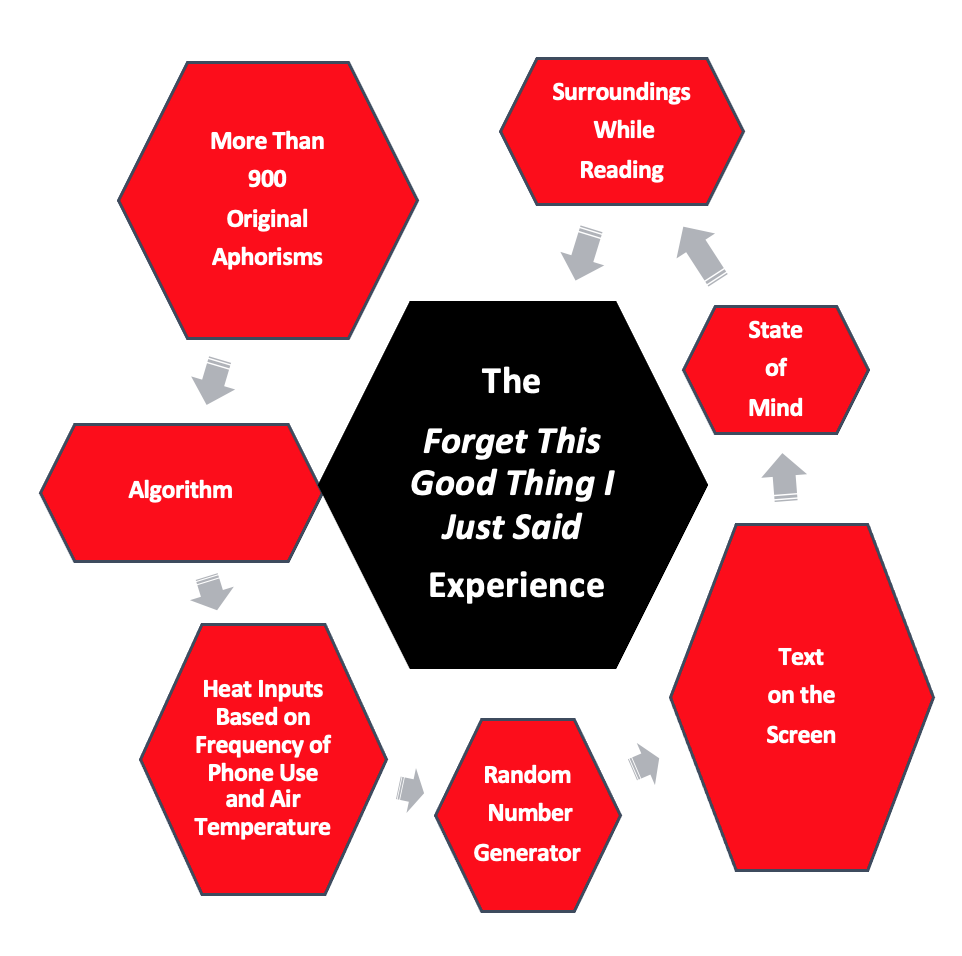
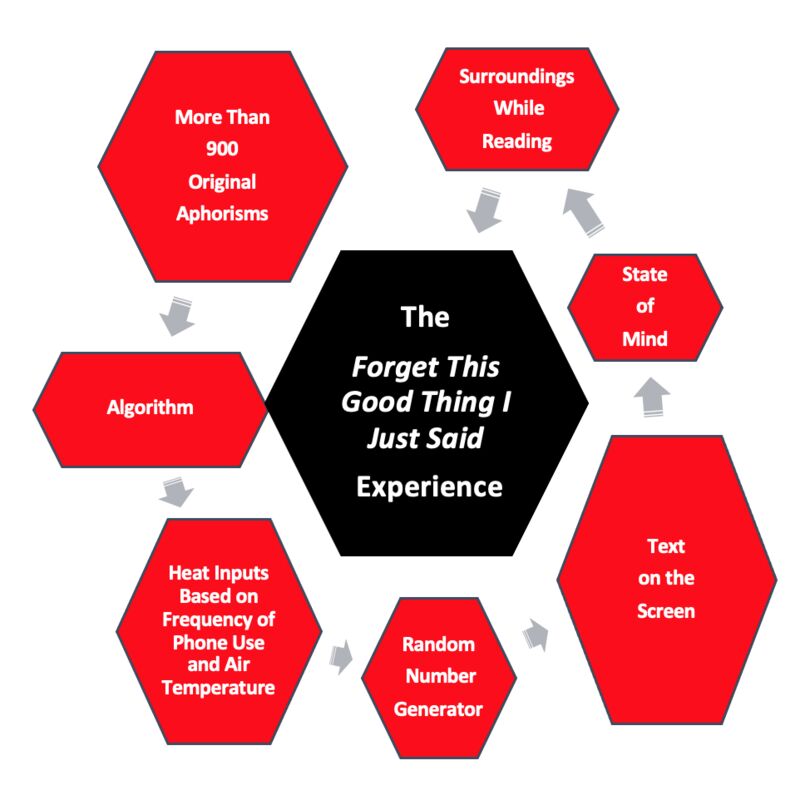
Like the I-Ching, this is an oracle that harnesses synchronicity, to deliver a wholly unique experience each time you read it. A random-number-generator draws on the conditions in your phone to select from more than 900 original aphorisms.
Forget This Good Thing I Just Said is an original work by Colin Dodds and Matthew Dublin. The book version of Forget This Good Thing I Just Said is also a book, and was named a finalist for the 2022 Big Other Book Award for nonfiction.
The small screen of the smartphone is a new format like the codex was 2,000 years ago. And it has different qualities and capabilities. It can harness a new kind of obsessive energy. Hopefully, the little screen, used just a little differently, can redirect that incredible energy in cool new directions.
Forget This Good Thing I Just Said is a hopeful and fun experiment in what’s possible from this funny cultural, social and psychological moment. It’s an app, a conversation, an oracle perhaps. But above all, it’s a series of chance encounters. How it works A collection of more than 900 original aphorisms meets interactive random-number-generating technology. The result is that one aphorism follows another, but always in new sequences, so a reader never has the same experience twice, and no two readers have the same experience. As new patterns emerge, or seem to emerge, the import and meaning of the work changes over time.
How random it is, or why it’s a conversation
"Anyone who considers arithmetical methods of producing random digits is, of course, in a state of sin." - John von Neumann
The app's unpredictability is derived not solely from complex algorithmic design — in which case pseudorandomness or "mechanically" initiated randomness would be the best we could do — but is instead supplied by the physical world.
Your mobile device or computer generates its own thermal "noise," or signals from the heat of its processor, resulting in a source of statistically random number generation. Those numbers are used to randomize the aphorisms that are displayed to you. In short, through your interaction, you are creating the unpredictability of your own experience.
Why it exists
It’s an exploration. It’s an experiment. What it finds or helps you find is what it’s for. Let’s all find out together.
What it costs
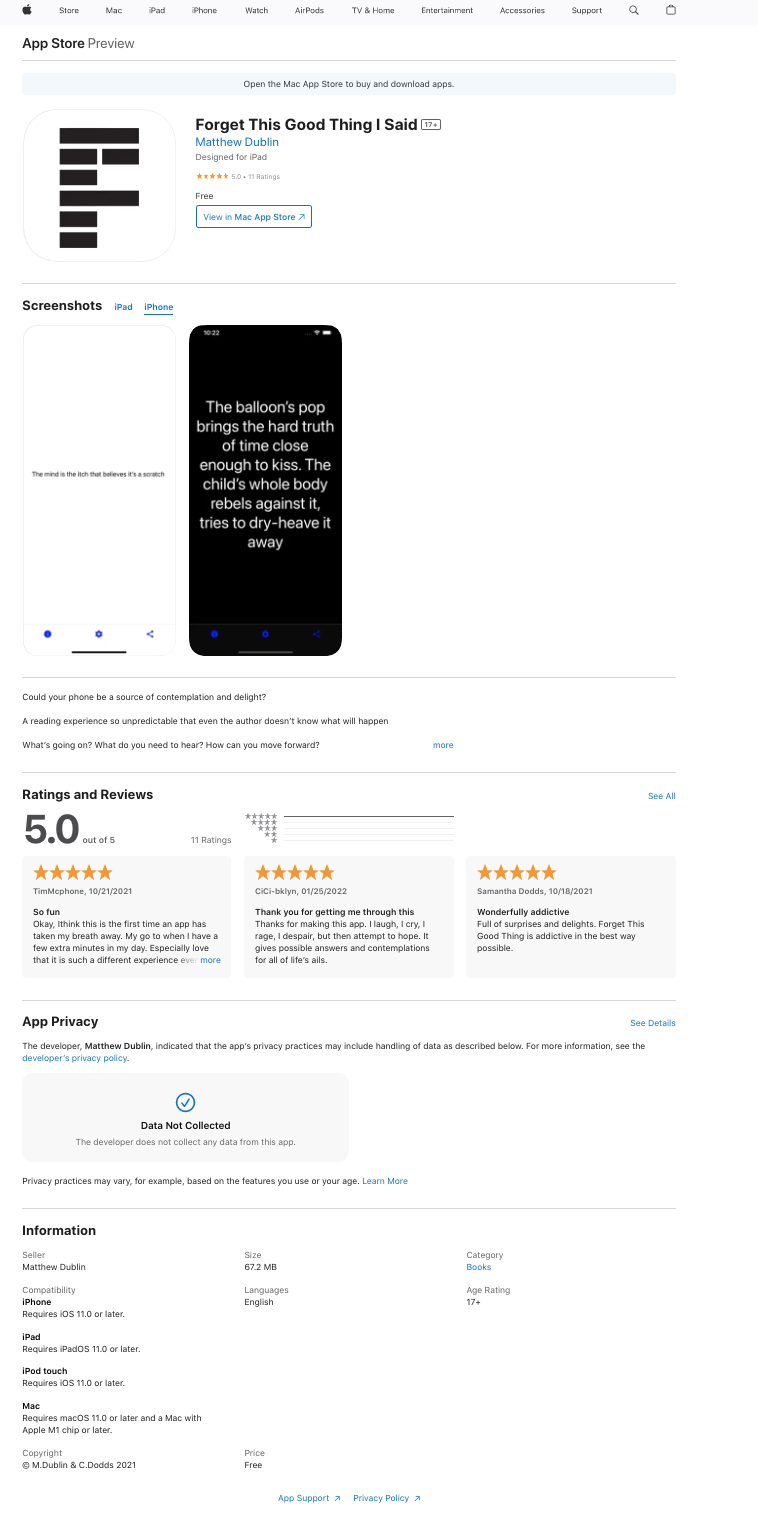
The app is free, and collects no personal data. The book costs money.
Why it’s on your phone
Everything’s getting reduced to small noise on a small screen, from the King James Bible to the theatrical cut of Lawrence of Arabia. Maybe by starting with small noise on a small screen, something may grow.
What it’s like
A conversation with a smart, long-lost friend who has big news, and keeps changing the subject.
Who made it
Matthew Dublin and Colin Dodds. As a duo, they have collaborated on numerous projects including music, audio experiments and independent films.
You can read about some of the thinking behind the app’s use of environment-responsive ring-oscillator technology to randomize the experience here. And you can read about how the technology and the structure of the work fit together here.
In this recent two-part interview with aphorist Colin Dodds, he discusses his own background and some of the inspiration behind the project.