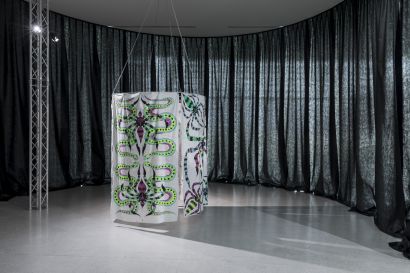
Lazari’s spatial arrangement draws on the cultural phenomenon of tarantism connected to a popular belief in the Salento region that a spider bite could trigger hysteric behavior, particularly in women. It was believed that the bitten women (tarantate) could be healed through an hours-long ritual involving dance accompanied by the entrancing rhythm of tambourines. Lazari’s multimedia installation responds to this phenomenon, combining a soundtrack with hand-painted banners bearing illustrations of spiders and snakes as symbols of the transformative process of life, death, and rebirth. A small tambourine placed between the banners serves as a connection to the infinite universe. Painted on the tambourine’s drum skin is an ouroborus, or snake biting its own tail, representing the eternal cycle of life. In this magical and mystical atmosphere, the intensity reached through dance and music, as witnessed in tarantism, offers a way to break free from social oppression.
A performance piece inspired by the dance and music of the traditional pizzica ritual, re-interpreting the movements of both the spider and the bitten women can be an additional work to the installation.