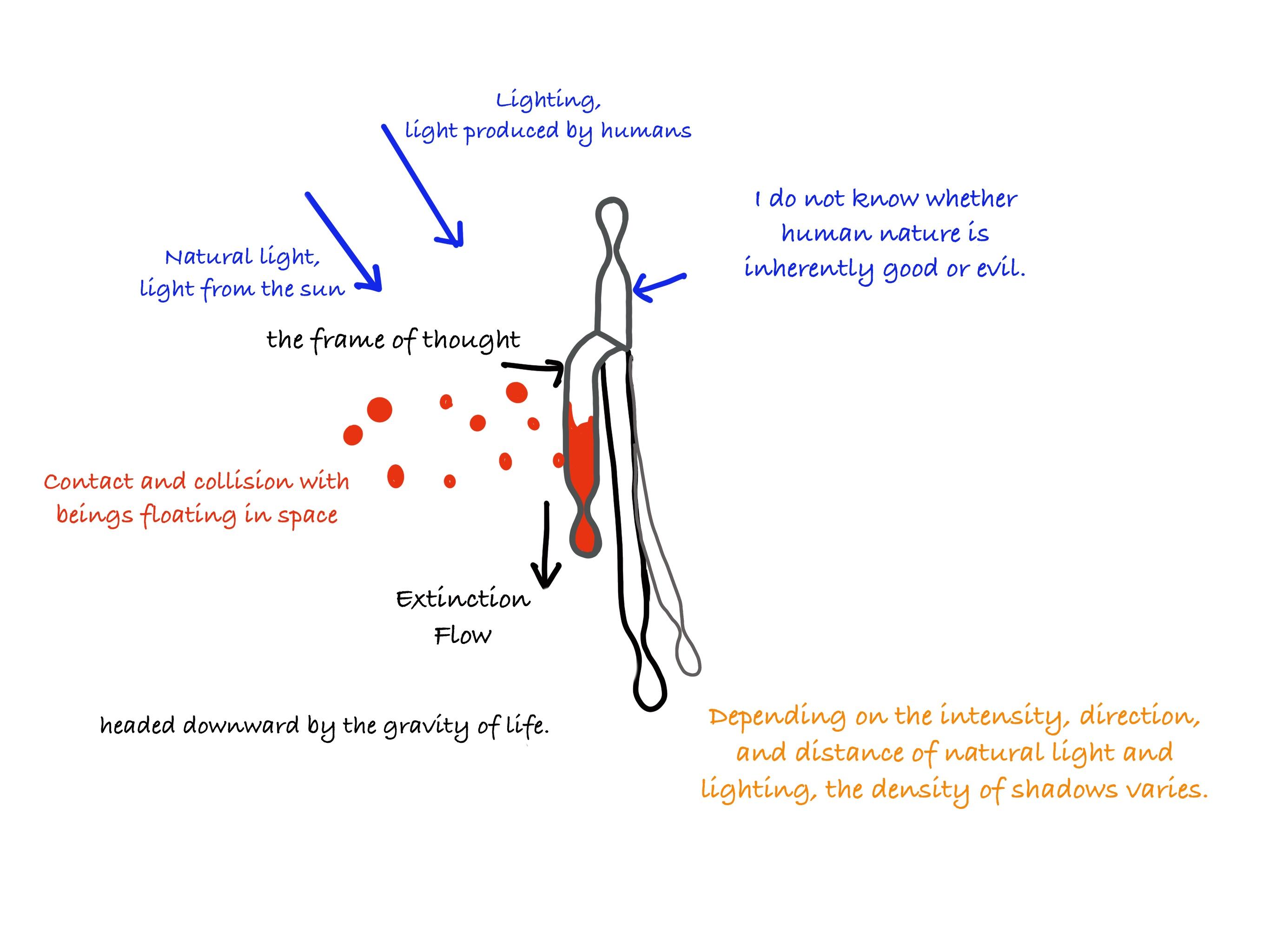
In the work of the Permeate series, the human figure and head, and body are cut out with scissors from an aluminum coil. After dipping the skeleton in gesso and drying it, the human is shaped with Hanji by hand. One side of the human figure is left uncolored, and the human figure on the opposite side is bent and facing downward. It paints and permeates the figure of a thinking human facing downward. Then, the varnish is applied. Irregularly attach a human shape to a flat surface. Head and torso without arms and legs. Arms and legs are the means by which human beings can do something. The head and body are mental things, not means of action. Only the head and torso were used to express the human essence. The human figure is cut into two parts on either side. One side is human nature that has not been stained, and the other side is in contact with the relationship between beings in the outside world. The results permeated with this appear dyed in their own colors and adapt to the situation. There are shadows that appeared when the light of the exhibition hall and natural light did not pass through the frame of reason permeated by the external existence. The shadow is another existence that makes one think deeply about the meaning of one's own existence and life. The human form attached to the flat surface undergoes social weathering downward by the gravity of life. The human frame is colored and the uncertain life is thought of as the way of each individual's life.
Realizing that modern people face tragic situations, the artist focuses on the universal and fundamental theme of human suffering. In a tragic situation created by the spirit and human beings to overcome it in a tragic situation, the artist seeks to realize the ultimate goal of life through the act of art.The works of KO Gangpil on display remind us of our childhood memories. It's similar to drawing a person you recognized at the time instead of holding a colored pencil before learning to read. Perhaps we have drawn figures of humans at least once or hundreds of times consciously or unconsciously. The artist also slightly changes the identical human body shape in this exhibition's works and creates infinite paintings.
Like a sense of mission... There is no desire to fill the screen, and the limbless figure stands upright, albeit weak, with particular scale and pattern. Only colorful human bodies exist on a white screen.
Artist Ko Gangpil draws human bodies with the same shape on white Korean paper in various colors. If you look closely at the lines making up the human body, you will see that they overlap and blur. If you follow the lines, they take us back to where we started like the paths of our lives do. The lines get stuck at some point just like we get stuck in times of trouble in life. In this sense, they appear to depict the journey of life. If you take a step back and look at the entire work, no one part is emphasized, or the shapes are concentrated but positioned uniformly as if forming a pattern. Each human figure exists in that space and stands satisfied with that amount of space as if no more space is needed. This represents the independent entity of modern people who live while protecting the minimum area to lead their own lives without being influenced by anyone. It makes me think that it may be a manifestation of the reality faced by the artist—that is, the “real you and me” and “our selves” acquired while living in the present.
Usually, we perceive and experience the world through our bodies. We learn about the world, pursue pleasure, and feel pain through the body's sense organs. We are tactual, physical, and instinctive while being beings of reason and intelligence, too. Writers have explored the body using the actual body as a tool or biological material as medium. They try to prove the process or result through their work. However, the human body in Ko Gangpil's work is not physical. Humans are primitive animals, and their physical bodies function like animals. He seeks to reveal the world of spirit where humans are distinct from animals—that is, humans as beings capable of thinking. Goh named the human body in his work “contemplation.” The body is the essence and the root of the human world as well as the identity of the artist himself. While the human body drawn during childhood is a shape of unconscious instinct, the artist's human body is a drawing of conscious essence.
To the artist, the human body acts like an independent symbolic sign, and only the head and torso are expressed to the extent that it can be inferred to be a human body. Because it has neither legs nor feet, it cannot stand proudly on the ground but floats like a ghost. It may be that, as a human being, as an artist, he is too harshly aware of reality and he cannot take root on paper. However, the human body is repeated, formed into groups, and expanded to an installation work rather than a piece of paper. For the artist, drawing itself is an act of thinking and a way to exist as an artist. It is a stubborn will to set foot on the difficult path of art. In the work, the artist stands the human body upright and repeats it countless times like a symbol of faith that one day wants to escape.
The artist's symbolic human bodies are evenly balanced throughout the picture. There is neither edgy feeling nor sense of anxiety nor tension, and each individual element does not compete or interfere with one another. Unlike the heads bowed in their seats, they boast of colorful colors that appear to show off. They take up only as much space as they need to exist in their place…A rapidly changing society seems glamorous at first glance, but modern people who have no choice but to adapt to avoid becoming degenerate outcasts cannot hide their anxiety. Moreover, the social and economic crises resulting from the climate crisis further endanger us today. The space I have secured solely for myself in the crisis offers comfort and solace even if they last only for a brief moment. Is that why? The objects in the artwork maintain a particular area as well as stability throughout the screen.
We strive to lead a prosperous life in a stable environment. We who exist in the flow of time only live in today's moments, and an eternal state of stability is impossible. The artist heals himself through his work toward a sense of eternal tranquility that is impossible in reality.
The artist's past works also depicted the same human body shape. The powerful and vivid colors on the canvas give energy to the body that otherwise looks too fragile to stand on its own. However, the artist has deprived the body of the energy in the works on display at this exhibition. Another thing to note is that the base material was changed from canvas to Korean paper. This seems to be the author's attempt at finding legitimacy as an Asian painting major. As an artist, I see another attempt to explore artistic tradition and the essence of being a human being. The artist's journey to find the essence as a human being and, as an artist, to reflect constantly on philosophical questions, to engrave them on his work, and to find answers through his symbolic system will continue.
November 6, 2023
Im Kyungmi , curator , Incheon Museum of Art