Tokyo Shibuya.
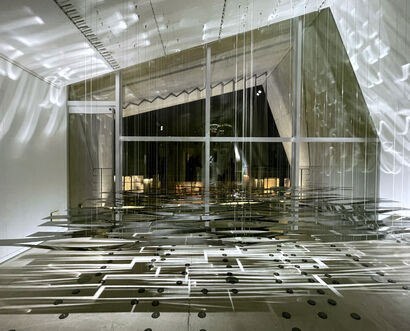
The culverted Shibuya River is reversed and revealed on the ceiling surface of Miyashita Park, a huge structure built above it.
More than half a century ago, the Shibuya River, which flows alongside Miyashita Park, was hidden underground, but many people may not know that the river lies underground alongside this structure. However, this “stream” still influences the urban development of Shibuya to this day. We have brought this stream to the surface once again and made it a “river” that reflects the flow of time as a water mirror of this changing city.
Many different cultures have been born in this city at different times and will continue to do so in the future. Many of these trends appeared and disappeared like a momentary blister, creating new scenes and flowing out into the world. Not all of the many fleeting moments in the daily lives of many people that made them into one big trend were in the spotlight, but I think they were important tributaries of what Shibuya is, and of the culture that was born in Shibuya.
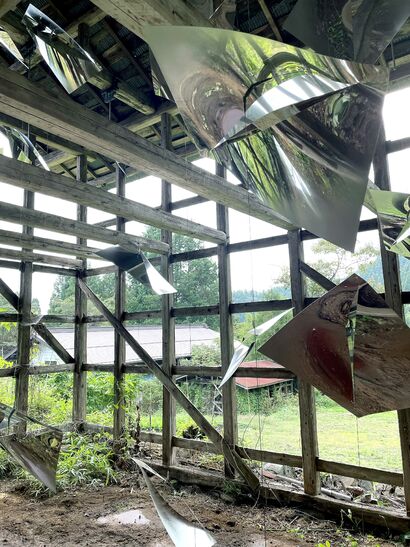
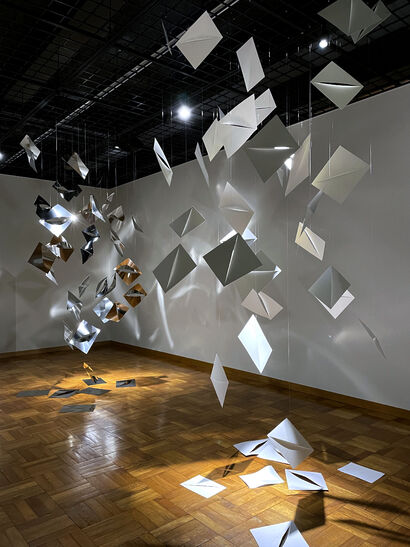
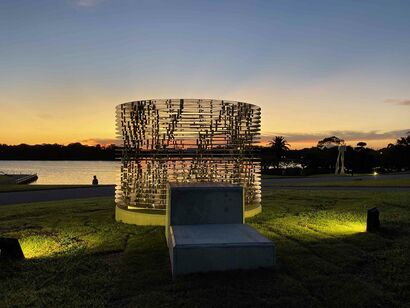
The convex shape of the ceiling is drawn by a single board folded and compressed from both sides, with curvature caused by the material and gravity. The fold positions repeat in regular cycles, in a pattern of opening (the next fold position is far away) ⇄ closing (a series of fold positions close together). In the open folds, individual lights appear as moiré, blurring and overlapping with the view captured on the surface, while in the closed folds, a continuous, blended view appears on the surface as a single coherent image.
Many events may be tributaries, but they can also become mainstream at a moment’s notice. The light from the compounding of many such events flows out and becomes part of the city. This three-dimensional object becomes a river that reflects the “flow of time”, connecting the different scenes scattered around the city and the culture that will continue to be born and change in this place in the future